

Bitcoin continues to trade below the $90,000 level, struggling to regain bullish momentum as market sentiment deteriorates. A growing number of analysts are now openly calling for a broader bear market, pointing to persistent weakness, failed breakouts, and declining risk appetite across crypto. Despite this gloomy backdrop, not all market participants are convinced that Bitcoin’s next major move will be lower.
Some investors remain focused on 2026, arguing that structural conditions could begin to shift in the coming months. One of the key debates centers on long-term holders (LTHs). While social media narratives increasingly claim that LTHs are distributing Bitcoin at record levels, on-chain data suggests a more nuanced reality.
According to a report by analyst Darkfost, much of the perceived LTH selling has been distorted by large, isolated movements—particularly nearly 800,000 BTC transferred from Coinbase—which skewed traditional LTH metrics.

After adjusting the data to exclude this anomaly, a clear change in supply dynamics emerges. Rather than accelerating distribution, the adjusted chart shows signs that long-term holder supply is stabilizing, and in some cases beginning to recover. This challenges the dominant bearish narrative and suggests that selling pressure from seasoned holders may be fading.
As Bitcoin consolidates below key resistance, the divergence between price weakness and shifting on-chain behavior sets the stage for a critical inflection point ahead.
Long-Term Holders Reduce Selling Pressure
Darkfost adds important context to the evolving Bitcoin narrative by focusing on long-term holder (LTH) supply dynamics. According to his analysis, the monthly LTH supply change—measured as a 30-day rolling sum—had remained firmly locked in a distribution phase since July 16.
For several months, this metric consistently showed negative readings, confirming that long-term holders were gradually reducing their exposure and releasing supply into the market.
That trend has now shifted. The latest data shows the metric moving back into positive territory, with approximately 10,700 BTC transitioning into long-term held coins. While this figure is still relatively small in absolute terms, it marks a clear inflection from sustained distribution to early re-accumulation.
In practical terms, it suggests that LTHs have slowed their selling activity to the point where their aggregate supply is beginning to grow again.
This shift is particularly notable because it is occurring while short-term holders (STHs) continue to hold their positions rather than aggressively selling. The combination points to a cooling of sell-side pressure from both cohorts, even as price remains under pressure.
Historically, similar transitions in LTH supply behavior have often preceded periods of sideways consolidation or, in more constructive cases, the early stages of bullish recoveries.
While this signal alone does not guarantee an upside move, it does suggest that the market may be moving away from forced distribution and toward a more balanced phase, depending on how broader macro and price trends develop.
Bitcoin Consolidates Above Long-Term Support
Bitcoin’s price action continues to reflect a market caught between structural support and lingering downside pressure. After failing to hold above the $100K–$105K region earlier in the quarter, BTC entered a sharp corrective phase that accelerated into November. That move pushed price decisively below the 50-day and 100-day moving averages, confirming a short-term trend shift from expansion to contraction.
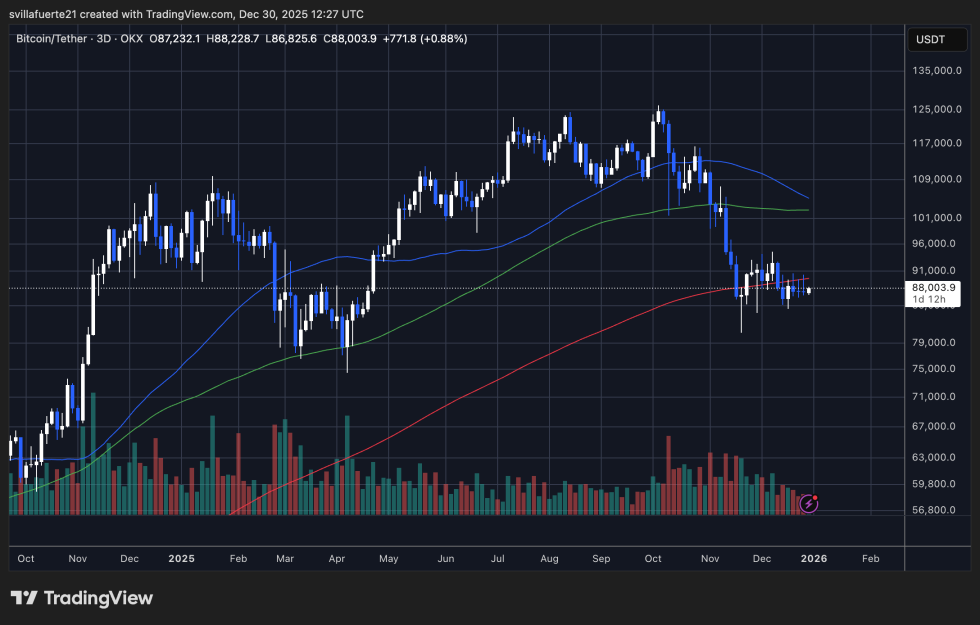
At present, Bitcoin is consolidating around the $88K zone, hovering just above the rising 200-day moving average, which sits slightly lower and continues to act as a critical long-term support.
This area has become a key battleground: repeated downside wicks suggest buyers are defending the level, but upside follow-through remains limited. The declining slope of the shorter moving averages reinforces the idea that bullish momentum has not yet returned.
Volume dynamics also support a consolidation narrative rather than active accumulation. Selling pressure has eased compared to the November breakdown, but demand has not expanded meaningfully enough to reclaim prior resistance. Structurally, the market appears to be transitioning from a high-volatility selloff into a compression phase.
As long as BTC holds above the 200-day moving average, the broader bullish structure from earlier in the cycle remains technically intact. However, a failure to defend this level would expose the $80K–$75K region as the next major support.
Featured image from ChatGPT, chart from TradingView.com

Editorial Process for bitcoinist is centered on delivering thoroughly researched, accurate, and unbiased content. We uphold strict sourcing standards, and each page undergoes diligent review by our team of top technology experts and seasoned editors. This process ensures the integrity, relevance, and value of our content for our readers.