

The submission of South Korea’s long-awaited crypto bill continues to face hurdles due to the ongoing disagreements between the main regulatory agencies over policies related to stablecoin issuers.
South Korea’s Digital Assets Act Delayed
On Tuesday, local news outlets reported that South Korea’s Second Phase of the Virtual Asset User Protection Act will be delayed until next year as financial authorities continue to clash over stablecoin issuance-related legislation.
According to Yonhap News Agency, financial circles and the National Assembly shared on December 30 that the main policies of the crypto framework have been largely decided.
Notably, the Financial Services Commission (FSC)’s draft is expected to include investor protection measures such as no-fault liability for crypto asset operators and isolation of bankruptcy risks for stablecoin issuers.
As part of investor protection measures, stablecoin issuers will likely be required to manage reserve assets in deposits and government bonds. In addition, they will be required to deposit or entrust at least 100% of the issuance amount with custodians such as banks.
The bill could also require crypto asset operators to comply with disclosure obligations as well as terms and conditions. Moreover, it may “impose strict liability for damages on digital asset operators in accordance with the Electronic Financial Transactions Act in cases of hacking or computer system failures.”
It will seemingly address allowing the sale of domestic crypto assets, subject to sufficient disclosure of information. Despite this, the key issues remain unresolved, suggesting that the final submission deadline will likely be pushed to the start of 2026.
Stablecoin Issuance Dispute Continues
As reported by Bitcoinist, the Financial Services Commission failed to submit the highly anticipated Digital Assets Act, which is expected to address the issuance and distribution of Korean won (KRW)-pegged stablecoins.
The financial regulator did not meet the December 10 deadline set by the South Korean ruling party to submit the government’s legislation to the National Policy Committee.
The bill was delayed after the FSC and the Bank of Korea (BOK) were unable to resolve their differences over the issuance of won-denominated stablecoins nearly three weeks ago.
The financial authorities have been debating this issue for months, with reports in November suggesting that the long-awaited legislation, which was expected to be approved at the end of this year, risked being delayed.
The FSC and the BOK disagree on the extent of banks’ role despite agreeing that financial institutions must be involved in the issuance of won-pegged tokens. The central bank has pushed for a consortium of banks owning at least 51% of any stablecoin issuer seeking approval in the country.
Meanwhile, the FSC has shared concerns that giving a majority stake to banks could reduce participation from tech firms and limit the market’s innovation.
Yonhap News Agency highlighted that the financial authorities also face other disagreements, including the initial capital requirements for stablecoin issuers, with opinions ranging from 500 million to 25 billion won, and whether to separate the stablecoin issuance and distribution functions of exchanges.
An FSC official reportedly asserted that they are “currently in the process of gradually narrowing the differences in positions with the relevant agencies,” while “discussing all possibilities with an open mind.”
The report also noted that the ruling party’s Digital Asset Task Force (TF) is allegedly preparing its own version of the bill, based on the legislative proposals submitted by lawmakers.
Notably, recent reports affirmed that the government’s proposal should be announced by early next month at the latest, as the integrated bill must be submitted in January 2026.
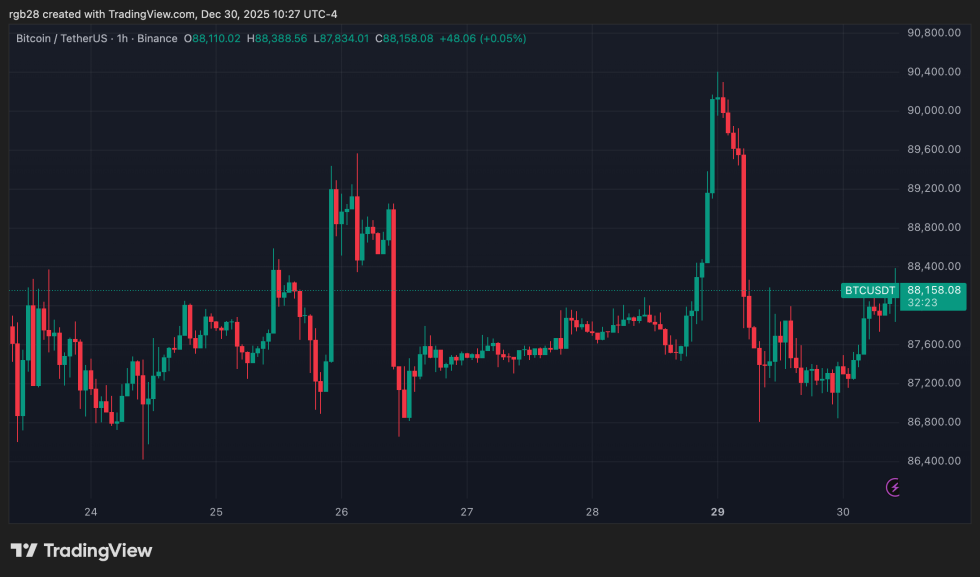
Bitcoin (BTC) trades at $88,158 in the one-week chart. Source: BTCUSDT on TradingView
Featured Image from Unsplash.com, Chart from TradingView.com

Editorial Process for bitcoinist is centered on delivering thoroughly researched, accurate, and unbiased content. We uphold strict sourcing standards, and each page undergoes diligent review by our team of top technology experts and seasoned editors. This process ensures the integrity, relevance, and value of our content for our readers.