
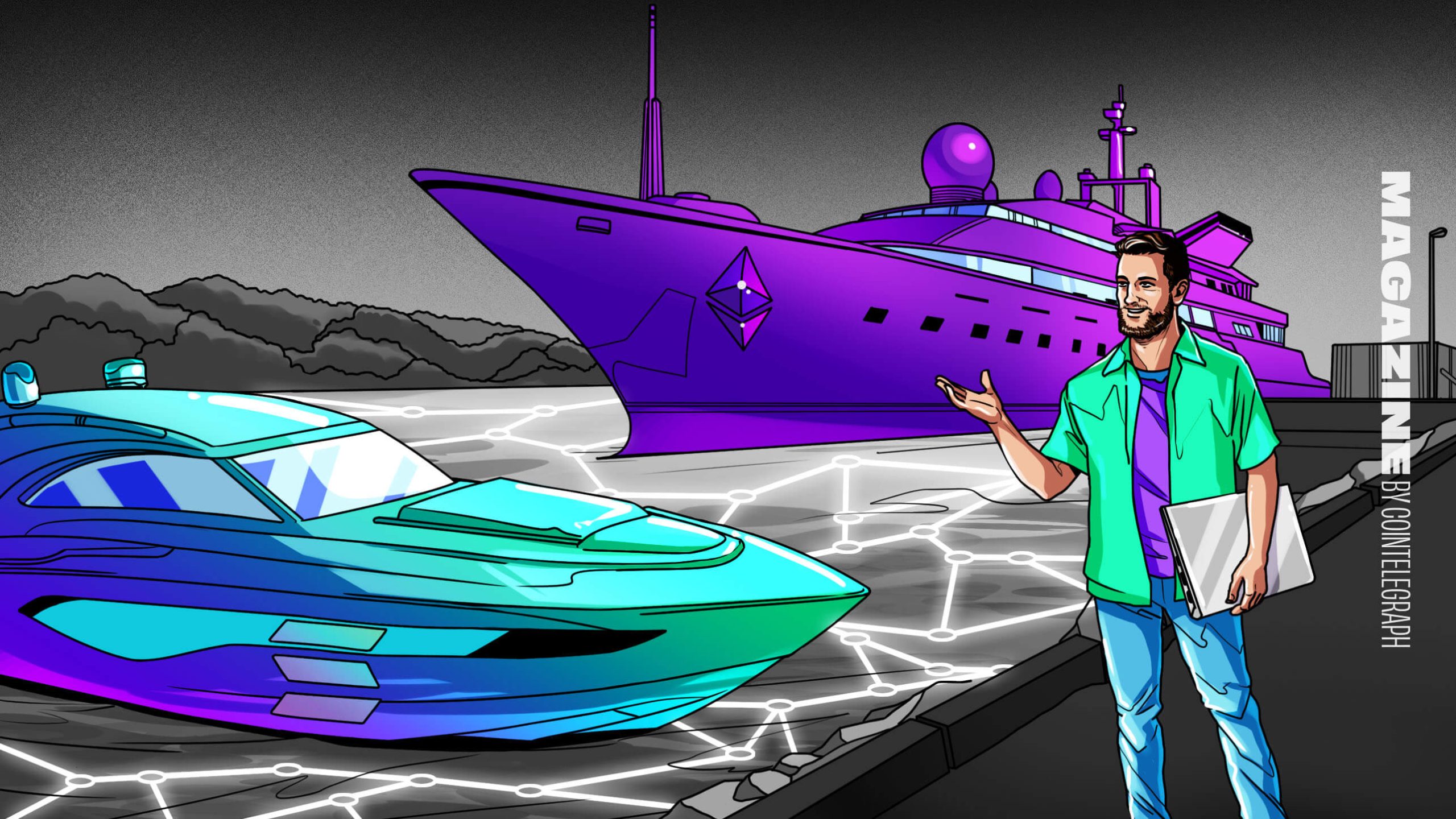
Max Resnick, the Consensys researcher who publicly campaigned to fix the Ethereum roadmap before dramatically jumping ship to Solana a year ago, knows all about dysfunctional governance.
He interned at the first Trump White House during the middle of Covid.
“It was an eye-opening experience of how the government works. Things just don’t work in the government. Everything is broken in some way,” he tells Magazine.
Resnick, 25, says it took a month of effort just to get a whiteboard to use during his time at the health economy desk at the Council of Economic Advisors.
He says the worst part of working in the US government was how it twisted reality to suit an agenda.
“When you’re in a situation where you’re ostensibly supposed to be truth seeking, and then you end up actually spinning the facts for whatever political agenda, it’s something that I didn’t really enjoy that much.”
Max Resnick’s campaign to scale Ethereum’s L1
Now the lead economist at Anza, which develops Solana’s main client, Agave, Resnick sees himself as maximally truth-seeking. He rejects ideology and heuristics, which refer to the imperfect mental shortcuts and simplified assumptions that can lead people astray when reasoning about problems.
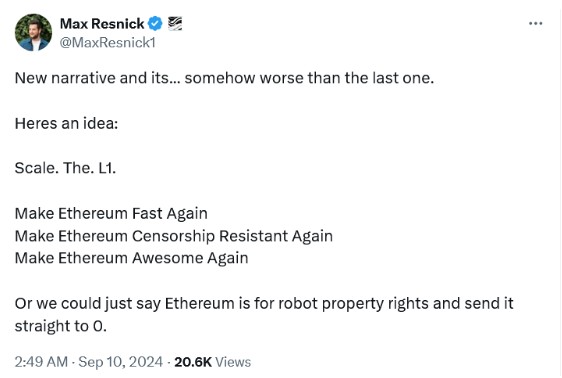
So when he settled on his view about the flaws with “parasitic” Ethereum L2s and the need to instead scale the L1, he wasn’t shy about telling the world. His profile scored a big boost when he appeared on Bankless in September 2024, making arguments some people found difficult to hear. Host Ryan Sean Adams asked if he was “trying to start an ETH civil war.”
Ethereum has subsequently refocused on scaling the L1 — although ETH maxis insisted this was the plan all along.
“I think they pivoted,” Resnick says, adding he is fine with being criticized over his campaign for change.
“You want to be good, make friends. If you want to be great, make enemies,” he says. “Mostly the people who are mad at me are not the core devs, many of whom agree with me, but they are the people who feel it’s their job to shill the token.”
“My philosophy was always: ‘Hey, I don’t care about the short-term token price, I care about the network in the long run and the industry and making the product better. In the end, if you make the product better, people will use it, and the price will go up.”
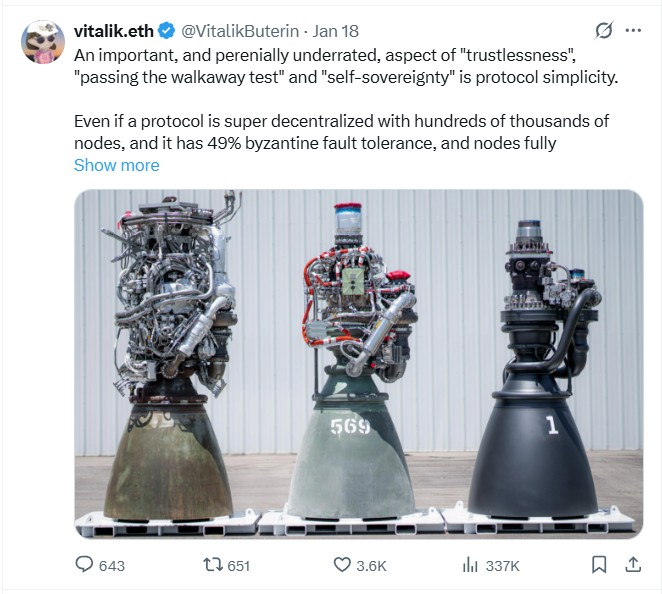
Resnick has continued to offer advice to Ethereum since jumping ship to Solana. On Jan. 9 he quote-tweeted Vitalik Buterin’s post in which the Ethereum’s co-founder claimed “increasing bandwidth is safer than reducing latency.”
“Ethereum refuses to compete on Latency because Vitalik is afraid. Afraid that the decade-old LMD-Ghost consensus engine won’t be able to handle it if they step on the gas, afraid of admitting that he was wrong on the L2 roadmap, and, most importantly, afraid that if Ethereum competes head-on with Solana, they will ultimately lose.”
Taking shots at the founder of a competing blockchain is par for the course in crypto, but it’s more personal in this instance, as Resnick and Buterin discussed the roadmap and its philosophical design constraints at length before his defection.
“I’ve talked to him for a significant amount of time about this,” he tells Magazine.
How did Max Resnick get into crypto?
The son of two professors, Resnick studied economics at the University of Michigan, where he developed an interest in health care policy and computer science. A course on algorithmic game theory sparked his curiosity about auction mechanism design and the Bitcoin white paper — which the professor delegated to him to teach.
After working as a research assistant, he got a job on a blockchain startup called Risk Harbor in 2021, designing novel AMMs and pricing risk for insurance. He found this frustrating as competitors like Nexus Mutual would undercut his painstakingly derived, accurate prices.
During this period, he became interested in Maximal Extractible Value (MEV). A paper he wrote in January 2023 about the interplay between MEV and censorship resistance helped him secure a job as head of research at Special Mechanism Group the following month.
Resnick explains previous attempts to solve MEV all looked at transaction reordering, but that misses the forest for the trees.
“The real issue is censorship resistance, which is like for a financial application, you have to be able to get your transactions on the chain, and if you have to pay somebody a ransom because they’re the only person with access to the chain, then it’s just not going to work very well,” he explains.
SMG was bought by Consensys a year later.
Resnick’s doubts grow over the Ethereum roadmap
MEV also inadvertently led to his disillusionment with Ethereum after he started to research its MEV upgrades as part of The Surge. The content coming out of the Ethereum Foundation’s Robust Incentives Group sounded wrong to Resnick.
“I really did not agree with anything they were saying from a fundamental auction theory perspective,” he recalls. “They were kind of saying things that made me suspect that they didn’t really understand the problem with MEV.”
Read also
Features
Reformed ‘altcoin slayer’ Eric Wall on shitposting and scaling Ethereum
Features
Building community resilience to crises through mutual aid and Web3
He began to see the L2s as extractive and being too addicted to sequencer revenue to ever follow through on plans to decentralize.
He now has a reputation for taking shots at Ethereum on social media, but until he flipped sides, he was pretty antagonistic about Solana, too.
A few weeks before he jumped ship, he found the coordinates of a data center in Amsterdam that he claimed contained a large proportion of Solana’s validators and painted a literal bomb target on it, writing:
“One precision tactical strike on (52.3675,4.9041) in Amsterdam and bye bye Solana. This is what we mean by ETH needs to be in war mode. The ticker is ETH.”

It was an unorthodox job application, but a month later, Resnick became the lead economist at Anza.
“It was definitely a weird move to go from posting about blowing up the Solana data center to then working on Solana a month later.”
“But I was always interested in what they were doing in terms of: how can we take their ideas and put them in Ethereum? And then I think Toly (co-founder Anatoly Yakovenko) and I agree a lot on how a blockchain should work.”
Resnick says Solana’s culture was a breath of fresh air. He’d attended Solana Breakpoint and found the conference humming with energy. He sat in on a Solana core dev meeting and was impressed by its ‘can-do’ mentality.
Illustrating the point, Resnick says the first meeting about Solana’s Alpenglow consensus upgrade happened in January 2025 and was on testnet by the end of the year. The upgrade replaces Proof of History and the Tower BTF mechanisms with Votor and Rotor.
“Compare that to The Merge, which took five years on Ethereum,” he says, referring to the switch from Proof of Work to Proof of Stake in 2022. “When we decide that we’re doing something … we definitely know how to get it done.”
Read also
Features
Bitcoin mining industry ‘going to be dead in 2 years’: Bit Digital CEO
Features
Terrorism and Israel-Gaza war weaponized to destroy crypto
A new perspective in Solana
As an economist, Resnick says he spends a lot of time in meetings just asking engineers where the revenue is coming from.
His role also encompasses thinking about big picture issues.
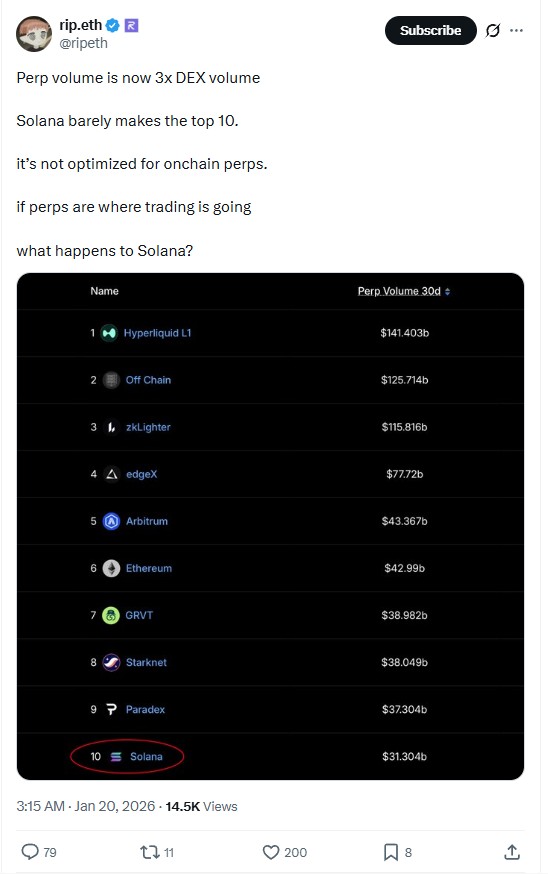
Along with co-founder Yakovenko and other Solana leaders, he helped coauthor the mid-year roadmap upgrade that proposed the goal of Application Controlled Execution.
ACE gives smart contracts and DEXs bespoke control over how trades are ordered, matched and settled, which is similar control to the way Hyperliquid is able to delay certain transactions to make the market more efficient.
Amusingly, ACE was originally called ASS (Application Specific Sequencing) until venture capitalist Kyle Samani contacted Resnick, demanding it be changed.
Resnick is particularly interested in tackling validator MEV on Solana by targeting both transaction reordering and censorship resistance. A related upgrade he’s working on for 2026 is Multiple Concurrent Proposers (MCP), which will replace the current single leader monopoly with multiple ones to avoid having a potential central point for censorship and MEV extraction.
Resnick told the Gwart Show on Jan.10 that the MEV he is concerned with is the “value that the validator gets from their privileged position as the block producer. And I basically want to send that value to zero because I think it’s bad for the chain as a product.”
“I want to build a system that minimizes the effective toxic flow so that we can have tighter markets and more liquidity and more trading.”
Solana vs Ethereum is a generational divide
Resnick is only in his mid-20s and a member of Gen Z, and his story probably helps illustrate a generational and cultural divide between Ethereum’s mature but cautious research-driven approach and Solana’s move-fast-and-build-stuff engineering ethos.
He says Solana has a “definitely younger attitude.” From his perspective, the people who’ve been building on Ethereum for a decade are now old and jaded.
“They’re incredibly rich, so they don’t care as much as they used to, and they don’t have the same energy that they used to have. So we constantly need new people coming in and not only with new ideas, but with new energy to push things forward. I would say I very much have a bias for action.”
Cautious change happening sometime in 2030 — like the Lean Ethereum Zero Knowledge (ZK) plan — sounds like a lifetime away. Putting off an upgrade that can speed up the chain today, in case it impacts the long-term vision, seems insane.
“We make trade-offs like that all the time,” he says. “There’s people that don’t want the lattice hash, for example, because it makes it harder to do ZK stuff. And like, ‘Well, nobody’s doing ZK stuff, so we’re going to do the lattice hash because it’s better.”
Vitalik Buterin is still only 31, and was younger than Resnick is now when he started trying to solve the blockchain trilemma while remaining committed to cypherpunk values and censorship resistance.
Solana, meanwhile, embraced a more practical approach and scaled up with large amounts of hardware in data centers. Engineers fix problems as they arise rather than defer to researchers worrying about potential edge cases in 2055. To date, this approach has worked well, with Solana much faster and much cheaper today than the Ethereum L1, despite the tradeoffs.
Viewed this way, it’s easy to see why Ethereum’s approach of tying one hand behind its back to stay true to cypherpunk ideals does not appeal to everyone.
“Ideology is a crutch. It’s like a way of simplifying the world,” Resnick explains.
He uses the example of Ethereum’s ideal of “World War Three grade resistance”: That’s the idea that the blockchain must be able to continue to process transactions even if a large percentage of the network goes offline (AKA dynamic availability).
But optimising for something that will probably never happen impedes progress today. Resnick points out that Solana’s fast block propagation tool Turbine can’t be implemented on Ethereum because it would break dynamic availability. But he argues the juice isn’t worth the squeeze.
“If there’s a world war, like, this thing is going to zero anyway,” he points out.

Resnick says Ethereum isn’t all bad
Resnick is aware there are benefits to Ethereum’s research-driven culture, as that culture overlaps with his role in Solana.
“I think the engineering is really incredible, talent-wise on Solana, and it’s a lot of people who you kind of leave them in a dark room with some piece of the client and come back and it’s three times faster,” he says.
“But then when you start to get into, like, some of the more tricky trade-offs, that kind of starts to break down. And I think we’re kind of grappling with that now on Solana, and it kind of takes some of that Ethereum energy to sit down and formalize the problem and say, ‘these are the properties I want, and this is why it’s really hard to get them, and this is the only way to get them’.”
On The Gwart Show, looking back on the year since he left Ethereum, Resnick admitted to developing a grudging respect for ETH’s leaders since he took up a similar role.
“I think they got a lot of things wrong at Ethereum, but I have a level of respect for the magnitude of the role,” he said. “There are other considerations that you have when you’re doing this stuff, which is not just ‘how do I make the protocol as good as possible?’”
“And so I have mellowed out a little bit in like, ‘Wow. Yeah. Those guys I was criticizing, they were thinking about some things that I wasn’t thinking about.’”
Subscribe
The most engaging reads in blockchain. Delivered once a
week.


Andrew Fenton
Andrew Fenton is a writer and editor at Cointelegraph with more than 25 years of experience in journalism and has been covering cryptocurrency since 2018. He spent a decade working for News Corp Australia, first as a film journalist with The Advertiser in Adelaide, then as deputy editor and entertainment writer in Melbourne for the nationally syndicated entertainment lift-outs Hit and Switched On, published in the Herald Sun, Daily Telegraph and Courier Mail. He interviewed stars including Leonardo DiCaprio, Cameron Diaz, Jackie Chan, Robin Williams, Gerard Butler, Metallica and Pearl Jam. Prior to that, he worked as a journalist with Melbourne Weekly Magazine and The Melbourne Times, where he won FCN Best Feature Story twice. His freelance work has been published by CNN International, Independent Reserve, Escape and Adventure.com, and he has worked for 3AW and Triple J. He holds a degree in Journalism from RMIT University and a Bachelor of Letters from the University of Melbourne. Andrew holds ETH, BTC, VET, SNX, LINK, AAVE, UNI, AUCTION, SKY, TRAC, RUNE, ATOM, OP, NEAR and FET above Cointelegraph’s disclosure threshold of $1,000.