

Ondo Finance, Kinexys by J.P. Morgan, Mastercard, and Ripple have jointly completed the first near real-time cross-border, cross-bank redemption of tokenized US Treasuries — with the XRP Ledger serving as the settlement blockchain at the center of a transaction that connected public blockchain infrastructure directly to global banking rails for the first time.
The pilot, announced on May 6, executed in under five seconds — a stark contrast to the one-to-three business day timeframe that cross-border correspondent banking typically requires. It also occurred outside traditional banking hours, underscoring what the participating firms described as a step toward a financial system capable of operating 24 hours a day, seven days a week.
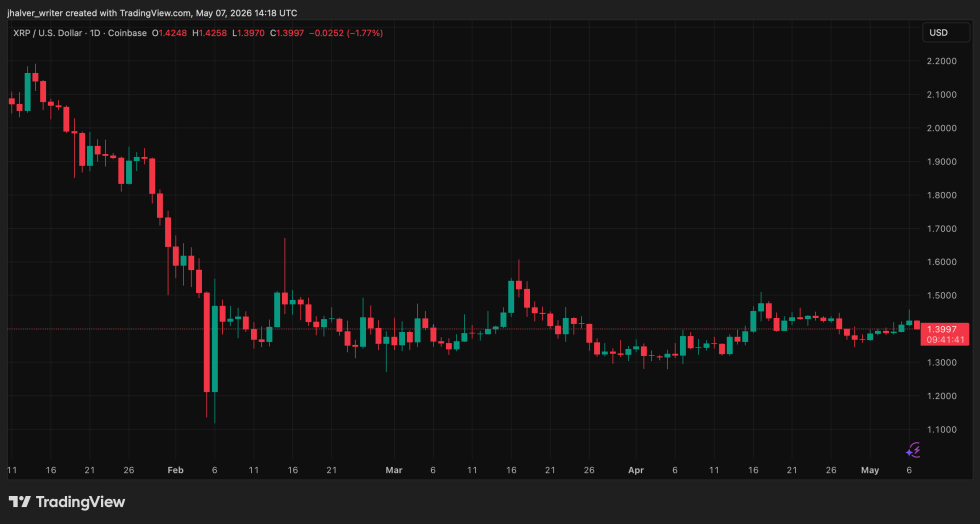
XRP's price trends sideways on the daily chart. Source: XRPUSD on Tradingview
Ripple Gains Relevance with Mastercard Partnership
The mechanics of the pilot reveal how each institution contributed a distinct piece of the settlement architecture. Ripple redeemed a portion of its holdings in OUSG — Ondo Finance’s Short-Term US Government Treasuries fund, a tokenized product available to accredited investors and qualified purchasers — directly on the XRP Ledger. Ondo processed the redemption and triggered a fiat payout instruction through Mastercard’s Multi-Token Network (MTN), a platform designed to enable interoperability between on-chain assets and traditional money movement systems.
From there, Mastercard’s MTN routed the instruction to Kinexys by J.P. Morgan — JPMorgan’s blockchain infrastructure platform, which has now processed more than $3 trillion in cumulative transactions, per figures cited in the announcement.
Kinexys debited Ondo’s Blockchain Deposit Account and delivered US dollar proceeds to Ripple’s bank account in Singapore through its correspondent banking network. One leg of the transaction settled on a public blockchain. The other settled on institutional banking rails. Both happened within the same uninterrupted flow.
What It Signals For The Broader Market
The transaction arrives against a backdrop of rapid growth in tokenized real-world assets. Tokenized US Treasuries crossed the $10 billion mark for the first time on February 11, 2026, according to TheStreet Crypto, and stood at approximately $12.88 billion by early April — a 225% increase over 15 months. The broader tokenized RWA market surged 256.7% from $5.42 billion at the start of 2025 to $19.3 billion by the end of Q1 2026. Despite that growth, redemption infrastructure has lagged, still dependent on wire transfers, manual processes, and fixed banking windows. This pilot addresses that gap directly.
Markus Infanger, SVP of RippleX, noted in the official release that the XRP Ledger enables real-time asset movement and that, when paired with global banking infrastructure, the pilot demonstrates how institutions can execute cross-border transactions as a single integrated flow — rather than a sequence of siloed instructions across separate systems.
The DTCC separately announced earlier this week that it plans to launch its own tokenization service later in 2026 — a signal that the institutional race to build out this infrastructure is accelerating across the industry simultaneously.
This development marks a pivotal moment for the nascent sector and, specifically, for the XRP Ledger’s positioning within institutional finance. Whether the XRPL’s role as settlement infrastructure in this pilot translates into a sustained and expanded use case will depend on how many further cross-border tokenized asset transactions adopt the same architecture — and how quickly the broader regulatory and banking framework catches up to what the technology can already do.
Cover image from Grok, XRPUSD chart on Tradingview

Editorial Process for bitcoinist is centered on delivering thoroughly researched, accurate, and unbiased content. We uphold strict sourcing standards, and each page undergoes diligent review by our team of top technology experts and seasoned editors. This process ensures the integrity, relevance, and value of our content for our readers.