
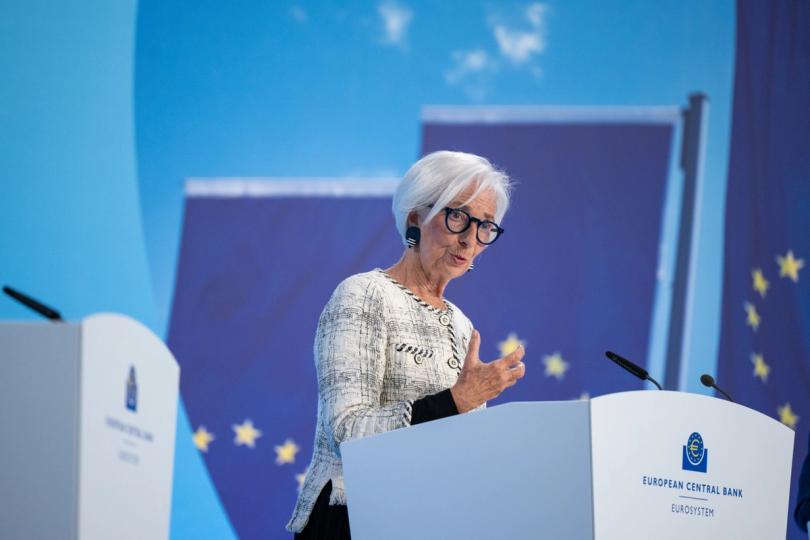
European Central Bank (ECB) President Christine Lagarde argued against the need for privately-issued euro-pegged stablecoins, even in the face of a market which is 98% dominated by dollar-pegged tokens.
Despite the rapid global adoption of USD stablecoins, Largarde argued Europe should focus on building tokenized settlement infrastructure anchored in central bank money rather than simply replicating the U.S. stablecoin model in a speech Bank of Spain’s LatAm Economic Forum in Madrid on Friday
“The case for promoting euro-denominated stablecoins is far weaker than it appears,” Lagarde said, arguing that the technological case for stablecoins can be replicated by central bank infrastructure, while their monetary function introduces unacceptable risks to financial stability.
Those comments come as Qivalis, a consortium of 12 of Europe’s largest banks, including ING, BBVA, BNP Paribas, Danske Bank, and UniCredit, announced plans to launch a privately-issued digital euro, not a CBDC, later this year under the same premise that Europe faces dollarization risks.
“If we don’t have a euro onchain with depth of liquidity, then the only alternative is the U.S. dollar,” Qivalis CEO Jan-Oliver Sell told CoinDesk. “That’s a real risk to Europe’s financial and digital sovereignty.”
Lagarde reiterated warnings that stablecoins could create financial stability risks during periods of market stress. She referenced the March 2023 collapse of Silicon Valley Bank, when Circle disclosed that $3.3 billion of its USDC reserves were at the bank, causing a brief de-peg of its stablecoin.
“At scale, such dynamics can transmit stress to the underlying asset markets. The promise of par redemption depends on the very market confidence that can vanish when financial stability deteriorates – and a mass redemption can accelerate that deterioration,” she said on Friday.
“As stablecoin use grows, so too does the potential for feedback loops between redemptions and asset markets,] particularly where issuers are non-banks.”
The growing global dominance of U.S. dollar-pegged stablecoins issued by Tether and Circle represents risks to Europe’s financial system, Lagarde said on Friday.
Lagarde noted circulation in six years has increased from $10 billion to $310 billion. However, she expressed concern that nearly 90% of the market is controlled by two issuers – Tether and Circle USDC).
She said that in Europe there’s increasing debate over the bloc’s urgent need to remain relevant.
“Europe must respond by promoting euro-denominated stablecoins of its own,” she said. “Otherwise, it faces a future of digital dollarisation and a loss of monetary sovereignty.”Lagarde is calling on the EU countries to support the development of a CBDCs. “We must build the public infrastructure that will enable alternative instruments, such as stablecoins and other forms of tokenised money, to operate within a framework anchored by central bank money,” she said.
Late last year, Lagarde announced the ECB’s plans for a “digital euro by 2029, assuming the European co-legislators adopt the necessary regulation by 2026,” adding that the preparatory steps, including pilot exercises and initial transactions, could begin as early as mid-2027.