
There is a moment every trader remembers, the one where they finally understood that trading is not about finding the next big winner. It is about surviving long enough for the wins to compound. For most traders, that moment comes after a painful loss. A blown account. A trade that went wrong and took three months of gains with it in a single session.
The rule that changed everything is not glamorous. It does not promise overnight riches. It will not make you the most exciting trader in the room. But it is the single principle that separates traders who are still in the game after five years from those who quit after five months. It is the 1% rule, and understanding it completely will change the way you approach every trade you ever place.
Key Takeaways
- The 1% rule means risking 1% of your total account, not investing 1%. Your stop loss distance determines your position size. The formula is non-negotiable: Risk Amount ÷ Stop Distance = Position Size.
- Ten consecutive losses at 1% risk leave you with 90% of your capital. The same ten losses at 5% risk leave you with 60%. Proper position sizing is the only free insurance available to traders.
- Never widen your stop loss after entry. The stop was placed at the point where your analysis is wrong. If the price reaches it, the analysis was wrong, accept it and move on.
- Minimum 3:1 risk-to-reward on every trade. At 3:1 RR you only need to win 34% of trades to be profitable. Most traders chase 80% win rates with 1:1 RR and wonder why they are losing money.
What the 1% Trading Rule Actually is — and What it is Not
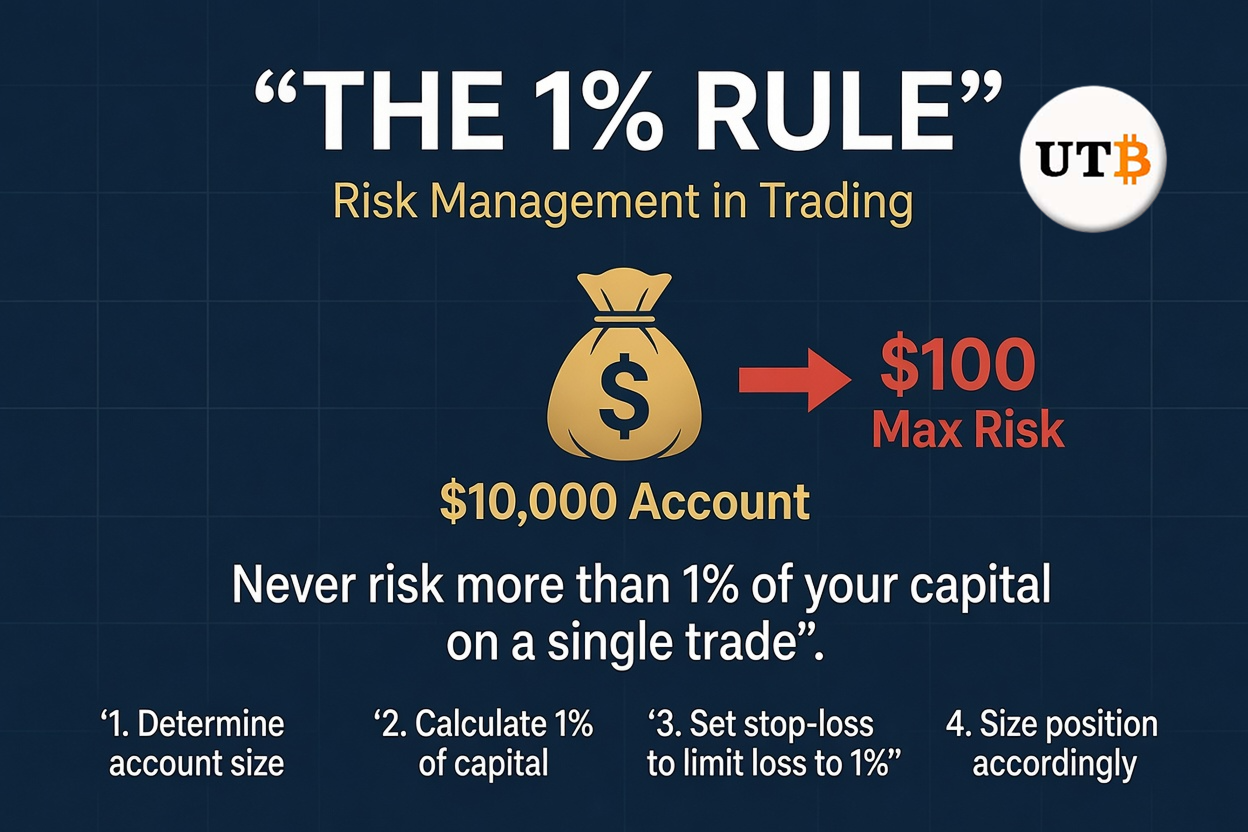
The 1% rule is simple to state and hard to follow: never risk more than 1% of your total trading account on any single trade. That is it. No exceptions for “high conviction” setups. No increase to 2% because the chart looks perfect. No doubling position size to recover from yesterday’s loss. One percent, every trade, every session, no matter what.
On a ₦1,500,000 account, 1% is ₦15,000 per trade. On a $10,000 account, it is $100. The actual naira or dollar amount does not matter. What matters is that this fixed percentage creates a mathematical structure that makes account destruction nearly impossible, even during extended losing streaks.
What the 1% rule is NOT
It is not about putting only 1% of your capital into a trade. It is about risking only 1%, meaning the maximum you can lose on any trade is 1% of your account. Your actual position size will be much larger, determined by where your stop loss sits. This distinction is what most articles miss and what most new traders get wrong.
The maths that makes it unbreakable
The reason the 1% rule works is not intuition; it is arithmetic. Most traders who blow accounts do not lose money on bad analysis. They lose money because their position sizes are too large for their stop losses. A good trade setup with a catastrophic position size is more dangerous than a mediocre setup with proper sizing. Here is the math that proves why.
Scenario: 10 consecutive losing trades — 1% rule vs 5% risk
Starting account₦1,500,000
After 10 losses at 1% risk₦1,356,905 — lost 9.56%
After 10 losses at 5% risk₦898,542 — lost 40.1%
After 10 losses at 10% risk₦429,467 — lost 71.4%
Trades needed to recover 1% drawdown~10 winning trades
Trades needed to recover 40% drawdown~67 winning trades
Ten consecutive losses happen. Every active trader experiences them. At 1% risk, ten straight losses leave you with 90.44% of your capital intact and require just ten winning trades to recover. At 5% risk, the same ten losses leave you needing a 67% gain just to get back to breakeven. At 10% risk, you need a 233% return to recover from the same run of bad luck. The 1% rule does not just protect capital, it protects the psychological capacity to keep trading rationally after a losing streak.
How to Calculate Exact Position Size Every Time
The 1% rule only works if you apply it correctly to position sizing. Most traders use it as a feeling, “I think this is about 1%.” Professional traders calculate it precisely before every single entry. Here is the exact formula:
Position size formula — use before every trade
Position Size = (Account Balance × Risk %) ÷ (Entry Price − Stop Loss Price)
Example on GBPUSD:
Account: ₦1,500,000 · Risk: 1% = ₦15,000
Entry: 1.2840 · Stop loss: 1.2800 · Distance: 40 pips
Each pip = ₦250 (at standard lot sizing)
Position size: ₦15,000 ÷ ₦250 = 0.15 standard lots
This means your stop loss defines your position size, not your conviction level, not your chart pattern quality, not your gut feeling. The stop loss and the 1% rule together determine exactly how large your position can be.
The Five Rules that Complete the System
The 1% rule is the foundation. These five supporting rules are what make it a complete risk management framework:
Rule 2 — The 3% daily maximum loss rule
Even at 1% per trade, a bad day with three simultaneous positions could cost 3% in a single session. Set a hard daily maximum loss of 3% of the account balance. When you hit that number — regardless of what the chart looks like close your platform and come back tomorrow. This prevents the emotional spiral of trying to recover same-day losses that turns a 3% drawdown into a 15% one.
Rule 3 — Never move your stop loss wider
The most dangerous four words in trading are “I’ll just give it room.” Moving a stop loss wider after a trade moves against you transforms a calculated loss into an undefined one. Your stop loss was placed at the point where your trade idea is wrong. If the price reaches that point, the idea is wrong, accept the loss and move on. Widening the stop is not risk management. It is hope management.
Rule 4 — The 3R minimum reward rule
Never take a trade unless you can identify a realistic target that is at least three times your risk (3:1 risk-to-reward). If you are risking ₦15,000, your target must be at least ₦45,000. This means you only need to win 34% of your trades to be profitable. At a 50% win rate with 3:1 RR, your monthly return is extraordinary. Most traders chase high win rates and accept poor RR — professional traders accept lower win rates and demand excellent RR.
Rule 5 — The consecutive loss pause rule
After five consecutive losing trades, stop trading for 48 hours. Not as a punishment as a diagnosis. Five straight losses mean either the market has changed character, your setups are not performing in current conditions, or your psychology has shifted into revenge mode. Two days away from the charts gives you the distance to identify which problem you are dealing with before it compounds into ten losses.
Rule 6 — Never increase risk after a win streak
This is the rule most traders break. After five or ten consecutive wins, the temptation to “press the advantage” by increasing position size to 2% or 3% feels logical. It is not. Win streaks end. The trade where you doubled your position size is statistically likely to be the trade that catches the reversal. Keep risk at 1% — compound through consistency, not through leverage.
The Psychology that Makes Traders Break Their Own Rules
Every trader reading this has heard the 1% rule before. Most have agreed with it intellectually. Most have broken it anyway. The reason is not ignorance — it is emotion. Three specific emotional states cause rule-breaking, and understanding them is as important as understanding the rule itself.
- Revenge trading — the impulse to immediately enter a new, larger trade after a loss to “get the money back.” The loss creates an emotional debt that the brain wants to resolve instantly. The 1% rule dissolves in this state because the normal position size feels insufficient to recover quickly enough. The solution is a preset rule: after any loss, you must wait a minimum of 30 minutes before considering the next trade.
- Overconfidence after wins — the feeling that a winning streak means you have “figured it out” and the rules no longer apply to you. This state is actually more dangerous than revenge trading because it feels like competence rather than emotion. Every professional trader has at least one story of their biggest loss happening immediately after their best month.
- Fear of missing out — the impulse to take a trade that does not meet your criteria because it “looks so obvious.” FOMO trades are the ones most likely to violate position sizing rules because the urgency of entering fast overrides the discipline of calculating correctly. If you did not plan the trade before the market opened, do not take it.
What the 1% Rule Produces Over 12 months — Real Numbers
Using the trading plan of 1% at a starting capital of ₦1,500,000 account, ₦100,000 risk per trade (6.67% — aggressive but capped at one trade per day), 1:3 RR, 20 trading days per month, the compounding mathematics are clear. At a 50% win rate: 10 wins at ₦300,000 and 10 losses at ₦100,000 produce ₦2,000,000 net profit per month. But the point is not the return, it is the survival.
A trader who follows the rules through a bad month loses a defined, recoverable amount. A trader who abandons the rules on one bad week can lose the same amount the disciplined trader earns in six months.
The 1% rule is not the most exciting piece of trading content we have ever published. It will not give you a hot tip or a buy signal. But it is the most important. The traders who survive long enough to become profitable are almost always the ones who learned position sizing before they learned chart patterns.
Frequently Asked Questions
What is the 1% rule in trading?
The 1% rule means you should never risk more than 1% of your total trading account on any single trade. It is not about investing only 1%; it is about ensuring your maximum possible loss on any trade is capped at 1% of your account balance. Your position size is then calculated based on where your stop loss sits, using the formula: Position Size = (Account × 1%) ÷ Stop Distance.
Why do most crypto traders lose money?
The primary reason most crypto traders lose money is poor position sizing and risk management, not bad analysis. Studies consistently show that 70–90% of retail traders lose money, not because their trade ideas are wrong, but because their position sizes are too large relative to their stop losses. One poorly sized losing trade can eliminate weeks of correctly-sized winning trades.
What is a good risk-to-reward ratio for crypto trading?
A minimum of 2:1 risk-to-reward is the baseline, with 3:1 being the professional standard. At 3:1 RR, you only need to win 34% of your trades to be profitable. At 1:1 RR, you need to win more than 50% just to break even after spreads and fees. Never take a trade where your target is smaller than twice your risk.
How do I calculate position size?
Use this formula: Position Size = (Account Balance × Risk %) ÷ (Entry Price − Stop Loss Price). Example: ₦1,500,000 account, 1% risk = ₦15,000. GBPUSD entry at 1.2840, stop at 1.2800 = 40 pips distance. If each pip is worth ₦250: ₦15,000 ÷ ₦250 = 0.15 standard lots. Calculate this before every trade — never estimate.
What is revenge trading, and how do I stop it?
Revenge trading is the impulse to enter a new, larger position immediately after a loss to recover the money quickly. It is the most common cause of account blowups because it combines emotional decision-making with increased position size. The solution is a preset rule: after any loss, wait a minimum of 30 minutes before considering another trade. Set this as a non-negotiable rule in your trading plan before you start each session.
How many trades should I take per day?
For the New York session strategy we use at UseTheBitcoin, the rule is a maximum of one trade per day. This is not a limitation; it is a discipline that forces you to wait for the highest-quality setups rather than overtrading on marginal ones. Most professional traders place fewer than 3 trades per day on average. More trades do not mean more profit; they mean more exposure and more opportunities to break your own rules.
Related Read
$0 to $22,000: Crypto Airdrops that Created Overnight Millionaires
Bitcoin and Gold Price Prediction
Hyperliquid HYPE Price Analysis
Zcash Price Analysis