
In brief
- Both Anthropic and OpenAI have declared any stock transfer without board approval void.
- Anthropic published a blocklist of unauthorized platforms, including Forge Global and Hiive—two of the largest regulated private-share marketplaces.
- The $6.6 billion OpenAI employee cash-out was a board-authorized tender offer, which both companies say is legitimate.
Anthropic and OpenAI both updated their stock transfer policies on Tuesday, and the message is the same: If you bought shares through an unauthorized channel, you may not actually own anything other than an expensive piece of paper.
Anthropic’s updated page says any sale or transfer of its stock without board of directors approval is “void”—not voidable, not disputed, void. The buyer would not be recognized as a shareholder and would have no rights.
OpenAI’s statement from today uses nearly identical language: Any transfer without written consent is void, and “the sale will not be recognized and carry no economic value to you.”
Both companies named the same list of targets: direct sales, special purpose vehicles (SPVs), tokenized interests, and forward contracts.
What’s an SPV and why does it matter?
An SPV is a shell company set up for a single purpose. In this case, to hold shares in a private company and pool outside money around them. Since direct transfers require company approval, SPVs became the standard workaround: The shell buys the shares, you buy into the shell.
The problem is the layering. PitchBook analyst Emily Zheng described it as “multiple layers of SPVs that create multiple layers of management fees,” nested structures where each layer charges its own fees and makes it harder to verify whether the underlying shares were ever legitimately acquired.
Under Tuesday’s statements, if the original transfer into any SPV lacked board approval, the whole chain is void.
Anthropic went further than OpenAI and published a specific blocklist: Open Door Partners, Unicorns Exchange, Pachamama, Lionheart Ventures, Sydecar, Upmarket—and new offerings on Forge Global and Hiive, two of the most established private-share marketplaces in the secondary market.
Notice that, per Anthropic’s statement, these offers are void, not voidable, or subject to conditions. In other words, this is a warning that their lack of value is already established before the moment the negotiation happens, and not after, so there is basically no legal protection, at least not in terms of the nature of what’s being traded.
Wait—Forge Global is on the list?
Yes, Forge Global is on the naughty list, and that’s the part that reshapes everything. Forge Global is not a gray-market scheme. It’s a regulated secondary marketplace where accredited investors trade shares in private companies. As Decrypt reported last month, Anthropic’s implied valuation on Forge had hit roughly $1 trillion, overtaking OpenAI’s $880 billion on the same platform, a figure Forge CEO Kelly Rodriques confirmed.
Anthropic’s statement doesn’t draw a line between gray-market operators and regulated platforms. Any transfer without board approval is void, regardless of where it happened. That leaves buyers on Forge and Hiive facing the same uncertainty as PreStocks holders.
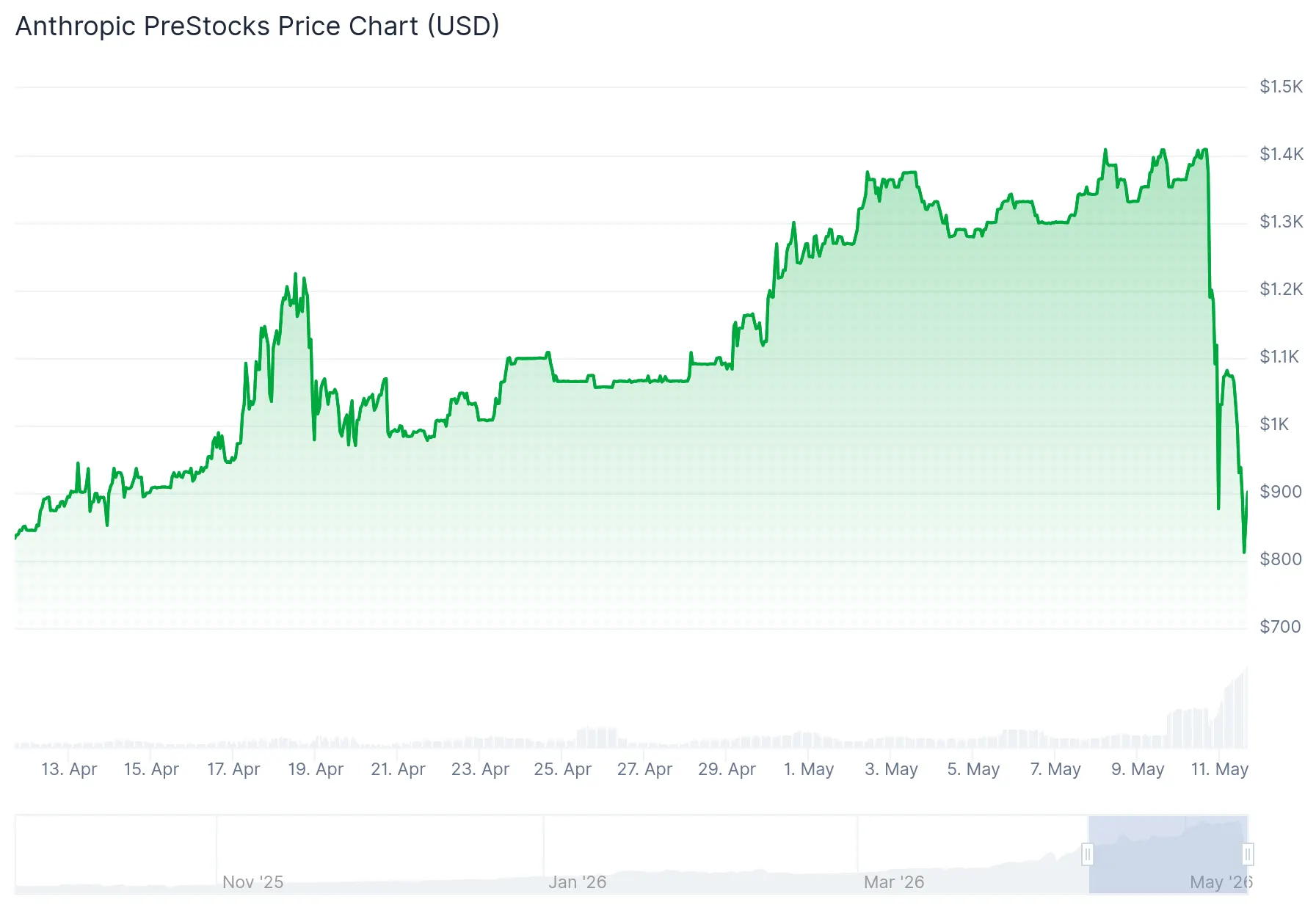
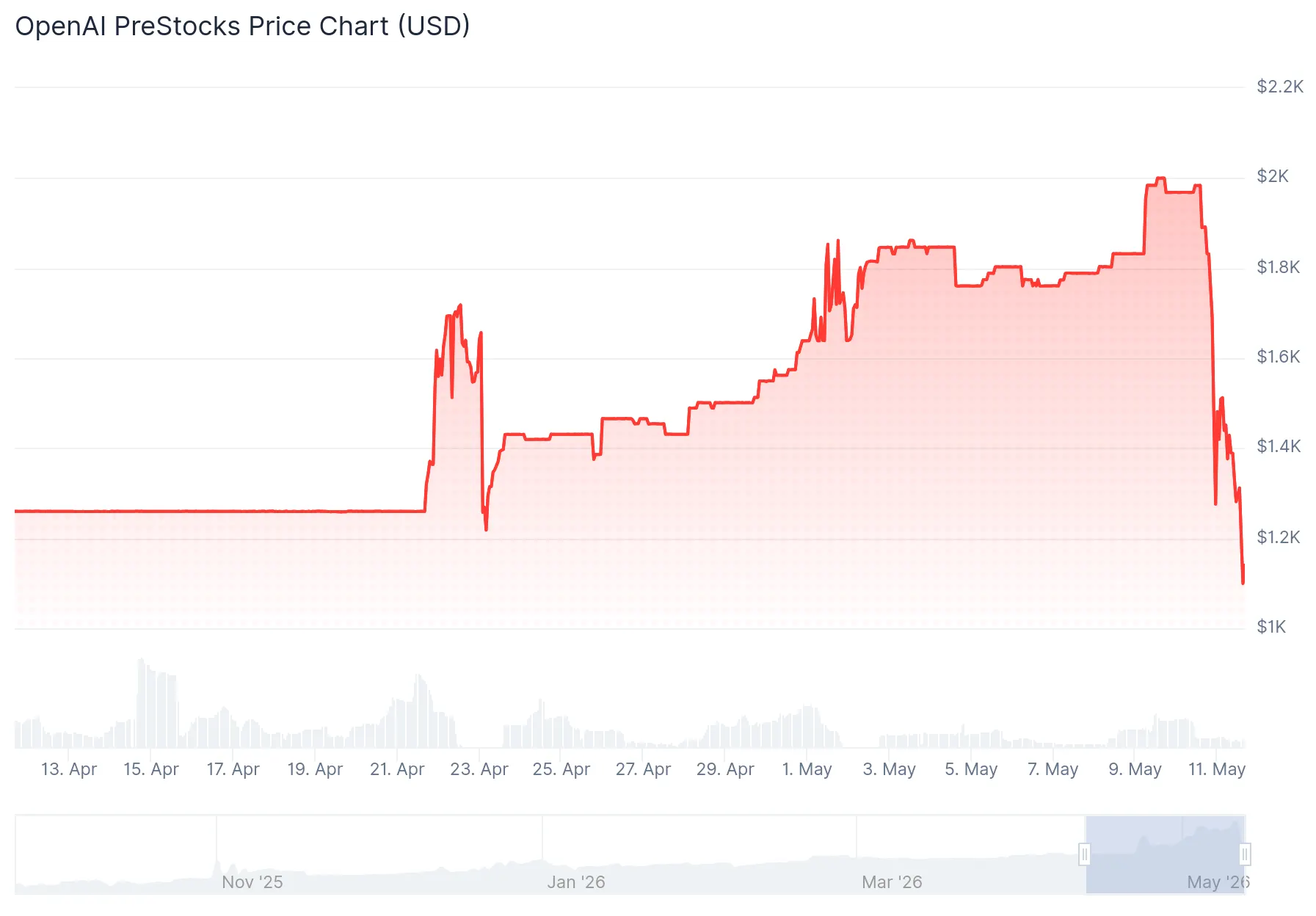
The tokenized market reacted immediately. The Anthropic token on PreStocks, a Solana-based SPV-backed platform, dropped from $1400 to $900 after Anthropic’s announcement, according to Coingecko. OpenAI’s equivalent performed even worse, crashing from $1,400 to $900 in 24 hours.
So how did 600 OpenAI employees just sell $6.6 billion in stock?
For those not into the weird and complex world of finance, this may be an obvious question, and the answer is the whole point.
In October 2025, OpenAI ran a board-authorized tender offer—current and former employees sold vested shares to institutional buyers including Thrive Capital, SoftBank, Dragoneer, and T. Rowe Price. More than 600 people participated, each capped at $30 million.
OpenAI organized it, disclosed it, and approved every transfer.
That’s what both companies are defending, not targeting. A secondary sale where the company controls who’s buying and signs off on the transfer is legal. The crackdown is about everything that skips that step—layered SPVs, tokenized wrappers, platform listings nobody consented to.
Where does Robinhood’s fund fit?
Three weeks ago, Robinhood Ventures Fund I announced it had purchased $75 million in OpenAI common stock, giving retail investors exposure through a NYSE-listed closed-end fund.
That’s a more regulated wrapper than a cold-pitch SPV—but Robinhood’s own product page discloses that RVI “obtains exposure either through a direct investment in a company or via one or more special purpose vehicles.” As of today, no public statement from OpenAI confirms it approved the April 17 transfer.
Robinhood and OpenAI had a public dispute last year over unauthorized tokenized OpenAI stock Robinhood airdropped to European users. Whether this latest $75 million purchase has OpenAI’s written consent—the only thing that makes a transfer valid under Tuesday’s policies—has not been confirmed by either company.
So the question should not be “is this a regulated platform?” but more something like “did the company approve this specific transfer in writing?”
That’s a harder question to answer, and both Anthropic and OpenAI made clear Tuesday they intend to enforce it.
The demand making all of this chaotic is easy to understand when you follow the money. Anthropic’s annualized revenue jumped from $9 billion at end-2025 to $30 billion by April 2026 a 233% increase in a single quarter, driven largely by Claude Code—with Amazon committed to invest up to $25 billion in the company. At those growth rates, investors who can’t get in through official channels will keep looking for side doors.
Tuesday was both companies nailing those doors shut and, in Anthropic’s case, posting a list of the ones it found open.
Daily Debrief Newsletter
Start every day with the top news stories right now, plus original features, a podcast, videos and more.