

As volatility persists in the market, Bitcoin faces a potential retest of the $70,000 price level following the recent pullback. With this waning price action, demand for the flagship asset among investors and traders is exhibiting a trend that could spell trouble for its near-term direction.
Demand Patterns For Bitcoin Are Undergoing A Change
Bitcoin continues to struggle with heightened bearish pressure, and a subtle but crucial shift is currently emerging in the market. Currently, BTC’s downside price action has begun to reflect changes in its demand dynamics.
In an analysis of the Bitcoin Spot and Perpetual Futures Demand Growth, Julio Moreno has shared that BTC’s total demand entered into a contraction phase on Monday, May 18. This shift comes after a steady upside since early March this year, driven by speculative demand.
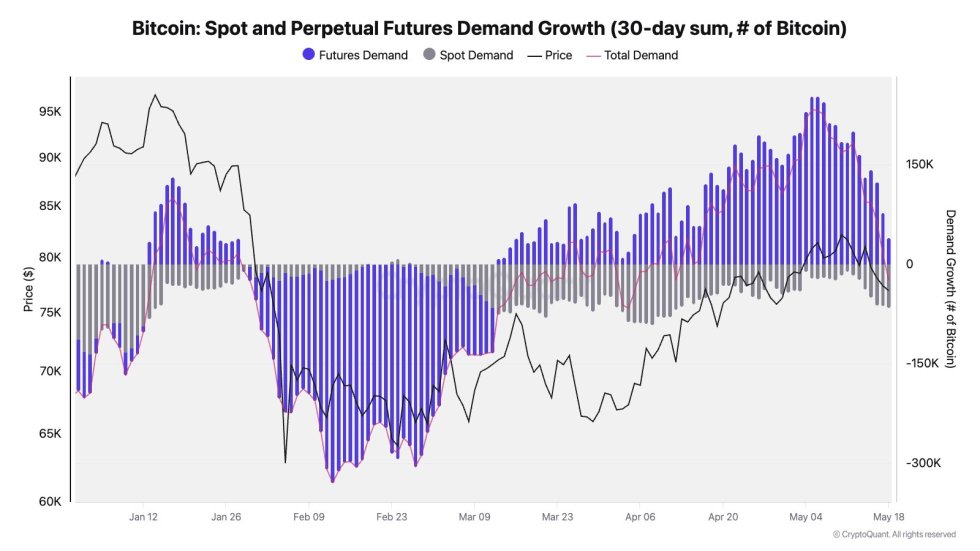
With fading buying pressure and cooling speculative activity colliding, this development triggered concerns about whether the market is either getting ready for a wider trend reversal or is about to enter a consolidation phase. Moreno highlighted that speculative demand growth, which is represented by the blue bars on the chart, reached its highest level as prices approached the $80,000 mark. However, this activity has since slowed down significantly.
Meanwhile, spot demand, indicated as the grey bars on the chart, is contracting slightly faster than the speed of the cooling speculative demand. As demand patterns continue to adjust, this could play a role in shaping BTC’s next major move in either direction.
BTC Held At Loss Matching Past Levels
During this weakening momentum, another development that is drawing attention is the number of Bitcoins held at a loss. According to Darkfost, another CryptoQuant author, the supply of BTC held at a loss by long-term holders is not 5.7 million BTC, matching levels previously seen at the peak of past bear markets.
In 2015, it was 5.96 million BTC, in 2019, it was 5.8 million BTC, while in 2022, it was 6.8 million BTC. It is worth noting that the most severe discomfort was felt by LTHs during the last cycle. Nonetheless, the recent 52% decline in Bitcoin is still significantly lower than what was observed in earlier bear markets.
Darkfost stated that this suggests a very large number of BTC was exchanged between $80,000 and $126,000, and the losses are probably present among the youngest cohort of LTHs. What’s important here is that the trend is not completely confirmed yet, but a slight distortion caused by the movement of 800,000 BTC from Coinbase on November 21 and 22 was observed.
Furthermore, a spike of more than 740,000 BTC can clearly be seen around April 21 and 22, while on Bitbo, the transaction to long-term holders occurs after 155 days. By adjusting the figure for this movement, the value could still be around 4.93 million BTC, which remains historically significant.
In the following 3 to 4 days, Darkfost noted that a number of LTH-related measures on platforms that use a 6-month threshold may also begin to move quickly. At that point, these BTC, which moved around $84,500, will officially shift from STH to LTH supply.

Featured image from Pixabay, chart from Tradingview.com

Editorial Process for bitcoinist is centered on delivering thoroughly researched, accurate, and unbiased content. We uphold strict sourcing standards, and each page undergoes diligent review by our team of top technology experts and seasoned editors. This process ensures the integrity, relevance, and value of our content for our readers.