



CryptoQuant data shows XRP’s 30-day liquidity index on Binance has fallen to about 0.043, its lowest level since January 2020, while futures open interest on the exchange sits near $488.3 million.
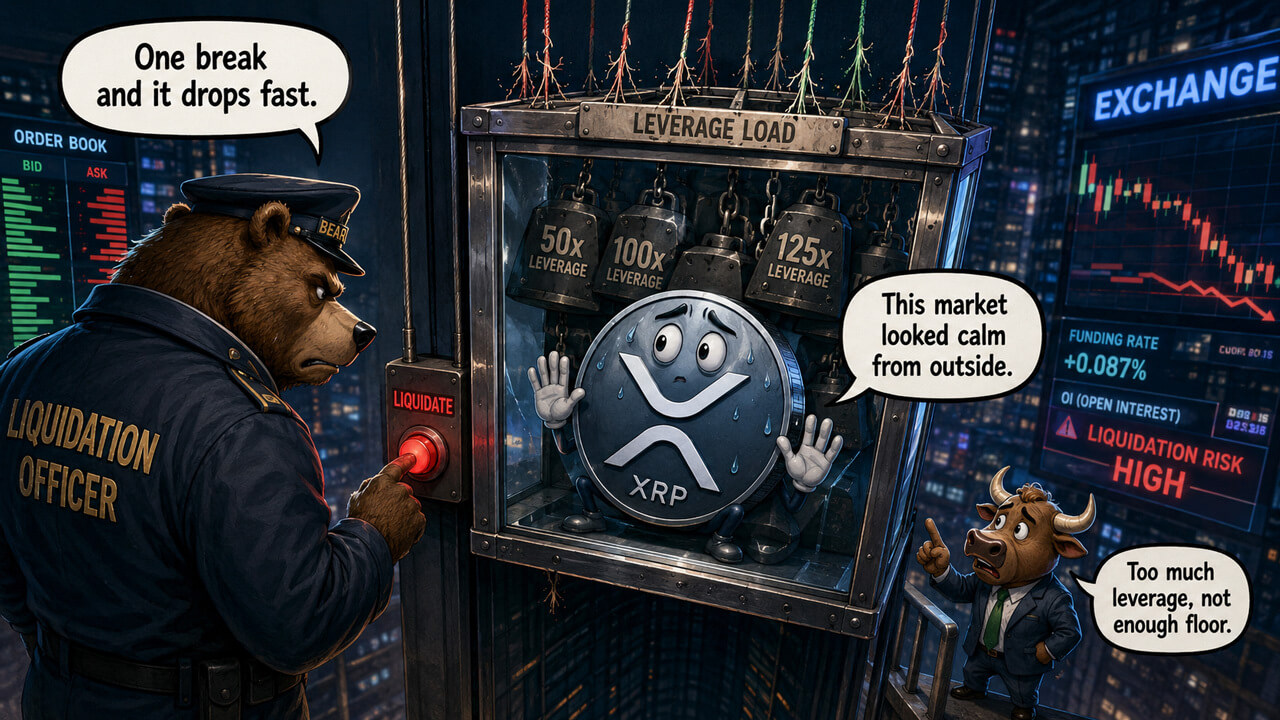
Liquidity is draining from the order book while leverage stays active, leaving the market compressed beneath a surface that reads as quiet.
XRP’s consolidation is happening in a thinner market, where the next large flow could move the price more aggressively than recent flatness suggests.
CoinGlass puts all-exchange XRP open interest near $2.9 billion, with 24-hour futures volume around $2.1 billion against spot volume near $307 million, a ratio of roughly 6.8 to 1, which means derivatives are already shaping price mechanics independently of organic spot activity.
| Metric | Current reading | Market-structure implication |
|---|---|---|
| Binance XRP 30-day liquidity index | ~0.043 | Lowest level since January 2020; thinner depth raises price impact |
| XRP price | ~$1.35 | Price looks quiet while underlying conditions become more fragile |
| Binance XRP open interest | ~$488.3M | Leverage remains active near the top of its two-month range |
| All-exchange XRP open interest | ~$2.9B | Large derivatives stack sits above a thinner spot market |
| 24h futures volume | ~$2.1B | Derivatives are driving a large share of activity |
| 24h spot volume | ~$307M | Organic spot activity is much smaller than futures activity |
| Futures-to-spot volume ratio | ~6.8x | A directional move can be amplified by derivatives rather than spot demand alone |
The thinnest book since 2020
When market depth is deep, big trades get absorbed with limited movement, but when depth is thin, the same order size pushes through the book faster, turning ordinary flows into sharp candles, and that cuts both ways.
CryptoQuant’s Binance XRP 30-day liquidity reading near 0.043 puts current conditions at their worst since January 2020, a level that preceded one of XRP’s more volatile phases.
Thin liquidity amplifies whatever flow hits the book first, making it more dangerous to be on the wrong side of the next confirmed move.
A spot buyer can push prices higher faster than usual, and a cascade of liquidations can accelerate a breakdown just as quickly.
With XRP liquidity on Binance at its lowest since January 2020 and the asset trading near $1.35, ordinary news flow or a single large market order can now move the price by a percentage that would require several times more capital in a deeper book.
A large derivatives stack on a thin foundation
CryptoQuant reports XRP open interest on Binance near $488.3 million, near the top of its two-month range, having touched roughly $500 million in mid-May, the highest level since March.
CoinGlass data shows all-exchange XRP open interest near $2.9 billion, with 24-hour futures volume around $2.1 billion versus spot volume near $307 million, putting derivatives activity at roughly 6.8 times spot volume.
When futures volume runs at that ratio above spot, a confirmed move through a key level can trigger a cascade that spot demand alone would not sustain.
With spot providing only about $307 million of 24-hour volume against $2.1 billion in futures, any sustained directional push in the derivatives market runs into limited organic buying or selling to act as a buffer.
Long liquidations reinforce a breakdown, and short covering drives an upside overshoot. The thin order book sits underneath a derivatives stack large enough to turn a moderate move into an outsized one.
| Market condition | What it means mechanically | Bullish path | Bearish path |
|---|---|---|---|
| Thin Binance order book | Large orders push through available depth faster | Spot demand can move price higher with less capital | Selling pressure can break support faster |
| Elevated open interest | More leveraged positions are exposed to price moves | Shorts can be forced to cover | Longs can be forced to unwind |
| Futures volume far above spot volume | Derivatives can dominate near-term price action | Breakout can overshoot spot demand | Breakdown can overshoot spot selling |
| Negative MVRV | Holders are underwater, reducing profit-taking pressure | Less sell-overhang if buyers step in | Weak demand can keep holders underwater |
| Neutral-to-low NVT | Price is better aligned with network activity than during overheated phases | Gives buyers a fundamental support argument | Does not prevent liquidation-driven downside |
MVRV and network activity
Santiment data showed XRP’s 365-day MVRV at -35.12% and its 30-day MVRV at -3%.
Both readings put holders underwater relative to their realized cost basis. An asset trading below the average acquisition price of its holder base carries less immediate profit-taking risk than one where most participants are sitting on gains.
That removes the euphoric distribution scenario from the near-term picture, as XRP moving higher from current levels faces a smaller selling overhang from profit-takers than it would if holders were sitting on large unrealized gains.
Negative readings from a backward-looking metric can reflect undervaluation, but they can also reflect weak realized demand. Holders who are underwater can stay there for extended periods if new buyers are absent.
XRP’s current MVRV position reduces the sell-trigger risk from existing holders, while leaving the demand-confirmation question open. Until buyers prove they can lift price through resistance, lower sell-trigger risk is the metric’s only contribution to the setup.
CryptoQuant analyst YJ argued that XRP’s price is better supported by network activity now than during the 2025 rally.
The NVT ratio near 170.2, neutral-to-low compared with 2025 peaks, shows price is better aligned with actual transaction activity than during prior speculative phases, giving buyers entering here a more defensible fundamental entry than during the overheated period, when price outpaced network-derived value.
The NVT reading provides a more defensible fundamental floor, giving the current price level greater backing from on-chain activity and serving as a separate dimension from the liquidity and leverage mechanics that will determine the next move, operating independently of NVT’s fundamental picture.
If buyers step in at current levels, they enter a market where the network-activity backdrop justifies the price more than it did during the 2025 overheated phase, even as the order book and derivatives structure determine whether that entry survives contact with the next large flow.
Two paths from the volatility setup
The bull case plays out if spot buyers or whales step in while the order book stays thin. Low depth amplifies demand the same way it amplifies selling, and a sustained spot bid can squeeze price higher fast, forcing short covering that extends the move beyond what spot volume alone would justify.
XRP’s MVRV position, with both long-term and short-term holders underwater, removes much of the selling overhang from profit-takers at current levels, giving any genuine demand a cleaner runway.
YJ’s NVT reading near 170.2 gives buyers entering here a fundamental support argument alongside the market structure setup.
If price breaks above near-term resistance with volume confirmation, the thin order book and elevated open interest can turn a breakout into an outsized squeeze.
| Path | Trigger | Amplifier | MVRV / NVT backdrop | XRP price implication |
|---|---|---|---|---|
| Bull case: upside squeeze | Spot buyers or whales step in while depth remains thin | Low liquidity amplifies demand; shorts cover into the move | Negative MVRV reduces profit-taking pressure; NVT gives a support argument | Breakout can extend faster than spot volume alone would justify |
| Base case: compressed consolidation | No decisive spot flow arrives; price stays near current range | OI remains elevated while liquidity stays thin | Holders remain underwater, but demand confirmation is absent | XRP keeps chopping while volatility risk builds |
| Bear case: liquidation cascade | XRP loses support while OI remains elevated | Long liquidations hit a thin book; futures activity overwhelms spot buffer | MVRV limits profit-taking risk, but leveraged longs become the main risk | A modest breakdown can turn into an outsized downside move |
| Shock case: liquidity vacuum | Macro shock, whale selling, or exchange-specific liquidity withdrawal hits suddenly | Order book fails to absorb flow; derivatives accelerate the move | Fundamentals matter less in the immediate move | XRP sees a sharp wick before liquidity rebuilds |
The bear case activates if XRP loses support while open interest stays elevated and order book depth stays thin.
Liquidations cascade through a book that lacks the depth to absorb them, and with futures volume running at 6.8 times spot volume, the derivatives stack has enough mass to drive price through technical levels without proportional spot selling.
A modest move below support becomes a sharper one once longs start unwinding. XRP’s MVRV position keeps profit-taking sellers relatively quiet, while leveraged longs cutting positions represent the larger near-term risk given OI levels and the thin book below current price.
Low liquidity amplifies the same move in either direction: it can turn a breakout into a squeeze in the bull case, and can turn a breakdown into a cascade in the bear case.