
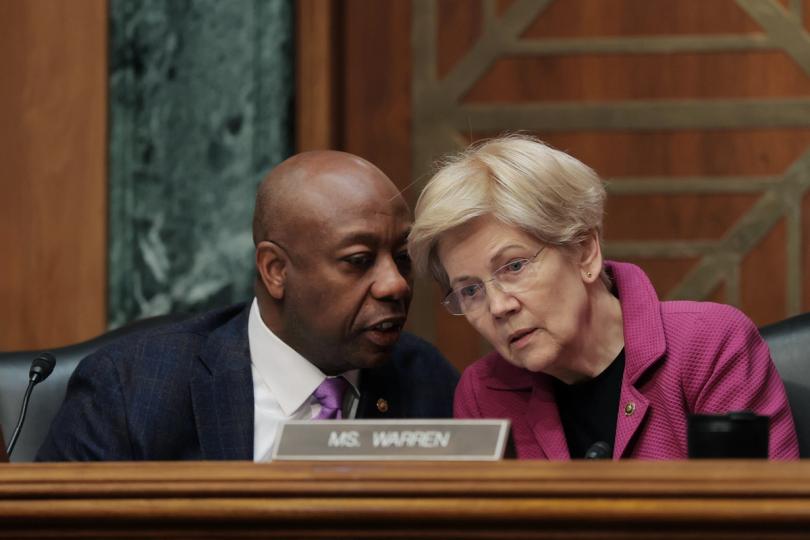
At the recent Senate Banking markup of the Digital Asset Market Clarity Act (CLARITY), Senator Angela Alsobrooks (D-MD) shared a story that should resonate with every parent in America. She spoke about her twenty-year-old daughter and her daughter’s generation – their intuitive interest in digital assets and their desire for a modern financial system that offers both opportunity and protection.
It underscored the growing urgency and gravity surrounding digital asset policy in Washington. “The digital revolution is upon us,” Senator Alsobrooks said. “It’s happening with us or without us. We have a responsibility to regulate it to create rules of the road.”
Her remarks reflected the growing recognition that the U.S. can no longer afford to approach digital asset policy reactively. This legislation is not just about the America of today; it is about tomorrow. We owe it to our children and the younger generation to get this policy right.
Chairman Tim Scott framed the debate through the lens of opportunity, faith and the American dream for working families. Senator Cynthia Lummis, one of Congress’s earliest bitcoin champions, emphasized the bipartisan work behind the legislation. Even senators who withheld support at this time, including Senator Lisa Blunt Rochester, spoke thoughtfully about how engaged her constituents are with this technology and emphasized the importance of legislation that ensures their protection.
The question now facing us is whether the U.S. will lead in shaping that future or will neglect that responsibility.
The 15-9 vote to advance Clarity to the Senate floor underscores three critical realities for the future of the American economy.
First, serious bipartisan policymaking regarding digital assets is not only possible but is already happening. The markup was a testament to the fact that credible policy and thoughtful engagement can still move Washington forward. Even senators who ultimately did not vote in favor of the bill, including Senator Mark Warner (D-VA), expressed their intention to continue working toward a constructive path forward.
The desire of leaders like Senators Scott, Lummis, Tillis, Alsobrooks, Gallego, Hagerty, Moreno and others to bridge the gap – including on the complex issue of stablecoin yield – shows that a bipartisan path is the only durable way forward.
Second, digital assets and the blockchain are here to stay. As articulated throughout the hearing by Senators on both sides of the aisle, the debate over the viability of digital assets is over. The only question is whether the U.S. will lead in shaping the future of digital finance or cede that leadership to others.
Nearly 68 million Americans, about one in five, already own digital assets. New Harris polling shows the number has increased by 12 million in the past year alone, putting American holders closer to one in four. They are teachers, construction workers, veterans, entrepreneurs and small business owners, with a third Gen Z and another third millennials. They use digital assets to send money to family members, make purchases and plan for their financial futures. Eighty-three percent of all American holders agree that stronger regulation is needed to protect consumers. Yet 88% of global crypto exchange activity occurs on foreign exchanges beyond U.S. supervision. Americans deserve the protections, clarity and oversight that only a federal framework can provide.
Finally, Congress must finish the job. The time is now. It is imperative that the full Senate act promptly.
The GENIUS Act established the payment layer through stablecoin legislation, but without Clarity to provide the market structure, trading platforms oversight and asset classification needed to support it, the U.S. risks leaving the job unfinished. As Treasury Secretary Scott Bessent has rightly noted, stablecoins without a broader market structure are a “foundation without walls.” If we fail to act, we risk sending the next generation of American innovation and the talent, investment and tech that comes with it, to foreign jurisdictions.
This important work is the industry’s responsibility as well. Comprehensive market structure will not arrive because we asked for it; it will arrive because we match the seriousness Congress has shown. The time is now to continue engaging substantively and constructively with concerns raised by members of Congress. Doing so is not the obstacle to the work; it is the work.
The markup proved that the momentum is with us. The resolve in that room showed that Washington recognizes the high stakes for American competitiveness and the future of digital finance. We have the mandate, bipartisan support, and the duty to ensure that the future of digital finance is unambiguously American.
America has long led the world because it has embraced innovation, markets and the rule of law. The window is open. The only question is whether we will close it on our terms.
A vote for Clarity is a vote for regulation – the rules this generation needs and the rules the next generation will inherit. Congress now has the chance to shape this technology rather than chase it. Let’s finish the job on the Senate floor.