

Add ZyCrypto News On Google
Bitcoin (BTC) traded relatively flat on Saturday, after a brief stabilization following a sharp downturn earlier in the week.
Notably, on Thursday, Bitcoin slipped to around $72,642, marking its lowest level since mid-April. The drop came as markets reacted to reports of renewed geopolitical tensions following U.S. military strikes on Iranian facilities. While prices have since recovered modestly, Bitcoin continues to hover near $73,000, still roughly 11% below its recent peak of $83,000.
However, analysts caution that the current consolidation may not reflect real stability. According to Ki Young Ju, founder of CryptoQuant, the broader market structure still resembles a bearish phase. On-chain indicators continue to point to weakening demand and prolonged distribution, suggesting the market could remain under pressure for an extended period.
“Once profit-taking cascades, Bitcoin investors’ PnL typically falls for about 18 months… Since the trend turned in Oct 2025, the bear market could last until early 2027.” He tweeted on Friday.
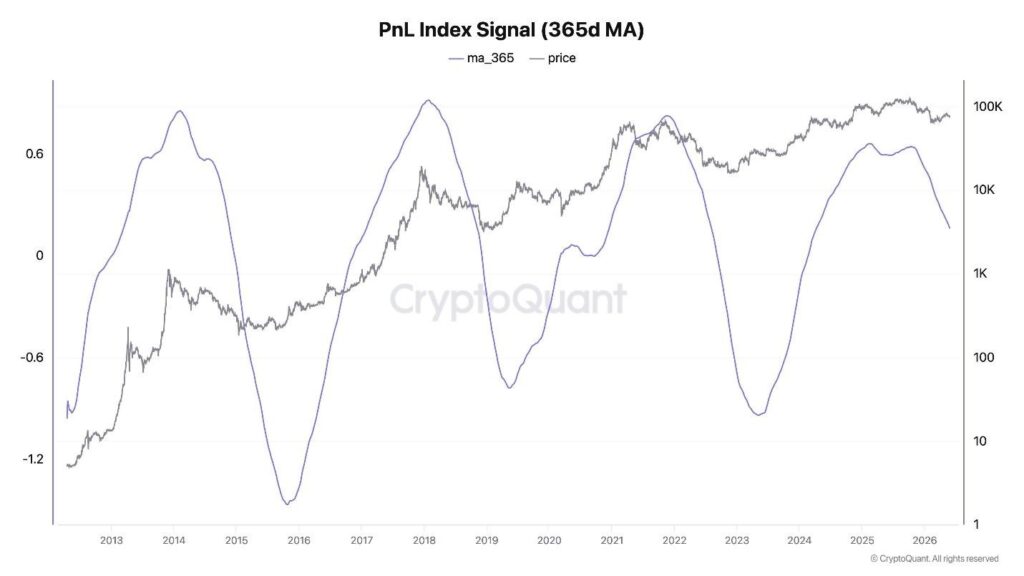
He added that a true trend reversal would require a return of sustained unrealized profits and renewed accumulation, conditions that have yet to materialize.

 
Notably, CryptoQuant data also shows that whale activity, or wallets holding between 1,000 and 10,000 BTC, has been declining at one of the fastest rates this year. The pattern mirrors previous bear market phases, particularly 2022, when large holders shifted from accumulation to distribution as market momentum faded.
Moreover, smaller institutional-like holders, often referred to as “dolphins” (100–1,000 BTC), have also seen a sharp slowdown in growth. After peaking at approximately +970,000 BTC in October 2025, their accumulation trend has now fallen significantly below historical averages. Analysts argue this group has been a key driver of demand in the current cycle, and its weakening participation raises concerns about sustainability.
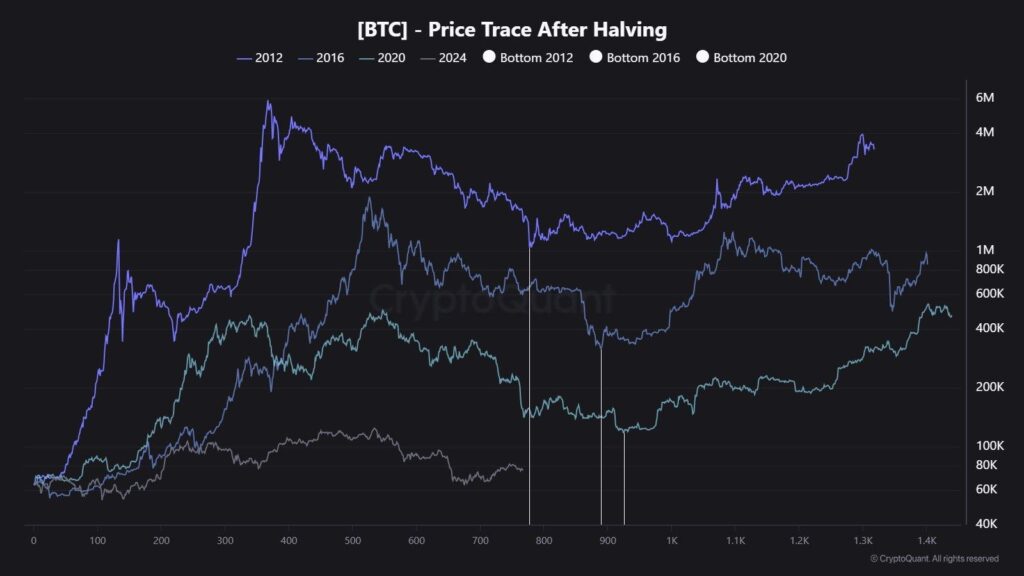
Maartum, an analyst at the same firm, added a more nuanced view of cycle timing, noting that, “Today +11 days marks the point in the 2012 cycle where we bottomed… However, based on more recent cycles, the bottom could still be ~119 days away.”
Meanwhile, additional data from Glassnode shows declining spot market activity and reduced inflows into exchange-traded Bitcoin products, reinforcing the narrative of cooling demand.
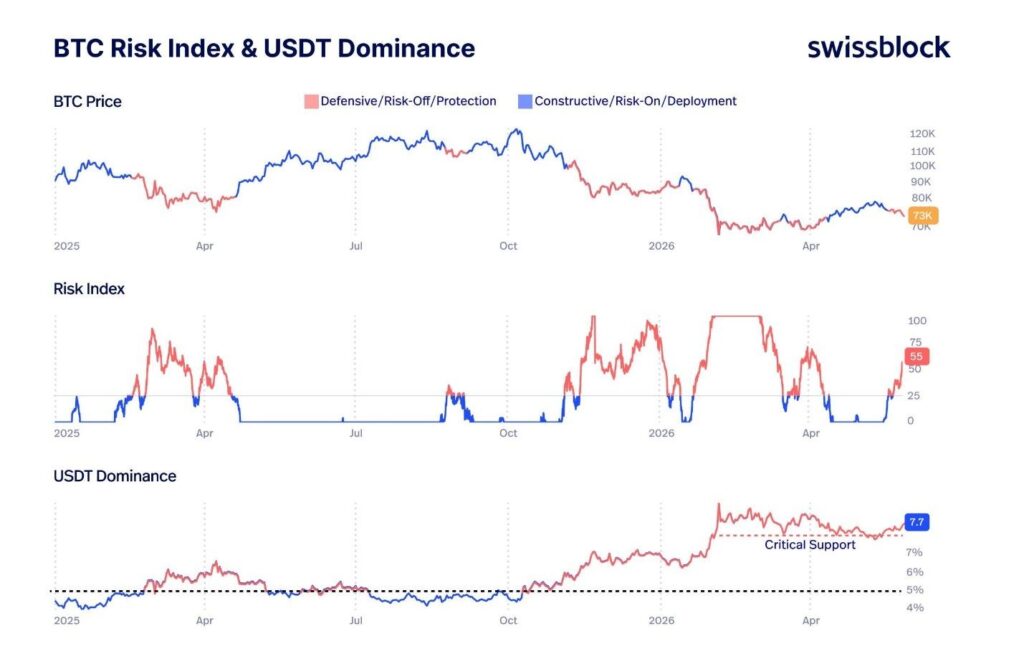
SwissBlock analysts also highlighted a broader shift toward risk aversion in market structure, noting that capital is rotating away from speculative exposure.
“Bitcoin chose to retreat back into Risk-Off mode. This is the defensive transition we warned about,” they wrote. “Observe the sequence: Risk expands → BTC loses structural strength → USDT dominance rebounds… the market prioritizes survival over upside.”
That said, taken together, these signals suggest that Bitcoin’s current environment remains fragile. With whale participation slowing, demand weakening, and macro uncertainty still elevated, analysts at CryptoQuant argue that the market may still be in the early to mid-stages of a broader bear cycle that could extend well into 2026 or even early 2027.
At press time, BTC was trading at $73,848 after a 0.22% drop over the past 24 hours.