
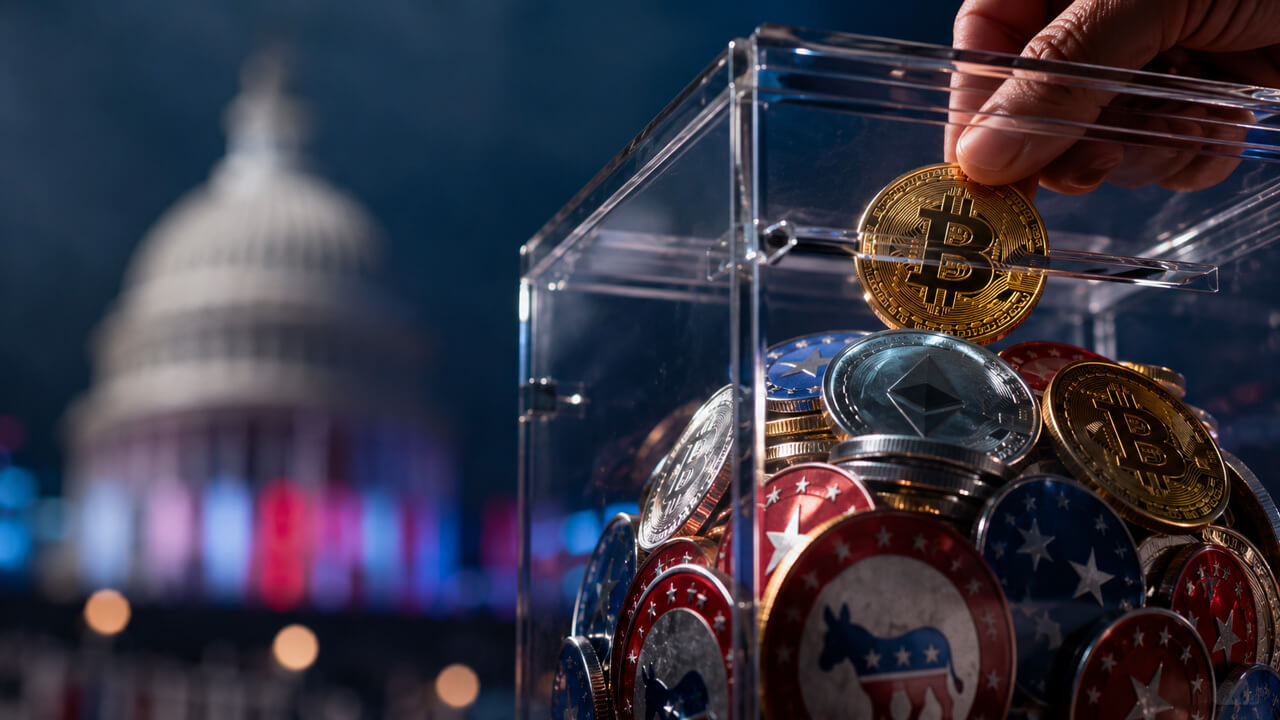
Less than four years after the collapse of FTX triggered calls for a sweeping crackdown, the crypto industry has emerged as one of the fastest-growing forces in American politics, spending millions across both parties, reshaping key elections, and transforming itself from a regulatory target into a powerful new political machine.
In 2022, Washington’s dominant question about the crypto industry had little to do with the fine print of securities law. After the collapse of FTX triggered a wave of congressional fury and handed Gary Gensler’s SEC a permission slip to pursue enforcement actions at scale, lawmakers on both sides of the political aisle were openly debating whether the sector deserved regulated status at all.
Cautious congressional allies began distancing themselves, and the media cycle was doing the industry no favors. For a little while, it looked like the whole market was headed for supervised wind-down.
But by the end of the 2024 election cycle, Bitcoin’s political environment had been almost entirely remade. Crypto companies collectively spent around $139 million shaping that year’s elections through a network of super PACs, and they’ve since assembled a war chest exceeding $220 million for the 2026 midterms.
The sector’s transformation from a regulatory punching bag to a lobbying operation capable of rivaling oil companies and banks in raw political spend shows what an industry does when it concludes (correctly) that its long-term survival depends on controlling the conditions under which it gets regulated.
How the crypto industry decided to fight back
Between FTX’s collapse and the 2024 elections, the defining pressure on the industry came from the SEC’s aggressive position on digital assets. The agency issued 46 crypto-related enforcement actions in 2023 alone, pursued landmark cases against Coinbase, Binance, and Ripple, and treated most digital assets as unregistered securities subject to the same oversight as stocks and bonds.
For companies like Coinbase, which found itself simultaneously suing the SEC and being sued in return, the agency’s intent was clear: it planned to define the industry’s regulatory future on its own terms, leaving little room for any input from the industry. The more enforcement pressure accumulated, the more clearly the industry saw that regulatory outcomes are fundamentally political, and that winning them requires political tools.
Andreessen Horowitz’s early decision to build an aggressive lobbying operation designed specifically to exclude crypto from SEC jurisdiction served as a template for how the industry could fight back at the structural level. The realization spread through 2023: the companies that’d survive the next decade would be the ones that saw Washington as a competitive arena, and that winning there required the same disciplined capital deployment as winning in markets.
Fairshake, the super PAC backed by Coinbase, Andreessen Horowitz, Ripple, and a consortium of other crypto companies, came up with concrete solutions. Fairshake itself operated across party lines, while two affiliates (Defend American Jobs for Republicans, Protect Progress for Democrats) routed money to each party’s candidates in parallel.
It was a strategic calculation built on the understanding that an industry capable of influencing either party’s electoral outcomes would reach a far more durable position than one committed to a single political faction.
Results from 2024 showed that kind of approach was successful. Fairshake and its affiliates spent roughly $139 million across 58 House and Senate races. About 85% of the candidates the network supported won their elections, including all six in New York, where the PAC spent $5.3 million exclusively backing Democrats.
One in ten members of the incoming Congress had received meaningful support from crypto industry ad spending, and the majority of those ads never mentioned crypto at all, targeting incumbents on unrelated character grounds instead. What political power actually buys
It took almost no time to see meaningful policy changes. The SEC reversed course on a sweeping scale: it dismissed its civil action against Coinbase in early 2025, dropped its lawsuit against Binance shortly after, and closed its investigation into Robinhood’s crypto business with no charges filed. Ripple, having spent years and tens of millions in legal fees fighting XRP’s securities classification, settled for $50 million and had its remaining $75 million in escrow returned.
New agency leadership under Paul Atkins formally disowned the previous enforcement-first position, and the GENIUS Act was signed into law in July 2025, delivering the first federal stablecoin framework the industry had been lobbying for across multiple congressional sessions. By November, the SEC had removed any mention of crypto from its 2026 examination priorities entirely.
In May, Fairshake’s affiliate Protect Progress spent $5 million supporting Democratic challenger Christian Menefee in Texas’ 18th Congressional District runoff, and another $2.8 million opposing incumbent Representative Al Green, who voted against both the GENIUS Act and the Clarity Act.
Green cast the wrong votes, the PAC identified the seat as removable, and moved nearly $8 million into the district to make the point. Across all Texas races today, crypto-backed PACs deployed money into multiple congressional and Senate contests, backing both Republican and Democratic candidates.
Separately, the Tether-backed Fellowship PAC, led by former White House crypto adviser Bo Hines, reported spending $1.75 million backing Texas Attorney General Ken Paxton in his Senate runoff against incumbent John Cornyn. Paxton won in what the Texas Tribune called a watershed moment that ended over three decades of Cornyn’s electoral dominance. The industry backed the winning side, across party lines, in one of the most-watched primary elections in the country.
However, there has been quite a bit of controversy surrounding the newfound success of crypto lobbying groups. Lawmakers, including Representatives Maxine Waters and Brad Sherman, documented at least 12 cryptocurrency cases the SEC dismissed or closed since early 2024, pointing to what they described as a “troubling correlation” between those closures and the industry’s political spending patterns.
Former SEC enforcement attorneys noted publicly that the scale of case dismissals was unusual given the reportedly strong evidence the agency had assembled in several of those actions.
The industry’s counter-argument (that the crackdown was overreaching and politically motivated from the start) carries genuine weight, but the question of who’s now writing the rules and for whose benefit is a legitimate one that the sector’s advocates haven’t fully put to rest.
The most morally and politically honest answer is that crypto’s regulatory environment shifted because crypto’s political leverage shifted first, and Texas elections showed how that leverage is now being applied. Crypto PAC spending in Texas has already exceeded $2.5 million on congressional candidates alone this year, up from $1 million across the entire 2024 cycle, and that’s before the general election spending begins later this year.
That puts the industry on a path that resembles the early chapters of Big Tech’s lobbying ascent or Wall Street’s post-crisis political infrastructure build, with a slight distinction: it’s moving faster than either of those precedents did.
The industry that once sold itself as an alternative to legacy financial power is now running the same playbook that legacy power has always relied on: grading legislators on specific votes, deploying capital to punish defection, and building the kind of durable congressional relationships that outlast any single administration.