

CME Group’s cryptocurrency futures and options have been trading continuously since 4:00 p.m. CT on May 29, making this the first full trading week without the classic weekend CME gap.
Over the inaugural 48 hours, over 7,200 contracts changed hands, representing roughly $50 million in notional value, enough to confirm that institutional demand for weekend hedging is real.
However, the launch coincided with the S&P 500, Dow, and Nasdaq all closing at record highs on June 1, while Brent crude settled at $94.98, up 4.2% with renewed US-Iran tensions, and Bitcoin nearly lost the $70,000 floor.

From chart gap to liquidity gap
Before May 29, Bitcoin spot markets traded continuously while CME futures closed every Friday afternoon and reopened Sunday evening.
When spot moved sharply over the weekend, the CME futures chart reopened with a visible gap between Friday’s closing price and Sunday’s opening tick. Traders treated those gaps as magnets, since price tended to return and fill them, often within weeks.
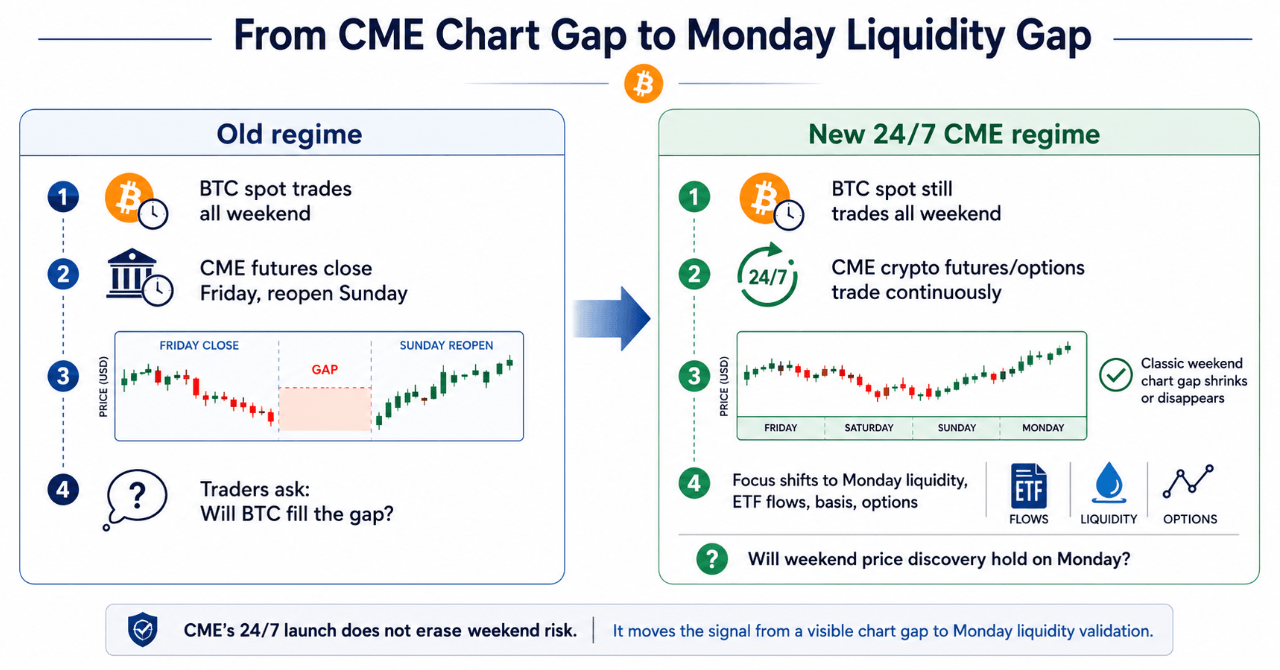
CME’s continuous trading closes the chart gap and opens a different one, as US ETF markets follow equity-market hours, some institutional desks run lighter over weekends, and Monday morning still represents the return of full cash-market participation. The new question is whether weekend price discovery holds when Monday liquidity arrives.
CME crypto derivatives averaged 407,200 contracts per day year-to-date in 2026, up 46% year-over-year, against a backdrop of $3 trillion in notional volume across all crypto products in 2025.
That volume base confirms institutions already use CME as a hedging venue, and the 24/7 extension removes the window during which that hedging was unavailable, without fundamentally changing where price is made.
Bitcoin as the weak link
The sharper framing for this week is that Bitcoin is underperforming a record-high equity session, and the narrowness of that equity rally makes the underperformance harder to dismiss.
Index records driven by Nvidia’s 6.2% session gain, while a slight majority of stocks fell, and the Russell 2000 dropped 0.5% point to a rotation into large-cap tech.
Bitcoin has historically tracked broad risk sentiment, which puts it on the wrong side of a tape that appears bullish on the surface but defensive underneath.
US spot Bitcoin ETFs shed roughly $3 billion across the ten trading sessions from May 15 through May 29, per Farside Investors data, including $733.4 million on May 27 alone and $527.8 million out of BlackRock’s IBIT that same session.
ETF flows are now the most direct institutional demand signal Bitcoin has, and that signal is running against the market-structure improvement CME just delivered, as continuous regulated futures access amplifies price discovery when institutional allocators are adding exposure.
| Market signal | Latest move | Read-through for BTC |
|---|---|---|
| S&P 500 / Dow / Nasdaq | Record closes | Headline risk-on tape |
| Nvidia | +6.2% | Rally concentrated in mega-cap tech |
| Russell 2000 | -0.5% | Weak breadth / defensive underneath |
| Slight majority of U.S. stocks | Fell | Index strength not broad |
| Brent crude | $94.98, +4.2% | Inflation/rate pressure still alive |
| Bitcoin | Nearly lost $70K | Failing to follow equities higher |
| Spot BTC ETFs | Roughly $3B outflows over 10 sessions | Institutional demand signal is negative |
Monday liquidity validates the weekend
If Monday’s return of full ETF and cash-market participation pulls Bitcoin back toward the equity performance, CME’s new structure contributes directly.
Institutions that hedged weekend crypto exposure in regulated futures through Saturday and Sunday arrive at Monday’s open with positions already adjusted, reducing the disorderly repricing that the old Sunday-evening reopen sometimes produced.
VanEck identified the $80,000-$85,000 zone as key resistance for a shift in momentum, and the three legacy CME gaps in the $70,000-$80,000 range stay unresolved targets that predate the new regime.
Bitcoin’s 30-day annualized perpetual basis had slipped to -0.45% as of mid-May, down from 3.16% a year earlier, a spot-led structure with minimal leverage overlay.
Recoveries from that configuration tend to be durable, spot-driven moves, and the bull case rests on ETF flows reversing and broad equity risk appetite widening beyond mega-cap tech, giving Bitcoin a tape to track.
Macro becomes the magnet
Oil-driven inflation fear is the cleaner short-term magnet when the chart no longer carries a gap to fill.
Brent at $94.98 keeps rate-hike expectations alive, and CME FedWatch showed traders pricing roughly a 56% chance of at least one US rate hike by year-end, and Treasury yields briefly touched 4.52% before easing to 4.46%.
If oil holds near $95-$100 and the ETF outflow streak extends into a second week, Bitcoin trades as a high-beta risk asset in a tightening environment, which is precisely what it has done for the past two weeks of that streak.
The just-below-$70,000 legacy CME gap sits directly within the current price range, and a clean break below it would remove the last nearby technical reference point. Citi’s recessionary Bitcoin scenario targets $58,000, relevant if the dollar strengthens on persistent rate-hike expectations.
| Scenario | Trigger | New market signal to watch | BTC implication |
|---|---|---|---|
| Bullish catch-up | Oil cools, equities remain strong, ETF flows reverse | Monday liquidity confirms weekend prices | BTC reclaims $80K–$85K resistance |
| Neutral digestion | Oil stays high but stable, ETF flows mixed | Basis and options skew stabilize | BTC chops around $70K–$80K legacy gap zone |
| Bearish breakdown | Oil holds $95–$100, rate fears persist, ETF outflows continue | Monday liquidity sells weekend strength | BTC loses the sub-$70K legacy gap area |
| Stress case | Dollar/yields rise and defensive hedging accelerates | CME 24/7 used for downside exposure | Citi-style $58K recessionary target enters view |
CME’s 24/7 launch gives institutions a better hedging tool, and when the macro environment pushes toward defensive positioning, that tool gets used to build downside exposure.
More efficient access to CME at 2:00 a.m. Saturday is an improvement in market plumbing with no bearing on price direction when yield expectations are rising.
The classic CME gap trade gave Bitcoin a visible, chart-based signal that drew institutional attention back to specific price levels regardless of macro conditions.
ETF flow direction, Monday liquidity depth, futures basis behavior, and options skew now carry that weight.
This week’s price action will show whether the new regime produces cleaner price discovery or removes one of the few signals that pulled BTC back from macro-driven dislocations.