

For traditional US banks, the CLARITY Act was intended as a firewall that effectively barred crypto companies from offering “passive” interest on stablecoins.
The legislation aimed to prevent a catastrophic deposit flight in which everyday checking account balances drain from the banking system into high-yield crypto exchanges.
But as lawmakers prepare to finalize the framework, Coinbase appears to be quietly structuring a loophole that relies on complex financial engineering to keep the lucrative yield flowing.
The key lies in a critical semantic distinction within Section 404 of the proposed legislation. While the CLARITY Act explicitly outlaws savings-account-style interest on stablecoins, it preserves “activity-based” rewards.
Enter Ethena, a synthetic dollar protocol that generates returns through an active, delta-neutral basis trade that involves shorting crypto perpetual futures while holding the spot asset.
By integrating with Ethena, Coinbase could theoretically route idle USDC into this strategy.
If successful, the exchange could pass along the profits of an active trading strategy and potentially offer massive yields on digital dollars right under regulators’ noses while deeply frustrating a traditional banking sector stuck offering negligible rates.
The legislative wall called CLARITY Act
The CLARITY Act, a sweeping US market-structure bill designed to define how crypto assets and intermediaries operate under federal regulations, has been a legislative battleground.
At the center of the dispute that dragged out the Senate Banking Committee’s process is the question of stablecoin rewards.
The latest compromise is primarily captured in Section 404, which was born from the Tillis-Alsobrooks amendment. The provision draws a hard regulatory line that the industry negotiated for months.
On one side is passive yield: simply holding a stablecoin balance and receiving periodic interest, which is structurally identical to a bank savings account. This is explicitly banned.
On the other side are activity-based rewards: incentives tied to actual customer activity, such as payments, transactions, platform usage, and trading. These are permitted.
The bank lobby pushed hard for these restrictions. Banking executives contend that firms offering bank-like products should face comparable oversight, reserve, and capital obligations.
If crypto platforms could freely pay savings-account rates on stablecoin balances without FDIC insurance requirements, they could easily siphon depositor capital at the expense of the regulated banking system.
JPMorgan Chase CEO Jamie Dimon recently voiced this exact frustration. In a recent interview, Dimon criticized Coinbase CEO Brian Armstrong and warned that the CLARITY Act could fail if traditional banking concerns aren’t addressed.
Asked if he was satisfied with the current draft of the bill, Dimon was blunt, saying:
“No, because it allows them to effectively pay interest on deposits, stablecoins or something like that, without protection that they should have. The banks will not accept it that way…”
For the legislation to become law, representatives from the Senate Banking and Agriculture committees must merge their advanced bills before it clears the full Senate, the House, and lands on President Donald Trump’s desk. But while Washington debates, the crypto industry is already building around the new rules.
Coinbase’s Ethena workaround
Coinbase relies heavily on stablecoins. In Q1 2026, the exchange reported $305.4 million in stablecoin revenue, making up roughly 52% of its subscription and services revenue.
The firm also stated that it held an average of about $19 billion in USDC across its products, accounting for more than 25% of the total USDC in circulation.
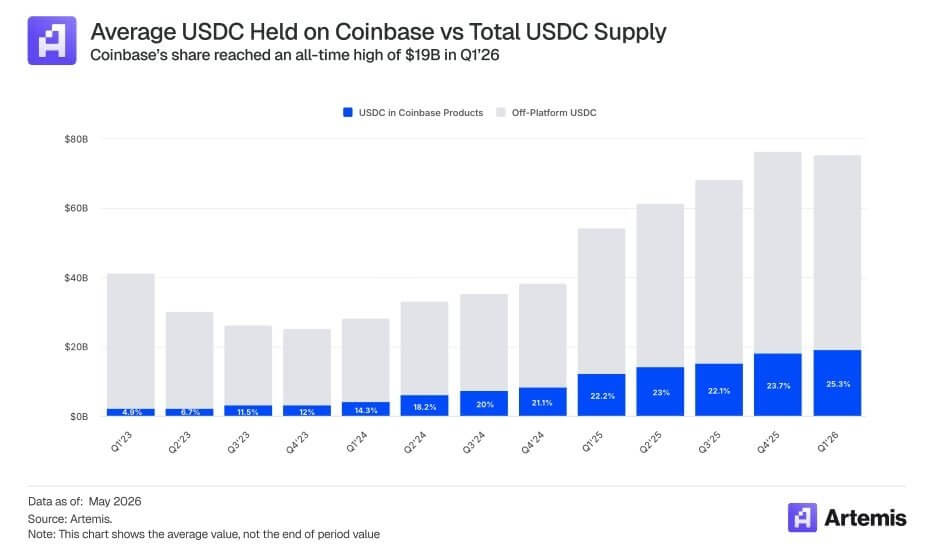
To protect this vital revenue engine under Section 404, Coinbase needed a product in which yield is tied to explicit activity rather than passive holding. Its new partnership with Ethena perfectly threads this needle.
Ethena stated:
“Ethena and Coinbase have partnered to grow on-chain finance and savings products for their 100 m+ user base, with the first growth initiative launching next week.”
Alongside the integration, Coinbase Ventures made its first investment into Ethena on the open market.
Coinbase also confirmed its expanded role, noting it will support security and operations across more than $5 billion in Ethena assets. Coinbase now serves as Ethena’s primary custodian, wallet provider, and perpetuals venue.
Because Ethena generates yield through complex trading activities, Coinbase can route yield-seeking USDC users into real borrow demand and active market strategies.
Guy Young, Ethena’s Founder, explicitly acknowledged the regulatory tailwinds, saying:
“Excited to partner with Coinbase for the first time to support their dollar savings products…Given the evolving nature of the Clarity Act, we expect further potential tailwinds for onchain native products like USDe from idle balances on exchanges, and Ethena is well positioned to support this transition.”
Yan Liberman, a managing partner at Delphi Ventures, highlighted exactly how lucrative this structural shift could be for both sides. He stated:
“Reading between the lines for the upcoming product launch referenced. Coinbase x Ethena is bullish because it can turn Coinbase’s ~$19B USDC base, with an implied ~$13B of reward-earning balances, into a funding rail for Ethena. If sUSDe yields clear baseline USDC rates, Coinbase can offer better USDC lending yields, loopers can lever the spread, and Ethena gets deeper/cheaper funding than native DeFi alone. Aave mechanics, Coinbase distribution.”
Liberman added that the CLARITY Act makes this pivot highly valuable. If lawmakers restrict passive USDC rewards, Ethena gives Coinbase a way to route users into real borrow demand rather than simply paying them for holding USDC.
He added:
“Coinbase needs products where yield is tied to explicit activity: lending, collateral, liquidity, or platform usage. Ethena gives them a way to route yield-seeking USDC users into real borrow demand, rather than just paying rewards for holding USDC.”

The new “Coinbase problem” for banks
While banks might feel protected by Section 404’s ban on passive interest, the Ethena loophole presents a new and immediate threat.
Stablecoins have outgrown their origins as a niche settlement layer. The total stablecoin market sits at roughly $320 billion, with USDC at about $76 billion and Ethena’s USDe around $4.5 billion.
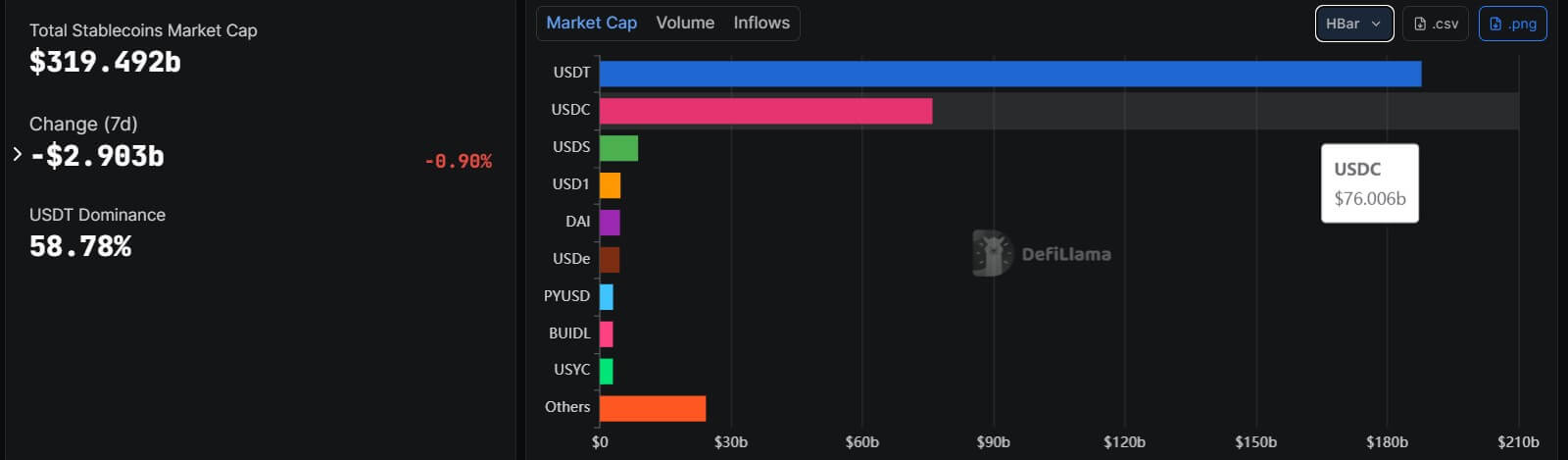
Because Circle backs USDC with highly liquid cash and cash-equivalent assets with monthly attestations, Coinbase’s strategy uses USDC as the trusted settlement asset, while Ethena supplies the yield-bearing synthetic-dollar layer.
Admittedly, an immediate systemic bank run is unlikely. US commercial bank deposits stood at roughly $19.3 trillion in late May 2026, and money-market fund assets sat at $7.78 trillion. Even if Coinbase converted its entire $19 billion USDC balance, it would be a drop in the bucket compared to the broader banking system.
However, the real danger to banks is marginal pricing pressure.
If mobile, yield-sensitive retail customers and institutional treasuries realize they can seamlessly access ~3.8% APY through an activity-based Ethena strategy inside a Coinbase app, they will inevitably move their idle cash.
To stem the outflow, traditional banks may be forced to raise their own historically low deposit rates, which directly eats into their net interest margins. Notably, US savings accounts yield just 0.38%, and interest checking accounts scrape the bottom at 0.07%.
Moreover, Tom Wan, head of research at Entropy Advisors, pointed out that the Coinbase and Ethena integration could be the beginning of an institutional synergy that bypasses traditional banking entirely.
Wan notes Ethena can leverage institutional lending via Coinbase Asset Management, utilize Coinbase Custody, and use USDC as a liquid stablecoin backing. In the future, Coinbase could become a primary basis trade venue and allocate backing assets to lending protocols like Aave on Base to grow USDe as a dominant savings product.