
Key Takeaways
- A whale just bet $111.5M that the S&P 500 will drop, using 50x leverage for an extremely high-risk move.
- The position is extremely fragile, as even small market swings could put the entire trade at risk almost instantly.
- Position size and structure suggest aggressive risk-taking rather than a traditional institutional hedge.
A whale just put $111.5 million on the line, betting the S&P 500 falls, and they’re doing it with 50x leverage. Reports across trading communities detail a single short position at extreme leverage, with a liquidation price around $8,295.
At that size, there is almost no margin for error. One bad session wipes the trade entirely. The position has captured attention for a reason. This isn’t a hedge. It’s a declaration that the market is headed lower, and whoever placed it is willing to lose everything if they’re wrong.
What Happened
Source – Hypurrscan On-Chain Position Dashboard
A large trader has taken a heavily leveraged short position against the S&P 500. The reported details:
- Position size: $111.5 million
- Direction: Short (betting on a price decline)
- Leverage: 50x cross leverage
- Liquidation level: ~$8,295
At 50x leverage, the math is brutal. A move of just 2% against the position is enough to trigger liquidation, meaning the trader is essentially betting that the S&P 500 not only falls, but falls soon.
The liquidation price of $8,295 also sits well below current levels, which tells you how aggressively this position is structured. There is no built-in cushion, no room to wait out short-term volatility.
Why This Trade Stands Out
Shorting the S&P 500 at 50x leverage is not something you see every day. The index tracks the 500 largest U.S. companies, making it one of the most stable and widely followed markets in the world. Betting against it at this size and leverage is bold by any measure.
A position like this typically points to one of three things:
- A strong conviction that a near-term market correction is coming.
- A speculative hedge against larger existing portfolio exposure.
- A high-risk directional bet on an imminent macro shock or volatility spike.
What makes it notable is not just the size, but the structure. Most institutional players managing risk at this scale would use far lower leverage and wider stop levels. Whoever placed this trade is not managing risk in the traditional sense.
They are taking a concentrated, time-sensitive stance on where the market goes next, and accepting the possibility of total loss if they are wrong.
Understanding the Liquidation Risk
The liquidation price of $8,295 is arguably the most important number in this trade. In leveraged trading, liquidation happens automatically when losses eat through the trader’s margin. At 50x, that threshold is very thin.
In practice, this means:
- A small upward move in the S&P 500 could put the position under immediate pressure.
- Normal day-to-day market swings alone can be enough to trigger forced closure.
- Cross leverage means losses are not isolated to this trade. They can pull from the trader’s broader account balance, making the overall risk even larger.
The trader has very little room for error, and even less time. Most professional traders would never concentrate this much risk into a single position.
The tight liquidation level says it all: the market needs to drop, and it needs to drop soon. If it does not, the position is automatically wiped, with no chance to recover.
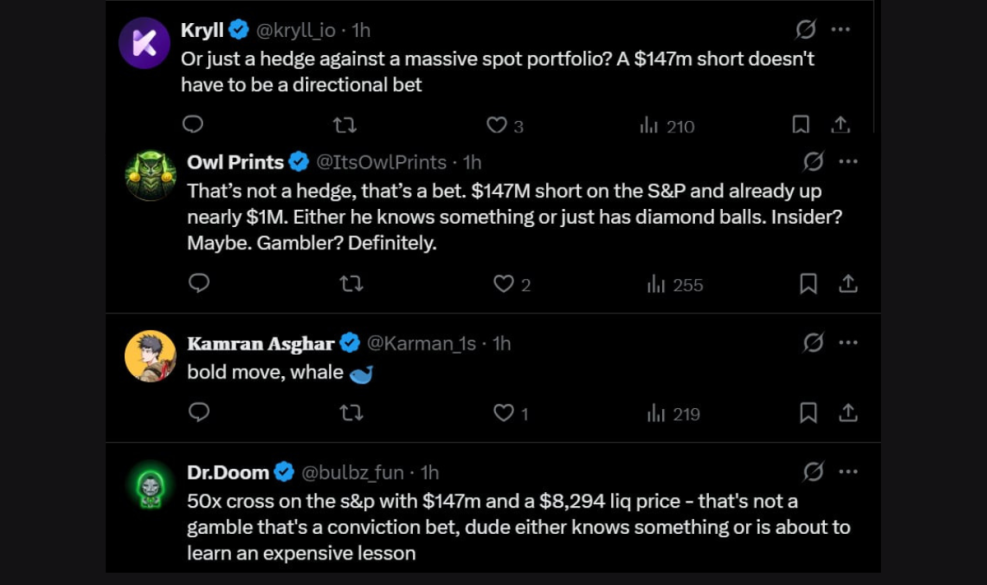
The reported position has sparked a strong reaction across trading forums and social media. Most of the conversation is centered on the sheer aggression of the trade, with many traders calling it exactly what it looks like: a straight-up bet.
The extreme leverage, the massive size, and the razor-thin liquidation margin have left little room for alternative interpretations. Most agree that whoever placed this is not hedging. They are gambling on a market drop.
Others are raising a different angle. Whale positions of this size sometimes serve a purpose beyond the trade itself, drawing attention, shifting sentiment, and influencing how other traders position. Whether this is a genuine conviction call or a move designed to shake market psychology, the fact that it is being widely discussed suggests it is already having an effect.
Final Thoughts
A $111.5 million short on the S&P 500 at 50x leverage is not a trade you place unless you are absolutely certain, or willing to lose it all. The structure leaves no room for doubt, hesitation, or bad timing. Markets move fast, and at this leverage, so does liquidation. Whether this turns out to be a well-timed macro call or an expensive lesson in overleveraging, the trade has already done one thing successfully: everyone is talking about it.
Frequently Asked Questions
What does a $111.5M 50x leveraged short on the S&P 500 mean?
It means a trader is using borrowed funds to bet that the S&P 500 will fall. With 50x leverage, even small price moves become much bigger, making the trade very high risk.
Why is this trade so risky?
At 50x leverage, there is almost no safety space. Even a small rise in the S&P 500 could quickly cause liquidation and a full loss of the position.
What is the liquidation price and why does it matter?
The reported liquidation level is around $8,295. If the market moves up to that level, the position is automatically closed to stop further losses.
Where can I learn more about leveraged trading?
You can visit our Trading Guide Section, where we explain leverage, liquidation, and trading risks in simple terms. It helps you understand how high-risk trades like this work.
What should beginners learn from this?
Leverage can increase both profits and losses very quickly. While it looks powerful, it can also lead to quick liquidation if the market moves the wrong way.