

Bitcoin has pushed above the $97,000 level, extending a recovery that has brought short-term relief to a market weighed down by weeks of uncertainty. While the move has reignited optimism among some investors, a large share of analysts remains cautious, arguing that the rally could still be a counter-trend bounce within a broader bearish setup for 2026.
Price strength alone, however, does not fully explain the current move. According to a CryptoQuant analyst, Bitcoin has shown notable resilience after decisively breaking the $94,200 resistance zone and accelerating toward the $97,500 area, with on-chain data offering important context behind the advance.
Related Reading
One of the key indicators supporting this move is Value Days Destroyed (VDD), a metric that sheds light on long-term holder behavior. VDD measures how long coins remained inactive before being spent, weighted by transaction size. In simple terms, it helps distinguish whether price movements are driven by experienced holders distributing old coins or by newer coins changing hands.
As of January 2026, VDD is hovering around 0.53, a historically low reading. This implies that the coins currently moving on the network are relatively young, while older holdings remain largely dormant. Such behavior suggests that long-term holders are not rushing to sell into strength, lending structural support to the recent breakout—even as the broader market debates whether this surge marks renewed strength or merely a temporary reprieve.
Long-Term Holders Reinforce Bitcoin’s Breakout Quality
The report by Carmelo Alemán, Verified On-Chain Analyst at CryptoQuant, highlights an important dynamic behind Bitcoin’s recent move above key resistance levels. Despite the sharp price appreciation, long-term holders remain largely inactive. In practical terms, this means that investors who have held Bitcoin through multiple cycles are not using the current strength as an opportunity to exit positions. Their restraint significantly improves the quality of the rally.
Historically, this behavior has mattered. When Bitcoin advances while Value Days Destroyed (VDD) stays low, it signals that older coins are not entering circulation. Demand is being met primarily by younger supply, allowing price to rise without triggering structural selling pressure from the most experienced market participants. These phases have often aligned with healthier expansion periods rather than short-lived speculative spikes.
The current breakout fits that historical pattern. Bitcoin’s move through resistance has not been accompanied by a surge in long-dormant coins being spent. Instead, long-term capital appears comfortable holding through higher prices, suggesting confidence in the broader market structure rather than urgency to lock in gains.
This supportive backdrop remains conditional. As long as VDD stays suppressed, the rally retains a strong foundation. However, a sustained increase in the indicator would change the narrative, signaling that long-term holders are beginning to distribute and potentially marking a shift toward heavier selling pressure.
Related Reading
Bitcoin price is trying to stabilize after a sharp rebound from the December lows, with the chart showing BTC reclaiming the $96,000–$97,000 zone. This level coincides with a confluence of technical factors, making it a critical area for short-term direction. The recent recovery followed a strong sell-off from the November highs. Where the price broke below the 50-day and 100-day moving averages and briefly capitulated toward the low $80,000s.
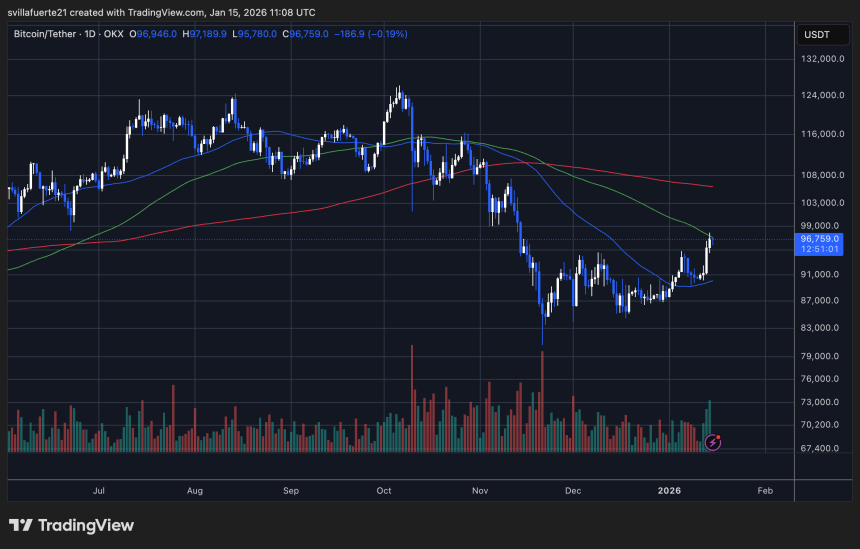
From a structure perspective, BTC is now printing higher lows on the daily timeframe, signaling a potential short-term trend reversal. Price has also reclaimed the 50-day moving average, which often acts as dynamic resistance during downtrends. Holding above this level would be constructive, as it suggests buyers are regaining control after weeks of distribution and volatility.
Related Reading
However, overhead resistance remains significant. The 100-day and 200-day moving averages, currently clustered between $100,000 and $108,000, represent a heavy supply zone where previous breakdowns occurred. A failure to push higher could lead to renewed consolidation or a pullback toward the $92,000–$94,000 support range.
Volume has increased during the rebound, showing genuine participation rather than a low-liquidity bounce. Still, the broader trend remains unclear. For bullish momentum, Bitcoin needs acceptance above $97,000 and a clear attempt toward the $100,000 psychological level. Otherwise, the move risks being a technical rebound within a larger corrective phase.
Featured image from ChatGPT, chart from TradingView.com