
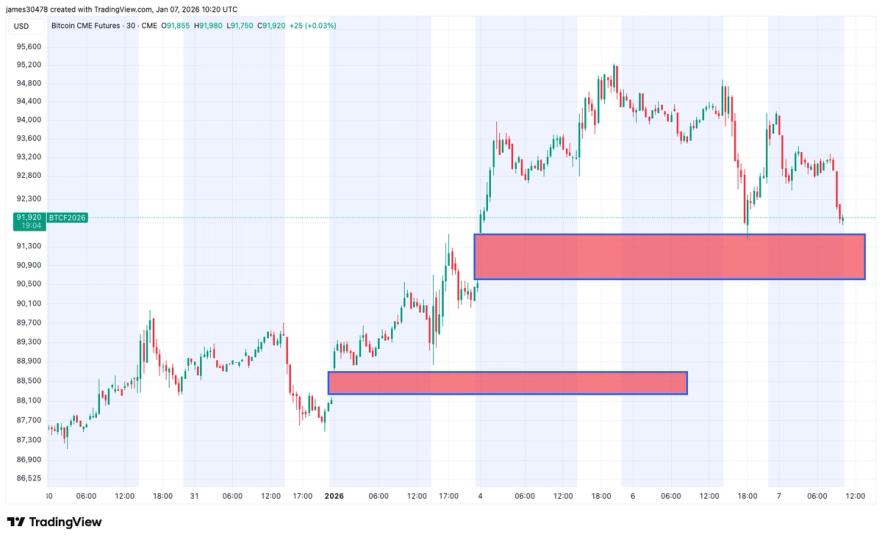
Bitcoin’s drop to just above $91,000 may be encountering technical gravity as an unfilled CME gap remains just below current prices.
The gap was created over the weekend after CME bitcoin futures closed on Friday near $90,600 and reopened on Sunday evening around $91,600.
CME bitcoin futures are cash-settled contracts designed to track the price of the largest cryptocurrency. Unlike spot markets, they do not trade 24/7. Instead, they close for an hour each day and over the weekend, meaning price gaps can form if bitcoin moves markedly at those times.
These gaps are closely watched by traders, because bitcoin has historically shown a tendency to retrace and trade back through them, a process commonly referred to as filling the gap.
While not a guaranteed behavior, gap fills have occurred frequently enough to become an established market narrative. In many cases, the retracement happens within days — often within the first week — after the gap forms, although some gaps can remain open for longer.
This behavior is comparable to the max pain theory in options markets, where widely observed technical reference points can influence price action. As with max pain, the CME gap dynamic can become self reinforcing, as traders position for a move toward the gap simply because it exists.
A similar gap dynamic is also emerging in BlackRock’s iShares Bitcoin Trust (IBIT) exchange-traded fund, which closed Tuesday at $52.45. Gaps are open around the $48 and $50 levels, highlighting how ETF trading behavior may increasingly mirror futures based technical patterns. As IBIT becomes more embedded within the bitcoin market structure and begins to rival CME futures in influence, these gaps could become another technical reference point for traders.
As of press time, CME bitcoin futures are trading around $91,900. From this level, the price would need to fall roughly 1.6% to fill the weekend gap near $90,600, and a further 4% decline would be required to fill the New Year’s Day gap around $88,000.