
In brief
- Actor Matthew McConaughey has secured eight trademarks from the U.S. Patent and Trademark Office, including a sound mark on his iconic “Alright, alright, alright” line from “Dazed and Confused.”
- The trademarks, registered to his J.K. Livin Brands Inc., give McConaughey standing to sue in federal courts against unauthorized AI use of his voice and likeness.
- McConaughey’s trademark strategy comes as the entertainment industry grapples with AI’s legal implications across multiple fronts.
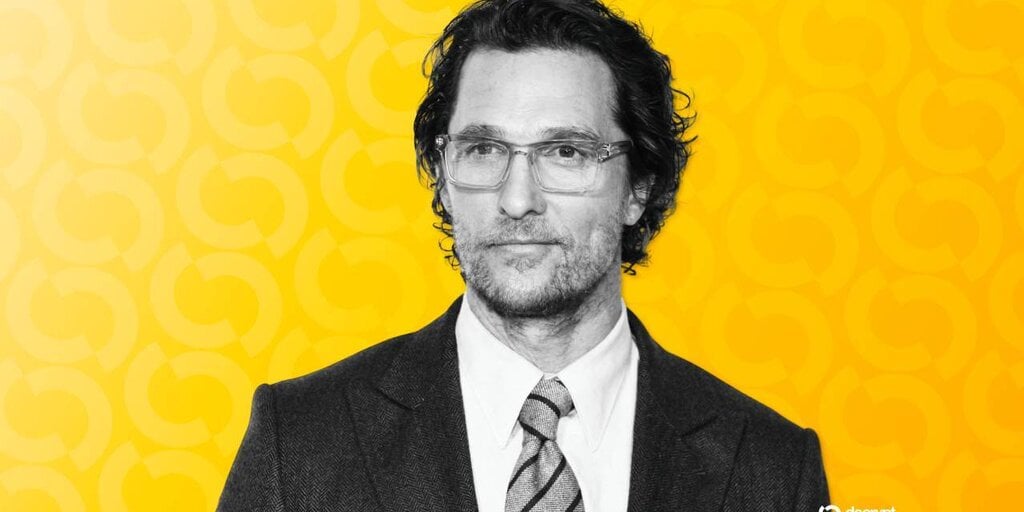
Actor Matthew McConaughey has locked down legal protection on his most famous catchphrase, securing eight trademarks including a sound mark on his iconic “Alright, alright, alright” line from the 1993 comedy “Dazed and Confused,” even as Hollywood continues to wrestle with how far artificial intelligence should be allowed to go.
The Academy Award-winning actor’s legal team at Yorn Levine obtained the trademarks from the U.S. Patent and Trademark Office over recent months, culminating in the approval for the sound mark that captures McConaughey’s distinctive three-word delivery.
The trademark registration specifies the exact pitch variations: “wherein the first syllable of the first two words is at a lower pitch than the second syllable, and the first syllable of the last word is at a higher pitch than the second syllable.”
By securing federal trademarks, McConaughey gains standing to sue in federal courts and potentially deter unauthorized AI-generated content featuring his voice or likeness, even when it’s not explicitly commercial.
“In a world where we’re watching everybody scramble to figure out what to do about AI misuse, we have a tool now to stop someone in their tracks or take them to federal court,” Jonathan Pollack, of-counsel attorney at Yorn Levine, told Hollywood trade publication Variety.
The eight trademarks, registered to McConaughey’s J.K. Livin Brands Inc., parent company of his Just Keep Livin apparel business, also include video clips of the actor and audio of him saying “Just keep livin’, right?” followed by “I mean.”
“I don’t know what a court will say in the end. But we have to at least test this,” noted Kevin Yorn, partner at Yorn Levine, whose firm represents entertainment industry luminaries including Scarlett Johansson, Zoe Saldaña, South Park creators Trey Parker and Matt Stone, and others.
Broader industry reckoning
The trademark move is complicated by McConaughey’s own embrace of AI, on licensed terms.
Last November, he announced a partnership with AI voice company ElevenLabs, where he’s an investor, to create Spanish-language versions of his “Lyrics of Livin'” newsletter using AI voice replication.
Meanwhile, in November, Warner Music Group resolved its copyright infringement lawsuit against AI music generator Udio, announcing an agreement that will convert the platform into a licensed service launching in 2026.
The settlement ended litigation filed last June when Warner joined Sony Music Entertainment and UMG Recordings in accusing Udio and competitor Suno of mass copyright infringement for allegedly training AI models on copyrighted recordings without permission.
Such collaborations point to a growing divide in Hollywood, with some artists viewing AI as an existential threat, while others see it as a tool, so long as they control the terms.
McConaughey’s message appears to land somewhere in between. Unauthorized AI? Not alright. Licensed, consent-based use? That’s a different conversation.
Decrypt has reached out to J.K. Livin Brands Inc. for comment.
Daily Debrief Newsletter
Start every day with the top news stories right now, plus original features, a podcast, videos and more.