
Kalshi has taken a major step in restructuring how prediction markets operate by moving its event contracts onto the Solana blockchain.
The transition brings U.S.-regulated prediction markets directly into decentralized finance, positioning the platform to compete more closely with its on-chain rival, Polymarket, while targeting deeper liquidity and broader user access.
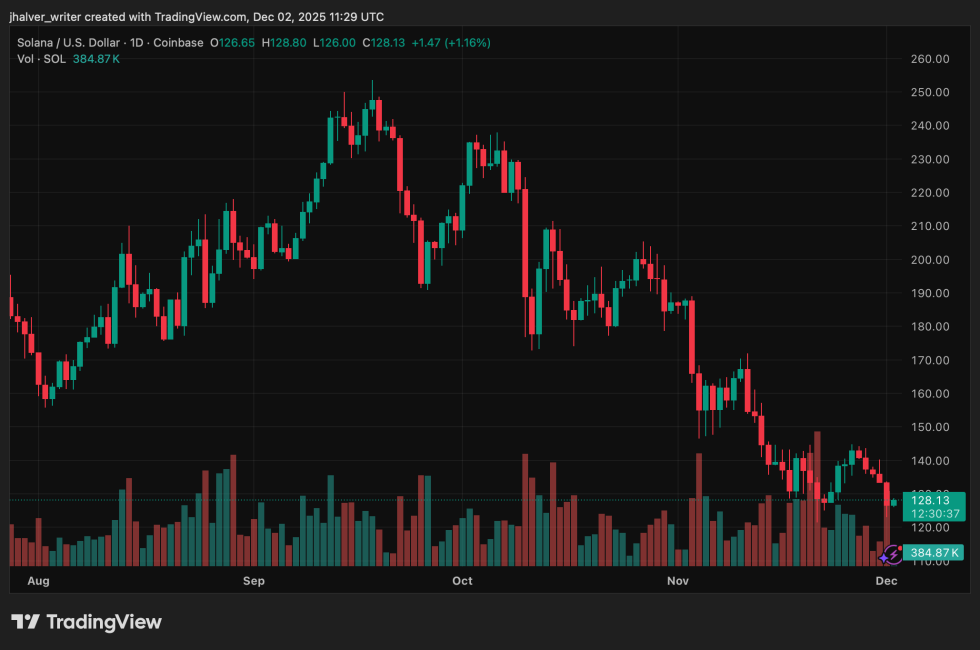
SOL's price trends to the downside on the daily chart. Source: SOLUSD on Tradingview
Prediction Contracts Move On-Chain
Kalshi’s event markets now operate as Solana-based SPL tokens rather than entries on a centralized exchange. Through an integration with Solana protocols DFlow and Jupiter, users can trade “yes” and “no” positions via crypto wallets, tap automated liquidity, and settle outcomes through on-chain logic.
The shift enables contracts to be traded, borrowed, lent, or used as collateral within DeFi systems. Kalshi is supporting developer participation with a $2 million grants program and a new Builder Codes system that rewards teams for driving trading volume through custom applications.
Executives describe tokenization as the platform’s long-term strategy, arguing that on-chain access offers speed, transparency, and programmability while preserving Kalshi’s CFTC-regulated framework. The hybrid model links decentralized liquidity with an off-chain matching engine.
Will the Move Capture Liquidity and Challenge Polymarket?
Prediction-market activity has surged in 2025, with sector-wide volume nearing $28 billion by late October. November saw Kalshi record $5.8 billion in trading, while Polymarket handled $3.7 billion following rulings that reopened U.S. access.
Liqudity has become the core competitive factor. By issuing markets as standard Solana tokens, Kalshi expects automated market makers, trading bots, and cross-protocol liquidity systems to tighten spreads and improve pricing accuracy.
Enhanced privacy is another draw, with tokenized markets offering wallet-based trading rather than identity-verified accounts. Industry analysts note that the move puts Kalshi in direct competition with Polymarket’s fully on-chain model.
Solana Expands Multi-Chain Prediction Economy
Kalshi believes Solana is the first step toward a broader on-chain architecture. The company plans to add EVM-compatible networks and deeper integrations with DeFi protocols to build a multi-chain forecasting ecosystem.
Additional partnerships, including earlier collaborations with Zero Hash and stablecoin custody support from Coinbase, reflect an effort to streamline global accessibility.
With its valuation recently rising to $11 billion after a major funding round, the company is signaling confidence that tokenized prediction markets will become a standard format for forecasting and derivatives tied to real-world events.
As prediction markets evolve toward decentralized models, Kalshi’s Solana rollout marks a turning point in how regulated platforms interact with crypto liquidity and sets the stage for intensified competition across the sector.
Cover image from ChatGPT, SOLUSD chart from Tradingview

Editorial Process for bitcoinist is centered on delivering thoroughly researched, accurate, and unbiased content. We uphold strict sourcing standards, and each page undergoes diligent review by our team of top technology experts and seasoned editors. This process ensures the integrity, relevance, and value of our content for our readers.