Crypto asset manager 21shares has identified three distinct phases behind bitcoin's recent market deterioration, citing weakening demand and forced selling rather than the Binance breach alone as primary drivers of losses.
In a research report published November 24, the firm's analysis suggests the cryptocurrency market remains vulnerable to prolonged defensive positioning. Bitcoin initially fell 5.1% in the two days following the Binance breach before recovering to $80,488 by November 4. However, heavier damage accelerated as capital drained from the market between November 4 and 11, when bitcoin declined 8.3% to $73,806.
Stablecoin Contraction and Institutional Outflows
Stablecoin supply contracted by $10.7 billion following the breach, marking the largest 18-day dollar-denominated reduction since Terra's 2022 collapse. Exchange-held stablecoin balances fell 15%, while U.S. spot bitcoin and ethereum exchange-traded funds collectively lost $3.9 billion between October 30 and November 13.
November bitcoin ETF withdrawals have reached record levels. U.S. spot bitcoin ETFs recorded $569.7 million in withdrawals Monday, with Blackrock's IBIT accounting for approximately $509 million. November's cumulative outflows reached a record $4.71 billion.
Liquidations Accelerate Decline
Forced selling accelerated the decline between November 11 and 14, when bitcoin dropped 13.5%. The period saw $1.6 billion in leveraged bitcoin longs liquidated over three days. Across cryptocurrency markets, weekly liquidations reached $5.8 billion through November 15, with longs accounting for 81%.
Key Support Levels Emerge
Analysts have identified bitcoin's realized price of approximately $53,250 as a significant support level. This metric measures bitcoin's aggregate cost basis using the valuation at which coins last moved onchain.
Kalshi's annual bitcoin minimum-price market indicates a projected floor of $53,000, with participants assigning a 59% probability to bitcoin falling below $55,000 before 2027, a 32% probability to breaching $50,000, and a 16% chance of slipping beneath $45,000.
Brief Recovery Proves Fleeting
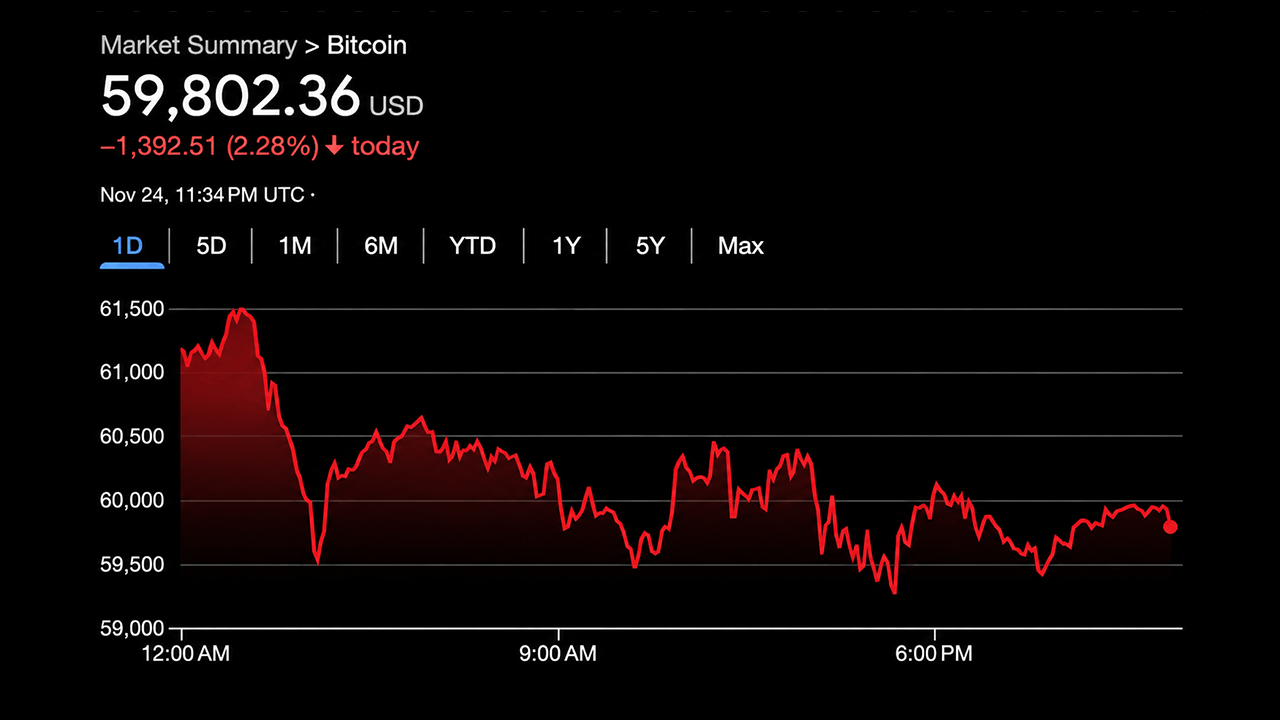
Monday's trading session demonstrated market fragility when bitcoin climbed to approximately $65,200 following corporate news, only to surrender its advance and return under the $60,000 region by Tuesday afternoon. The failed recovery highlights how favorable headlines can temporarily interrupt a bear market without sustained capital inflows.