OpenAI and Google released mathematical research papers this week that have reignited discussion about cryptographic security, though rumors of undisclosed breakthroughs remain unconfirmed.
On November 24, OpenAI added nine mathematical manuscripts to its public repository, including claimed solutions to decades-old computational problems in matrix multiplication, linear programming, and circuit complexity. The following day, Google released six research papers generated by its Gemini-based system, including work on integer factorization algorithms.
University of Texas complexity theorist Scott Aaronson acknowledged on his blog that he had encountered rumors suggesting OpenAI or Anthropic may have discovered cryptographic advances, though he expressed uncertainty about their precise nature. No laboratory has publicly demonstrated an attack against modern encryption, and neither company has confirmed the speculation.
Implications for RSA Encryption
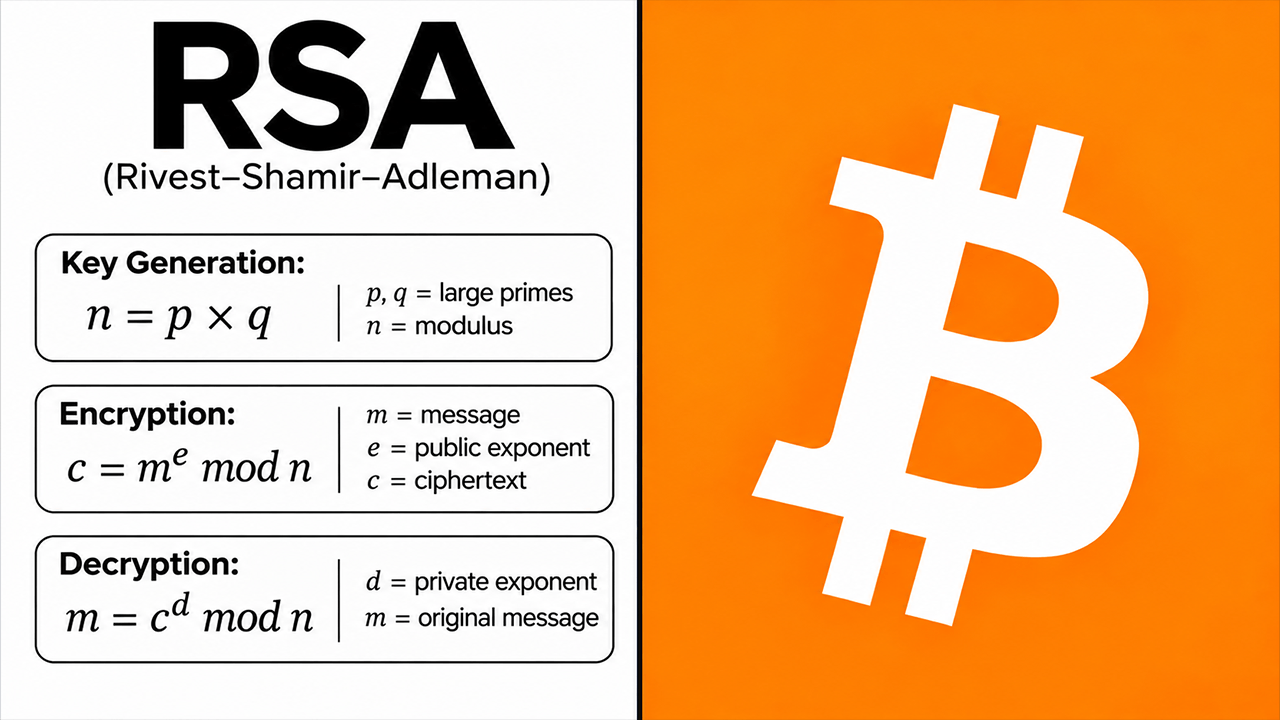
Charles Guillemet, chief technology officer at hardware wallet manufacturer Ledger, distinguished between integer factorization and primality testing. While primality testing was proven to be solvable in polynomial time in 2002, factoring remains a separate challenge. If integer factorization could be performed efficiently, it would compromise RSA encryption widely used in modern computing systems.
Google's factorization research, however, improves mathematical guarantees without establishing a practical threat. The algorithm remains considerably slower than existing methods and does not prove that factorization can occur in polynomial time.
Bitcoin's Different Cryptographic Foundation
Bitcoin does not rely on RSA or integer factorization for security. The network uses elliptic curve cryptography, specifically the secp256k1 curve, employing the Elliptic Curve Digital Signature Algorithm and Schnorr signatures to authenticate transactions.
Consequently, a breakthrough in integer factorization would not automatically compromise Bitcoin wallets or enable attackers to derive private keys from public keys. A practical solution to the elliptic-curve discrete logarithm problem would present a different risk, potentially exposing cryptocurrency holdings if public keys became vulnerable.
Ethereum and other blockchain networks rely on similar elliptic curve assumptions. Bitcoin's SHA-256 hashing algorithm, used in proof-of-work mining, represents a separate cryptographic primitive that would not necessarily be compromised by RSA or elliptic-curve breakthroughs.
As of late November, the distinction between published mathematical research and unconfirmed discoveries remains significant. No publicly demonstrated algorithm has invalidated current security assumptions, though the speed at which AI systems are addressing long-standing mathematical problems has prompted the cryptocurrency industry to consider whether its cryptographic defenses can evolve accordingly.