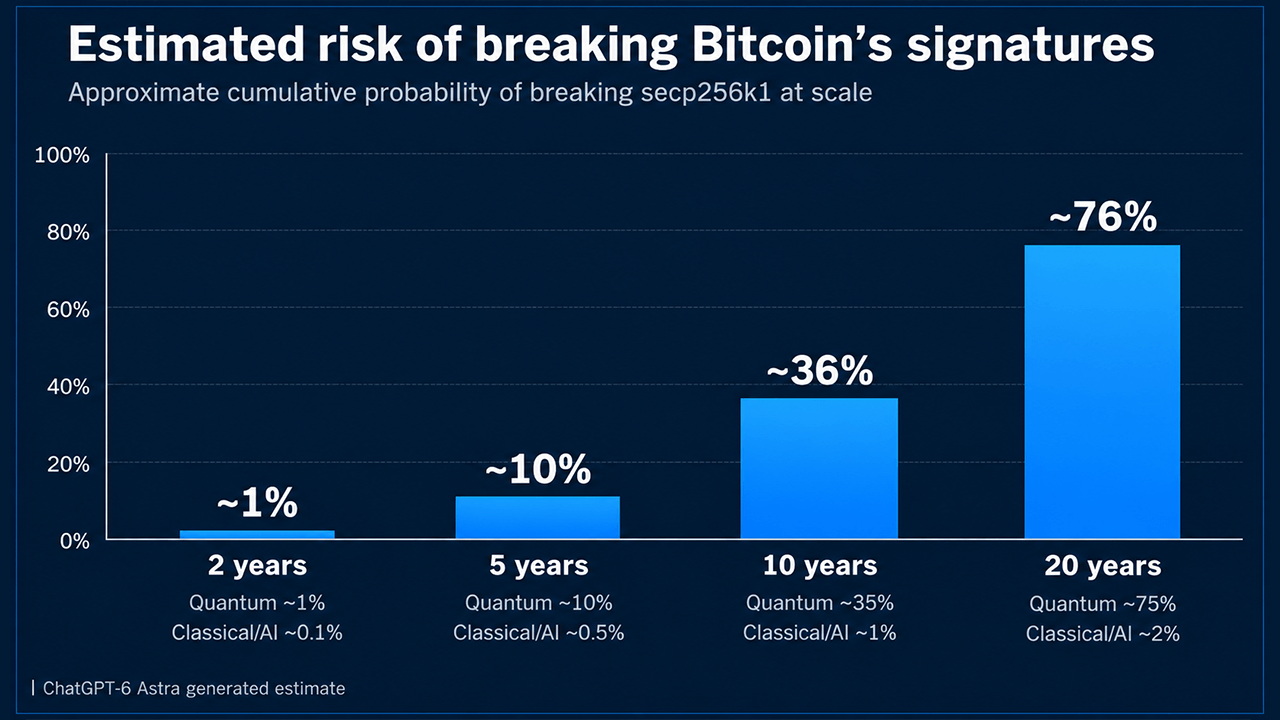
Bitcoin.com News consulted four artificial intelligence models to examine potential cryptographic threats to Bitcoin's security across multiple time horizons, following an October 11, 2026 post by onchain analyst Willy Woo that cited AI-generated estimates of cryptographic risk.
Each model was asked to estimate the probability that Bitcoin's ECDSA and Schnorr signature schemes could be practically broken—meaning an attacker could derive private keys from exposed public keys at scale—through either quantum computing or classical and AI-assisted mathematical breakthroughs.
Divergent Long-Term Forecasts
The models produced notably different assessments over extended periods. Hangzhou Deepseek assigned a 34% probability of a practical cryptographic break within 20 years, while OpenAI's ChatGPT-6 Astra estimated approximately 76%. xAI's Grok and Anthropic's Claude fell between those estimates at 60% and approximately 66%, respectively.
All four models estimated considerably lower risks in the near term. For the next two years, estimated probabilities ranged from 0% to 2%, with all models identifying quantum computing as the principal long-term concern rather than classical mathematics or AI-assisted cryptanalysis.
Key Findings Across Time Horizons
The models showed broad agreement that risks increase gradually over longer periods. For the next five years, estimates remained modest. Over ten years, probabilities began to rise more substantially, reflecting expert consensus that places practical quantum attacks well beyond 2030.
Classical cryptanalysis and AI-driven approaches were consistently rated as lower threats, with models noting the absence of any known practical breaks against secp256k1 and the lack of demonstrated AI-driven cryptanalytic shortcuts.
Expert Reasoning Behind Estimates
When asked to explain their forecasts, the models cited several consistent factors. Near-term estimates remained low because no cryptographically relevant quantum computer currently exists and practical attacks would require fault-tolerant hardware operating at substantial scale. Longer-term estimates reflected expert surveys assigning growing likelihood to quantum computing developments in the mid-to-late 2030s and beyond.
The experiment reveals variation in how AI models interpret Bitcoin's cryptographic future, though the models largely converge on the view that practical threats remain limited in the immediate term while longer forecasts paint a more uncertain picture.