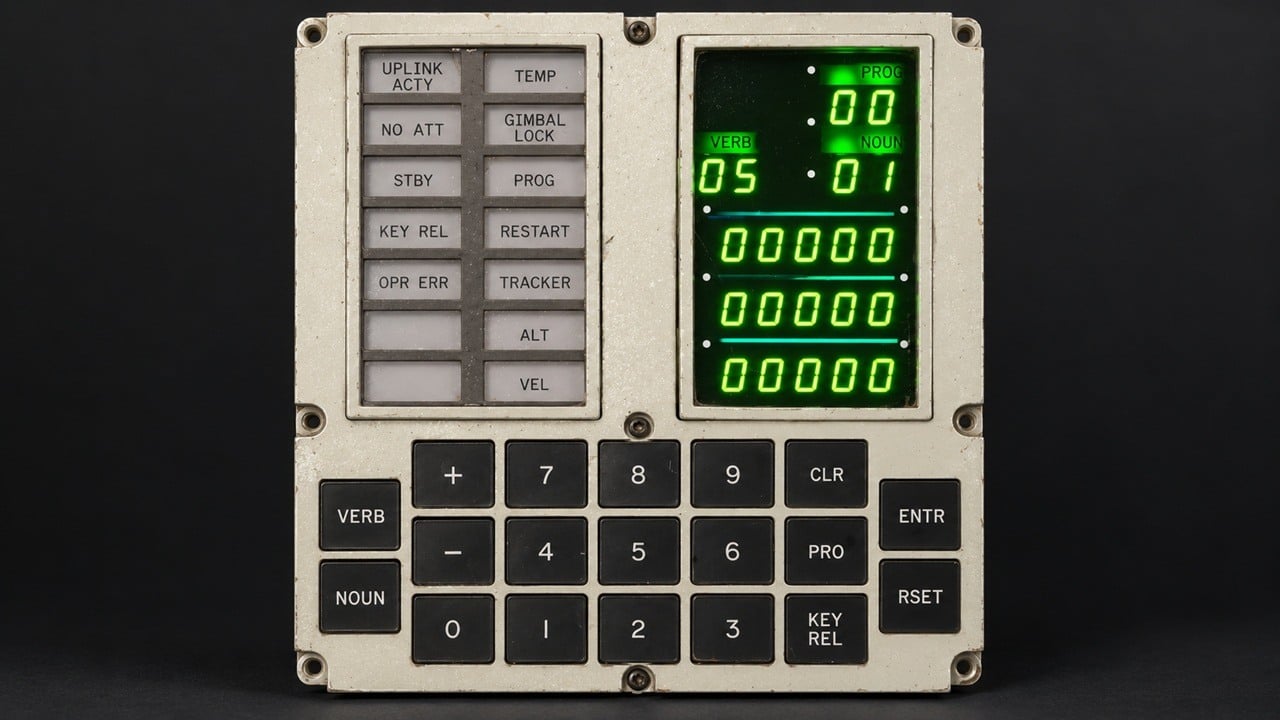
Computer scientist Ken Shirriff's 2019 project to run Bitcoin mining on the Apollo Guidance Computer—the navigation system that guided Apollo astronauts to the moon—has resurfaced as a compelling demonstration of proof-of-work difficulty.
Shirriff's team successfully programmed the AGC to perform one complete Bitcoin hash every 10.3 seconds. The computer, which weighs about 70 pounds and contains 2K words of RAM (roughly 4 kilobytes), can perform approximately 40,000 additions per second. The restored machine was originally believed to have been part of a lunar module test article before being discarded by NASA and later recovered from a scrapyard.
To validate the mining code, Shirriff fed the AGC a previously mined block header. The computer reproduced the correct result but, as expected, earned no Bitcoin.
Network Growth Since 2019
When Shirriff published the project in July 2019, Bitcoin's network operated at approximately 65 exahashes per second. At that difficulty level, Shirriff calculated the AGC would require about 4×10²³ seconds on average to find a single block—roughly one million times the age of the universe.
Bitcoin's hashrate has grown substantially since then. Following the September 5, 2026 difficulty adjustment, the network reached 934 EH/s, representing approximately 14 times the computational power Shirriff faced in 2019. This increase pushed mining difficulty 1.31% higher to 127.45 trillion.
Scaling Shirriff's original calculation by this factor suggests the AGC would now require roughly 5.8×1024 seconds to find one block—approximately 13 million times the current age of the universe.
Mining Economics in 2026
The next difficulty adjustment was expected soon after September's adjustment. Recent data showed hashprice—the revenue miners earn per unit of computing power—jumped 22.24% to $39.63 per petahash per day, with transaction fees comprising just 0.43% of miner rewards. The block subsidy remains the primary incentive keeping mining operations active.