
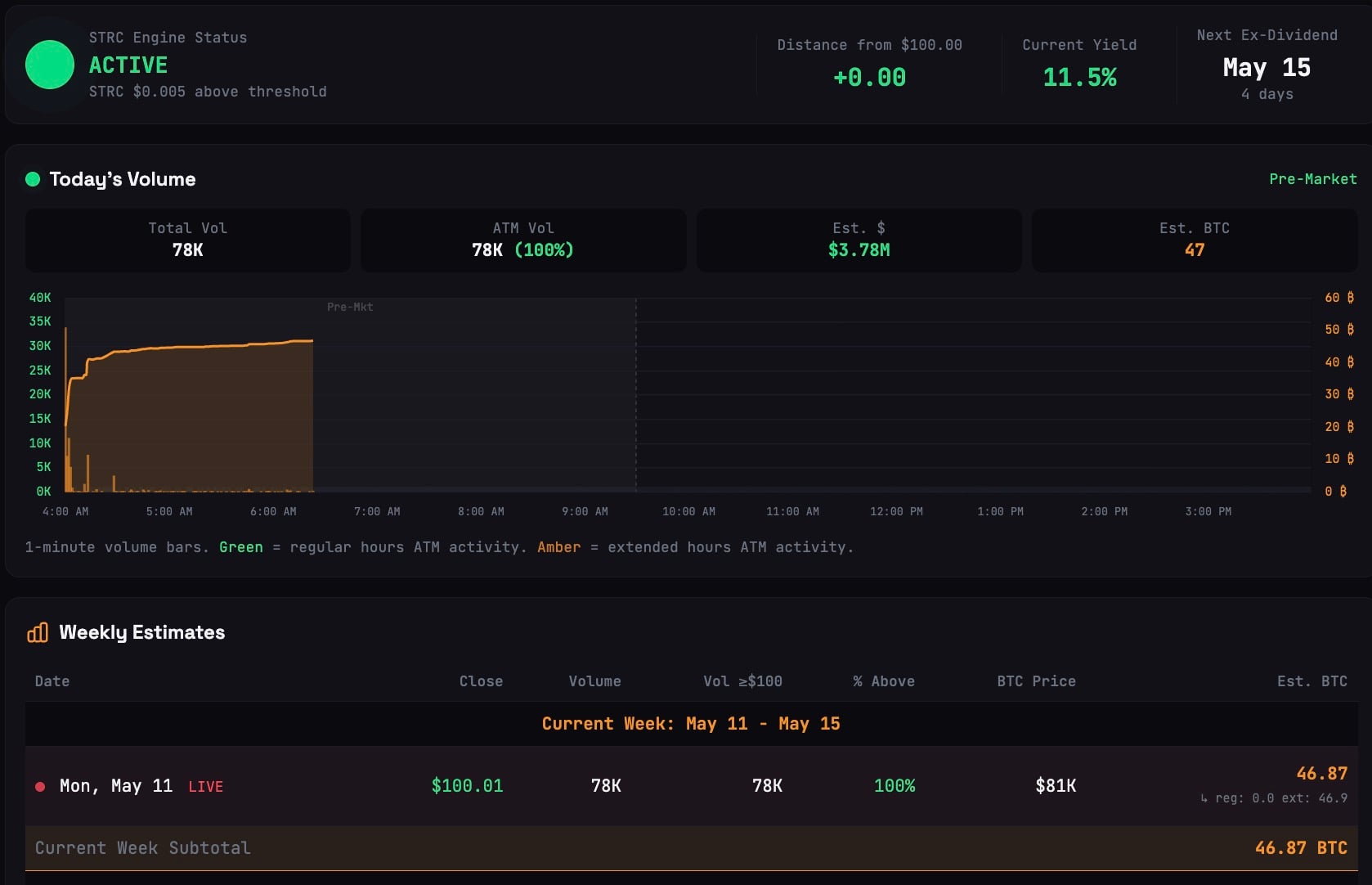
Privileged STRC shares have returned to their $100 par value after the longest drawdown in their history, effectively restarting the familiar conveyor belt – Strategy resumed selling shares through its At-The-Market (ATM) window and immediately directed the raised capital toward Bitcoin purchases.
Reflecting this operational restart, Strategy has already bought $43 million worth of BTC over the past week at an average price of $80,340.
Strategy plans to scale BTC buys
Building on this momentum, in just the first hours of today’s trading, volumes reached 77,000 shares, or about $3.78 million, allowing the company to accumulate another 47 BTC. The last time Strategy bought Bitcoin through STRC at peak capacity, the company acquired 34,164 BTC in a single week in April.
Veteran Trader Peter Brandt Calls ‘Major Bottom’ for SUI
3 Reasons Why Hyperliquid (HYPE) $50 Rally Failed, Bitcoin (BTC) Has No Fuel Left, Toncoin (TON) Critical Market Correction Begins: Crypto Market Review
The current 18-day recovery period required for STRC to rebound after April’s dividend cutoff exposed a vulnerability in the structure – the instrument’s elevated volatility during payout periods. To address this cyclical issue, Strategy management submitted a shareholder vote through June 8 on a reform that would transition dividend payments to a twice-monthly schedule.
The company expects that splitting the payments will reduce pressure on STRC’s price action, with the first payout under the new structure potentially taking place as early as July 15, 2026.
For years, Saylor’s philosophy was built around the concept of absolute Bitcoin holding. But now the strategy has become more complex, and the phrase “Never sell your Bitcoin” has officially been acknowledged as an oversimplification.
The new doctrine sounds different – “Never be a net seller,” which, according to Saylor, means the company is prepared to selectively sell BTC to pay STRC dividends, but only under the condition that for every Bitcoin sold, 10-20 more are purchased on top of it.
Now, with the ‘money printer’ back in play and $43 million already deployed in the past week, Saylor gets what matters most – a real-world testing ground for his new “net buyer” doctrine under live market conditions.