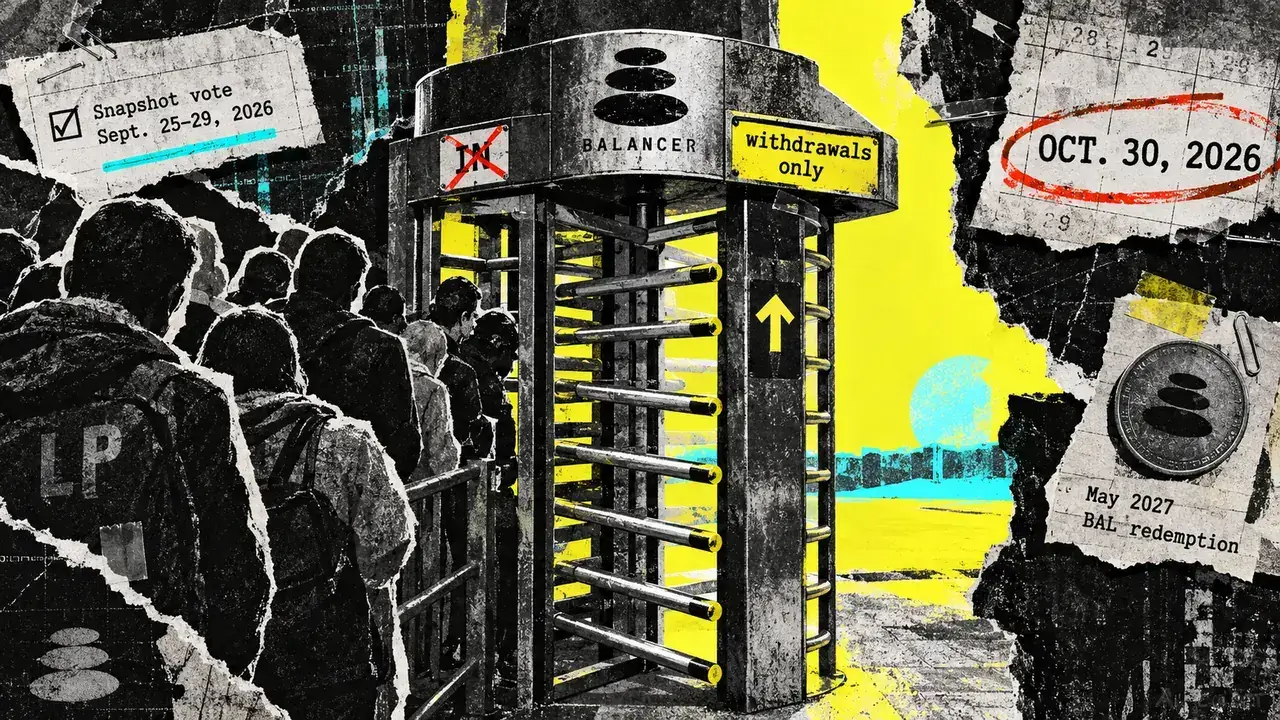
Balancer, a decentralized exchange that once held over $3 billion in total value locked, is proposing an orderly shutdown after a restructuring effort failed to restore the platform's financial viability.
The September 14 governance proposal would end new business development, begin winding down operations, and eventually distribute the remaining treasury to BAL holders. Token holders are scheduled to vote on the plan from September 25 to September 29.
The proposal follows a November 2025 exploit that drained approximately $128 million from Balancer v2 pools across multiple blockchains and prompted the closure of Balancer Labs, the corporate entity behind the protocol.
Failed Recovery Attempt
In April, BAL holders approved a narrower survival plan that ended token emissions, redirected protocol fees to the treasury, and cut operating costs. The restructuring reduced the team from roughly 25 people to 12.5 full-time equivalents and cut the operating budget by about a third.
The strategy centered on Balancer v3, which introduced features including Boosted Pools and AutoRange Pools. However, v3 failed to generate sufficient revenue to replace the declining returns from v2.
Former Balancer Labs chief executive Marcus Hardt stated that the turnaround strategy was limited by slower-than-expected commercial progress. He noted that the November exploit continued to affect adoption, with prospective partners repeatedly citing the hack during discussions.
"The product worked. It did not sell enough," Hardt said, adding that by August he could no longer identify a funded path to support the level of development v3 required.
Data from DeFiLlama showed Balancer's total value locked fell to approximately $58 million, reflecting both a broader contraction in DeFi activity and the protocol's struggle to rebuild.
Proposed Wind-Down Process
If holders approve the proposal, liquidity providers would face an October 30 deadline. Pools that can be paused would enter withdrawals-only mode, while Balancer would reduce protocol fees to zero where contracts allow.
The DAO has not yet published a pool-by-pool treatment plan, leaving liquidity providers with a proposed deadline but uncertainty about which pools will be paused or handled differently.
Funds recovered from the November exploit would be reserved separately for affected liquidity providers and excluded from treasury distributions to BAL holders.
BAL token holders would face a redemption process ending May 31, 2027, when they could burn BAL in exchange for a pro-rata share of treasury assets. The proposal estimates the managed treasury at a minimum of $9 million, though the final amount will depend on asset prices, remaining expenses, third-party claims, and an audit of DAO-controlled holdings.
Holders who participate in the redemption round would be eligible for a second distribution based on their redeemed amount. Those who skip the first window would lose access to the follow-on allocation.
The protocol's code will remain open source, allowing developers to fork or continue parts of the technology independently.