Financial institutions are pushing forward with tokenized deposits not only to modernize payments with programmable money and around-the-clock settlement, but to protect the balance sheet liabilities that fund their lending activities. According to Artem Tolkachev, Falcon Finance chief RWA officer, the underlying motivation for banks is balance-sheet preservation rather than technology alone.
While stablecoins move money off a bank's balance sheet and into the issuer's reserves, tokenized deposits keep the capital in place. Tolkachev noted that while a stablecoin competes directly with a bank deposit, a tokenized deposit essentially is the deposit itself, albeit in a programmable format.
Comparing Digital Dollar Formats
Underneath the surface, tokenized deposits, reserve-backed stablecoins, and overcollateralized synthetic dollars present different risk profiles for holders despite sharing the same face value:
- Tokenized Deposit: Sits on the issuing bank's balance sheet, allowing the institution to earn a return through lending. The holder relies on bank credit, supervision, and applicable deposit insurance.
- Reserve-Backed Stablecoin: Moves funds into the issuer's reserve assets, where the issuer earns the yield. Holders carry operational and reserve risks without any claim to the yield, as federal rules bar issuers from paying it out, and no deposit insurance applies.
- Synthetic Dollar: Relies on overcollateralization separate from the issuer, with returns determined by the collateral strategy and protection derived from collateral size and custody separation.
Regulatory bodies have reinforced the legal distinction of deposit tokens. The Dallas Fed stated in July that a deposit token remains a commercial-bank deposit on the issuing bank's balance sheet that settles at par. Additionally, an April proposal from the FDIC indicated that deposits held as stablecoin reserves would be insured to the stablecoin issuer as a corporate deposit, offering no pass-through insurance claim to individual stablecoin holders.
The Fight for Cheap Funding
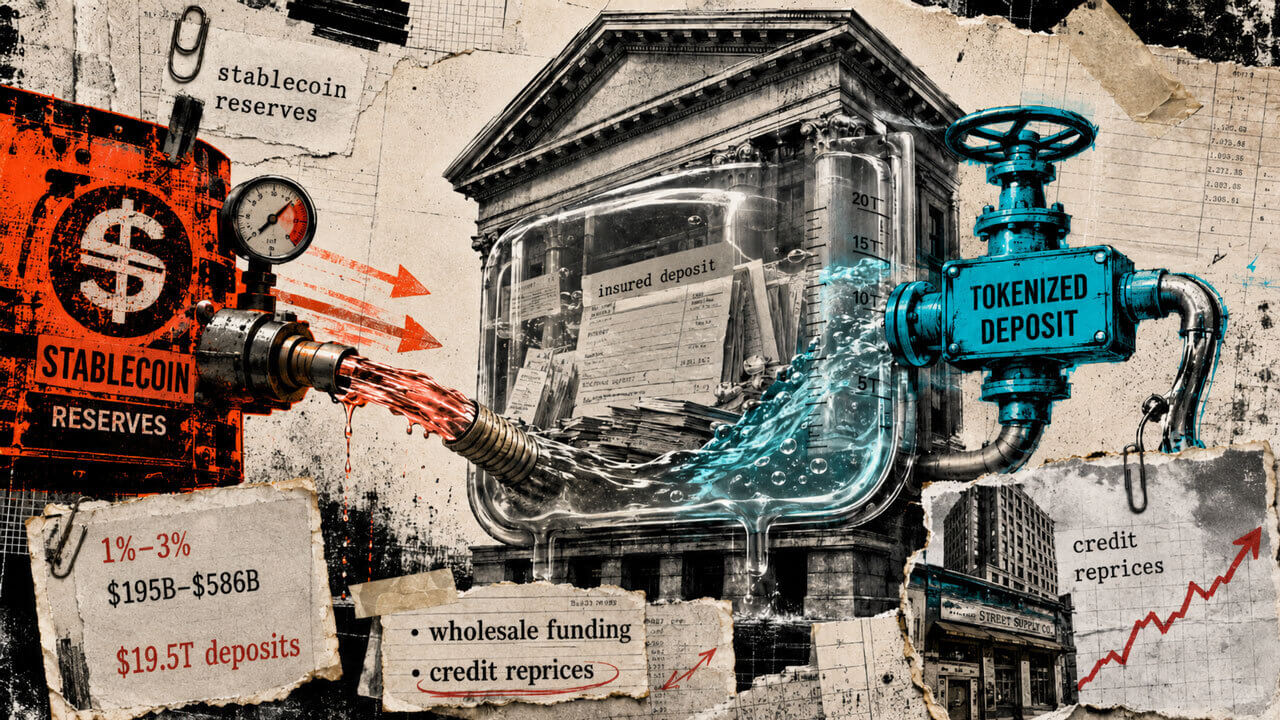
Industry experts warn that if stablecoins successfully draw deposits away from banks, the immediate consequence is higher funding costs. When institutions lose cheap, sticky deposit funding, they must replace it with pricier wholesale money to maintain lending levels, compressing profit margins before lending volumes are reduced. Both the Federal Reserve and the Bank for International Settlements have identified this mechanism linking stablecoin-driven deposit migration to higher funding costs and eventual loan repricing.
Major financial institutions are already deploying these digital formats. Wells Fargo announced plans in early August to launch tokenized deposits for corporate clients starting with USD-to-GBP transactions. Meanwhile, JPMorgan continues to operate JPM Coin as a deposit token on the Base blockchain, allowing institutional clients to move money on public rails while the underlying capital remains a commercial-bank deposit.
Ultimately, market participants suggest treasurers will utilize both tools depending on the specific use case: stablecoins for rapid, cross-border, 24/7 onchain settlement, and bank deposits for funds that require insurance, lending relationships, and balance-sheet backing.