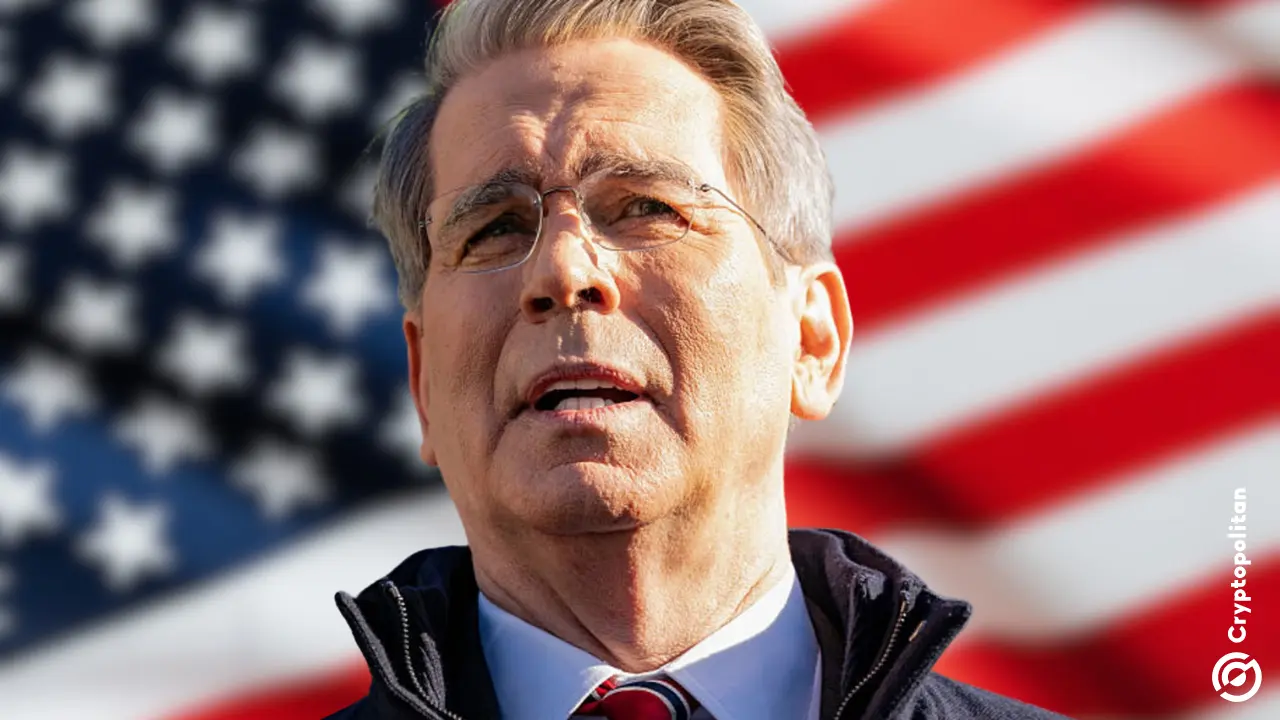
U.S. Treasury Secretary Scott Bessent is expected to hold discussions with Chinese Vice Premier He Lifeng regarding artificial intelligence, rare earth minerals, and trade issues. The talks are scheduled before President Donald Trump and Chinese President Xi Jinping are due to meet in Washington on September 24.
The inclusion of AI alongside traditional trade matters signals that artificial intelligence has become central to broader U.S.-China economic competition. Manufacturing and operating sophisticated AI models requires semiconductors, data centers, energy infrastructure, and critical minerals, meaning disagreements over AI development directly impact trade and industrial regulations across both nations.
Chinese Open-Weight Models Gain Market Share
Bessent indicated the talks should address both open-weight and closed-weight AI models. Open-weight systems make their trained model weights available for download, modification, and fine-tuning under varying licenses.
Chinese open-weight models have attracted American buyers due to lower pricing compared to closed-source American alternatives. According to CSIS, Chinese solutions comprised 41% of Hugging Face downloads over the past year. The organization also noted that Z.ai's GLM-5.2 model, featuring approximately 750 billion parameters, demonstrates competitive performance in coding and agent tasks relative to leading U.S. closed models.
The capability gap has narrowed significantly. Stanford's 2026 AI Index reported that in March, the top U.S. AI model held only a 2.7% advantage over the top Chinese model, continuing a trend from early 2025 when the two models regularly competed for the top position.
Rare Earths Remain Strategic Bottleneck
Rare earth minerals are essential for permanent magnets and components used in advanced manufacturing, defense systems, semiconductors, and automotive production. In 2025, China introduced export restrictions that disrupted these supply chains before U.S. and Chinese leaders agreed to suspend the restrictions for one year.
The United States has responded through financial support, production agreements, and price subsidies to develop alternative supply sources. The U.S. government signed an agreement with MP Materials establishing a decade-long arrangement with a neodymium-praseodymium production floor of $110 per kilogram. However, developing vertically integrated mine-to-magnet supply chains outside China will require years to implement.
Diverging Tech Ecosystems Create Global Uncertainty
Boston Consulting Group indicates that separate AI ecosystems devoted to the U.S. and China are forming, which will affect AI systems, cloud services, processors, and applications. This development creates complications for governments and businesses operating outside these two countries, as they must decide when regulatory changes on exports, security, and procurement will require technology transitions.
The financial stakes are substantial. PwC forecasts that global AI infrastructure investment will reach $31.6 trillion by 2050, with the United States accounting for $15.1 trillion and Asia Pacific for $8.2 trillion. The firm estimates that disruption to chip trade could reduce global investment by nearly 20%.
Bessent stated that Washington remains open to discussions on avoiding shared risks and preventing bifurcation of economic systems. However, expectations for a major AI agreement before the September 24 summit remain low amid ongoing mutual distrust between the nations.