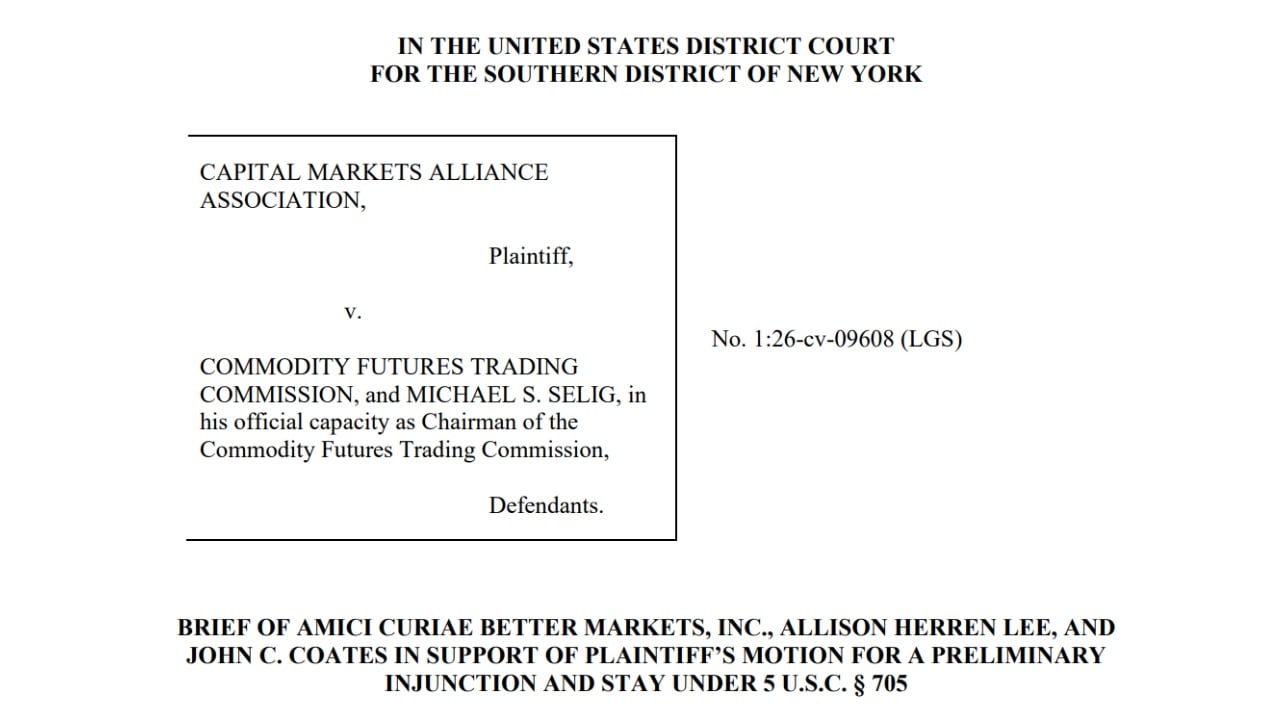
Better Markets has filed a friend-of-the-court brief supporting the Capital Markets Alliance's challenge to the Commodity Futures Trading Commission's approval of perpetual derivatives on individual U.S. stocks, escalating a legal fight over how such products should be classified and regulated.
Core of the Argument
The amicus brief was filed by former SEC Acting Chair and Commissioner Allison Herren Lee and former SEC General Counsel and Acting Director of the Division of Corporate Finance John C. Coates, who is also a Harvard Law professor. It argues that single-stock perpetual futures constitute swaps — and therefore bypass current Dodd-Frank Act protections for retail investors under the CFTC's new rules.
Specifically, Better Markets contends these products should be classified as security-based swaps rather than futures because they lack a fixed delivery date. Under that classification, the group says, they fall under the SEC's jurisdiction under the Dodd-Frank Act and must not skip critical protection measures, including registration and the requirement that trading occur only on regulated national securities exchanges.
Retail Risk Warnings
Better Markets, which the article notes has a history of opposing decentralized initiatives, argues that approving these swaps poses severe risks to retail investors because the products combine high leverage, no expiration date and automated liquidation features.
“These ‘perpetual futures’ are really shadow stocks that are leveraged roughly six-to-one, meaning an investor's entire portfolio can be zeroed out with just a 16% movement in the market. That level of volatility is common with single stocks and therefore the risk of total loss is real and likely frequent, ruining retail investors while enriching the platform companies,” the organization said.
“As we have seen in other nations where these products proliferate, investors can get wiped out in a matter of minutes, including overnight when automatic liquidation thresholds can be triggered,” it concluded.
Aligning With the CMA
Better Markets' position coincides with that of the CMA, which argues that the CFTC's recent approval of multiple filings for securities-based products fails to explain why it has long treated perpetual derivatives as swaps and disregards the impact of its new approach on investors and the wider securities market.
The CMA, whose members include industry heavyweights such as Cboe Global Markets, Citadel Securities and the Healthy Markets Association, is asking the court to vacate the approvals and acknowledge that the products constitute security-based swaps — effectively barring the CFTC from approving them while the case is pending.
A Broader Regulatory Fight
The case has become a major battle between industry incumbents and the CFTC, which is also facing challenges from state regulators over prediction markets. The SEC has already filed an amicus brief supporting the CFTC's new rule changes, contesting the CMA's allegations that the agency is “going rogue.”