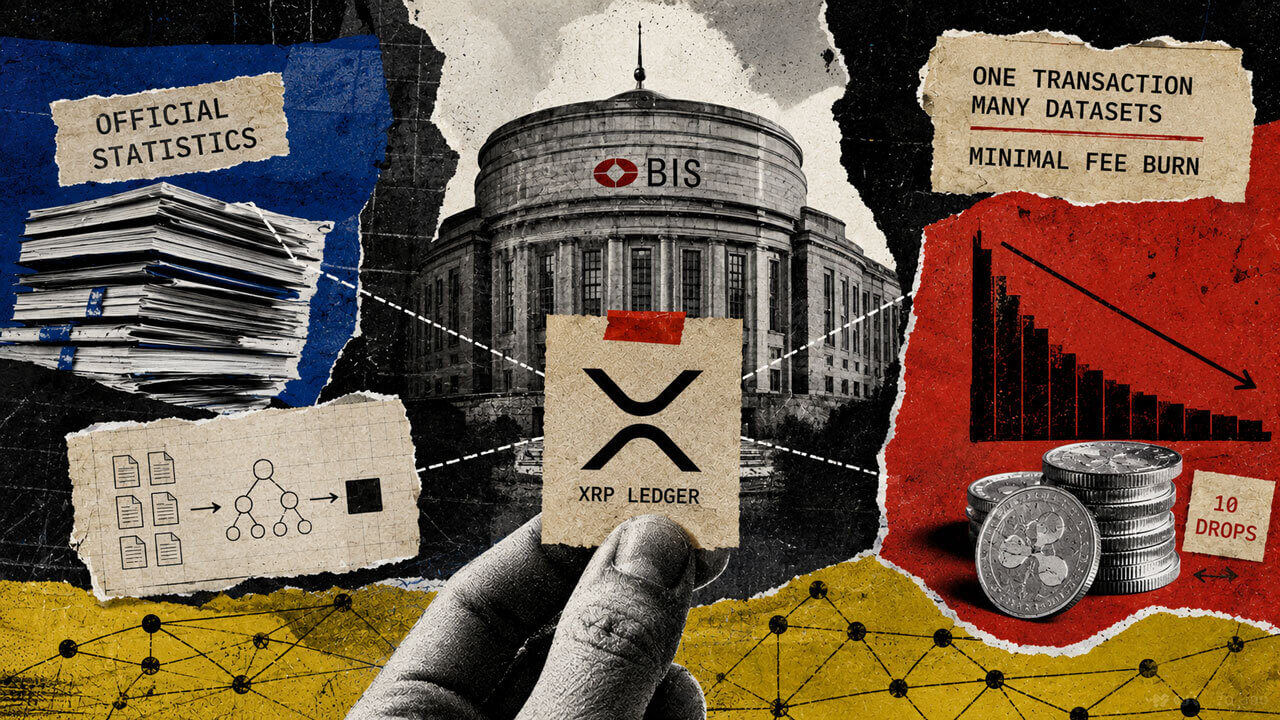
The Bank for International Settlements released a working paper on September 2 describing a prototype for authenticating official statistics using the XRP Ledger. The system converts statistical files into cryptographic fingerprints, anchors a summary on XRPL, and allows recipients to verify files against the public record.
The prototype demonstrates both promise and limitations for XRP. It provides XRPL with a legitimate institutional-grade use case, but its technical design deliberately constrains direct fee burn. A single ledger transaction can represent thousands of datasets, allowing useful activity to scale faster than the number of transactions consuming XRP.
How the System Works
The prototype normalizes statistical data in SDMX format and applies SHA3-512 hashing to files or individual data series. It combines these fingerprints using a Merkle tree structure that compresses large record groups into a single summary value called a root.
This root is written to the memo field of an XRPL transaction. The underlying statistics remain off-chain. Recipients receive the SDMX file embedded with the transaction reference, ordered fingerprints, and a signed verifiable credential to rebuild and verify the root against the ledger.
XRPL functions as a timestamped public notary rather than a database for economic figures. The open-source implementation is described as experimental, unsuitable for production, and unmaintained.
The authors selected XRPL for its low nominal fees, fast consensus finality, and accessible developer resources. They designed the blockchain interface as replaceable, meaning another ledger could perform the same anchoring function.
Performance and Constraints
Testing on a single developer workstation connected to XRPL DevNet showed median publication latency of three to five seconds and verification time of one to two seconds. The evaluation excluded sustained Mainnet load, enterprise firewalls, hardware-security-module-backed signing, and adversarial conditions. DevNet testing generated no real-world token demand.
Limited Token Economics
XRPL's standard transaction cost begins at 10 drops, equal to 0.00001 XRP. When a transaction enters a validated ledger, its fee is destroyed.
The paper illustrates the economic gap between transaction volume and fee burn. Under a constant 10-drop minimum, one million datasets batched at 1,000 per anchor would burn 0.01 XRP, while one million individual anchors would burn 10 XRP. The paper assumes a 10-drop fee and models per-dataset on-chain costs at $0.000000003 with 1,000-item batches.
Urgent releases may require smaller batches due to delay concerns, but XRPL's low nominal fee limits this penalty. Production cadence matters more than the headline number of authenticated files or data series.
Reserve requirements create a secondary pathway. Each XRPL address must hold a 1 XRP base reserve, plus 0.2 XRP per reserve-counting ledger object. Production deployment could increase held XRP across new institutional accounts, but this depends on deployment architecture rather than dataset volume.
The paper concludes that XRP would supply fees and reserves for a Mainnet version, while Merkle batching deliberately compresses the recurring fee flow. Under current fee mechanics, direct fee burn remains limited even as authenticated data volume grows.
The BIS work establishes XRPL as a viable low-cost authentication layer under controlled conditions. Material token demand would require sustained anchoring cadence, broad account creation, or other XRP-centered activity that the prototype did not demonstrate.