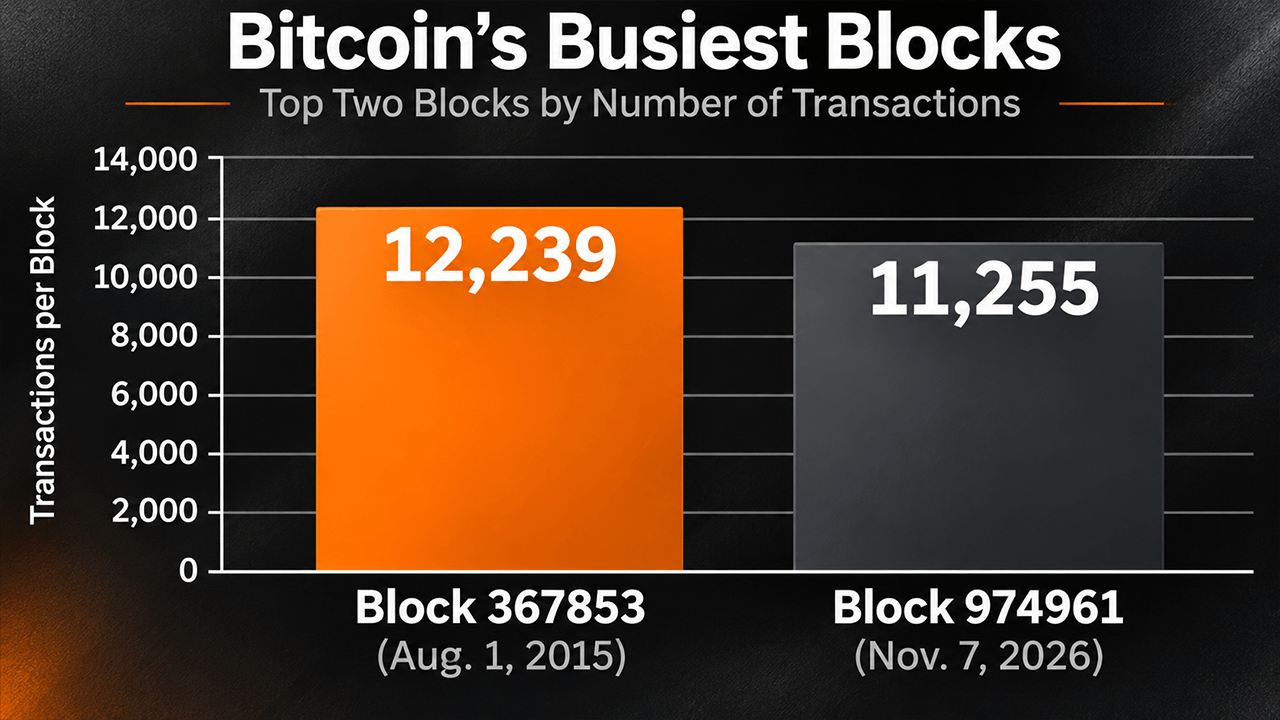
Bitcoin's blockchain came within 984 transactions of its all-time record on Saturday, Nov. 7, 2026, when block 974961 processed 11,255 transactions, the second-highest total in network history. The block was mined by Antpool at 18:24:12 UTC and measured approximately 1.1 megabytes, according to blockchain data.
Record in Sight
The milestone follows another unusually dense block three days earlier. On Nov. 4, Mempool.space developer Mononaut noted on X that block 974557 contained 10,573 transactions, then the second-highest figure of all time. That distinction lasted only three days. On Nov. 7, Mononaut documented the larger total, writing: "New #2 record: 11,255. We're rapidly closing in on the all-time high of 12,239 transactions from block 367853."
Block 974961 consumed 3,993,844 weight units, equivalent to roughly 99.85% of Bitcoin's maximum block weight. Of its 11,255 transactions, including the miner's reward transaction, 10,585 consumed 87.7% of the block's available space while paying less than 1 satoshi per virtual byte (sat/vB). The block collected approximately 0.002405 BTC in transaction fees, a negligible addition to the standard 3.125 BTC block subsidy. Its 11,794 inputs and 23,122 outputs reflected an unusually large collection of compact transactions rather than conventional, high-value bitcoin transfers.
The 2015 Record and Its Origins
The all-time record remains block 367853, mined by F2pool on Aug. 1, 2015, which contained 12,239 transactions. That block was constrained by the original 1 MB size ceiling rather than today's 4 million weight-unit limit, yet F2pool packed 12,239 transactions into approximately 999.96 kilobytes.
Of those, 11,796 transactions paid less than 1 sat/vB and accounted for 73.1% of the block's space, while another 442 paid 32 sat/vB or more and occupied 26.8%. No transactions fell between those two fee ranges. The block emerged from a period of what some called spam attacks or deliberate network stress tests, including campaigns that generated enormous quantities of tiny, low-value transaction outputs. F2pool subsequently undertook cleanup efforts that consolidated these outputs, reducing the number of individual entries nodes needed to track. The block included exceptionally small, nonstandard transactions, some measuring approximately 62 bytes. F2pool also mined block 367851 that day, containing 9,647 transactions.
Segwit and Runes Drive Modern Density
Much of the recent activity involves highly compact transactions associated with the Runes protocol, particularly minting activity involving UNCOMMON•GOODS, the first rune introduced around Bitcoin's fourth halving in April 2024. These transactions can use lightweight pay-to-anchor (P2A) outputs and carefully optimized structures, sometimes measuring approximately 80 to 100 virtual bytes.
Segregated Witness, Bitcoin's August 2017 upgrade, separated transaction signature data from the information used to calculate traditional transaction identifiers and introduced block weight, allowing witness data to count less heavily toward Bitcoin's capacity limit. Because transaction capacity cannot be measured simply by counting bytes, two blocks consuming comparable weight can contain dramatically different transaction totals depending on their contents.
Daily Activity and Market Context
Seven of Bitcoin's ten busiest transaction days occurred in 2026. The all-time daily record remains April 23, 2024, when the network processed 927,010 transactions shortly after the fourth halving and the introduction of Runes. Oct. 23, 2026, came close with 913,196 transactions, and Oct. 5 saw 904,518. Additional entries from July, August, September and June show elevated activity across multiple months.
November has presented a contrast. During the first seven days of the month, the protocol averaged approximately 534,200 transactions daily, roughly 25% below October's average of 710,400. On Nov. 2, daily activity fell to 381,886 transactions, the lowest reading since March 17. The slowdown coincided with turbulence across cryptocurrency markets following the late-October Binance security breach and subsequent declines in bitcoin's market price. On Nov. 7, daily activity recovered to 591,830 transactions.
The 2015 record remains intact, but its longevity no longer makes it appear untouchable. Another 985 transactions beyond November's second-place block would establish a new all-time high, depending less on conventional bitcoin payment demand than on the continued production of exceptionally compact transactions and miners' willingness to include them.