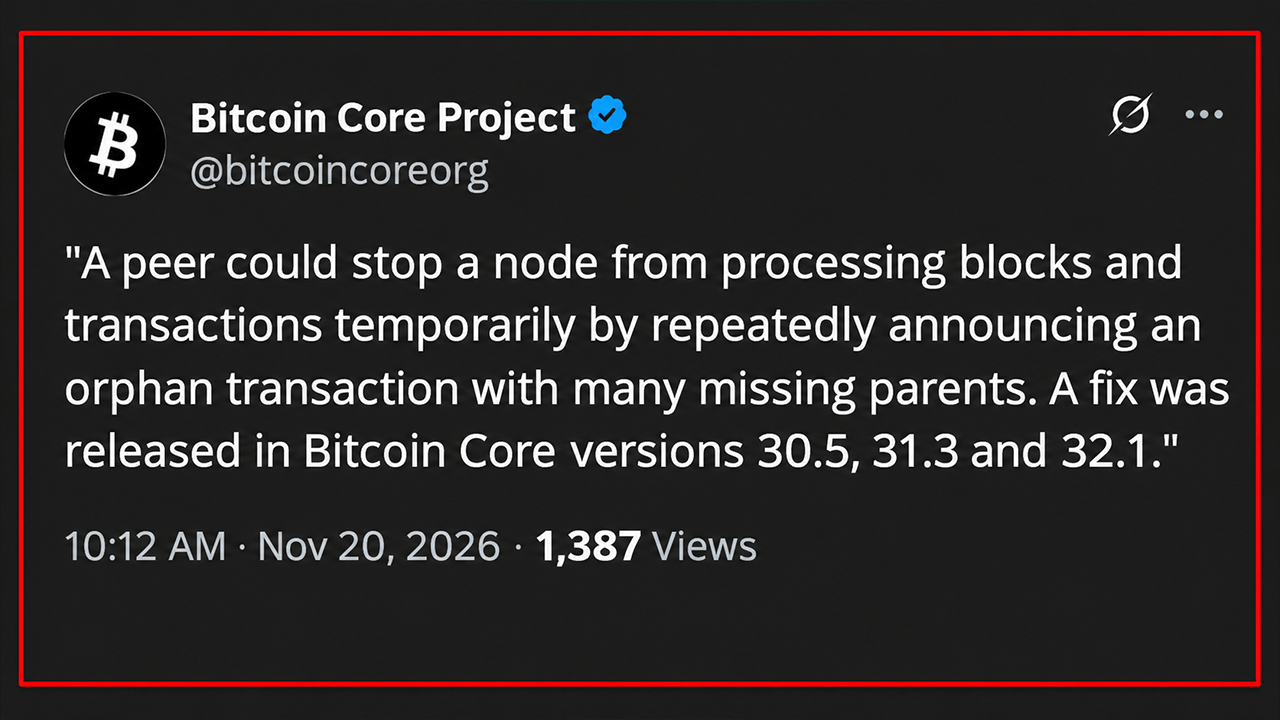
Bitcoin Core disclosed a medium-severity vulnerability on November 20, 2026, that could allow malicious peers to temporarily paralyze nodes through repeated transaction announcements. The flaw, identified through artificial intelligence-assisted security research, highlights growing challenges in cryptocurrency infrastructure security.
The vulnerability, cataloged as CVE-2026-117348 and titled "Node stall through duplicate orphan announcements," could prevent affected Bitcoin nodes from processing incoming blocks and transactions for more than a dozen seconds per malicious message.
Affected Versions and Fixes
The problem affected Bitcoin Core versions 29.0 through 29.5, 30.0 through 30.4, and 31.0 through 31.2. Corrective updates are available in versions 30.5, 31.3, and 32.1. The discontinued 29.x branch will receive no further patches.
How the Vulnerability Worked
Bitcoin Core maintains a temporary holding area called the "orphanage," where transactions await missing parent transactions. The vulnerability exploited an inefficiency in how the software processed transaction announcements.
Bitcoin inventory messages can contain up to 50,000 entries, but the software failed to disregard duplicate transaction announcements. An attacker could repeatedly reference an orphan transaction with thousands of missing parents, forcing the receiving node to perform the same computationally expensive checks thousands of times. Each manipulated message could stall processing for more than 12 seconds.
Discovery and Timeline
The vulnerability was discovered by Project Loupe, an automated security initiative developed by Elias Rohrer at Spiral, Block's open-source Bitcoin development division. Bitcoin Core developer Gregory Sanders validated the finding and brought it to the project's security team.
Project Loupe reported the vulnerability on July 8. An independent researcher identified as Stutxo submitted a separate report on August 4, the same day Sanders opened a corrective pull request. Developers merged the fix on August 6, and Bitcoin Core 32.1 incorporated it on October 27.
Broader Context on AI-Assisted Security Research
The disclosure occurs during a period of significant AI-assisted vulnerability discoveries across cryptocurrency infrastructure. In February, AI-assisted review identified a critical signature-verification weakness in the XRP Ledger's proposed Batch amendment. Another investigation uncovered a high-severity vulnerability in Nethermind, an Ethereum execution client.
In May, researcher Taylor Hornby used an AI-assisted auditing system to identify a four-year-old flaw in Zcash's Orchard privacy protocol. By August, sixteen volunteer developers using AI tools generated thousands of findings across cryptocurrency projects.
However, automated discovery has created complications. Maintainers face large volumes of reports requiring human verification, with legitimate security concerns competing with false positives.
Policy Changes
Recognizing these developments, Bitcoin Core revised its vulnerability disclosure policy in October. Issues classified as easily discoverable through LLM-assisted analysis now receive accelerated public disclosure alongside corrective releases.
Although the flaw permitted temporary denial-of-service attacks, the advisory noted no mechanism for stealing bitcoin or permanently damaging nodes.