Bitcoin's relationship with traditional financial markets has shifted ahead of the Federal Reserve's interest-rate decision on Wednesday. According to CoinMarketCap data, bitcoin's 15-day correlation with the Dollar Index has collapsed to nearly zero, down from a positive 0.08, while its link to U.S. equities has also faded considerably.
Bitcoin's short-window correlation to the S&P 500 fell to 0.43 from 0.75 in a single day, its correlation to the Nasdaq dropped to 0.30 from 0.60, and its 30-day correlation to gold declined to 0.28 from 0.69, according to CoinMarketCap's head of research Alice Liu.
The disconnection stems from heightened focus on cryptocurrency regulation, particularly after the Clarity Act failed a key Senate procedural vote on Tuesday. This regulatory attention has pulled trader focus away from broader economic indicators that typically influence bitcoin's price movements.
The shift has consequences for hedging strategies. Traders who relied on bitcoin's tendency to track U.S. stock indices as a basis for protective positions now face unreliable correlations. A strategy that worked days earlier may no longer provide the expected protection.
The Federal Reserve is widely expected to raise interest rates by 25 basis points at 2 p.m. ET. While this move is largely already reflected in market prices, the guidance offered by Chair Kevin Warsh could prove significant. Some observers suggest that without a larger increase or unexpectedly hawkish signals, the Dollar Index could weaken, which would typically support bitcoin prices in isolation.
Market analysts emphasize watching Treasury yields closely. Sharp movements in yield volatility can tighten financial conditions and potentially trigger broader risk-off flows across cryptocurrency markets.
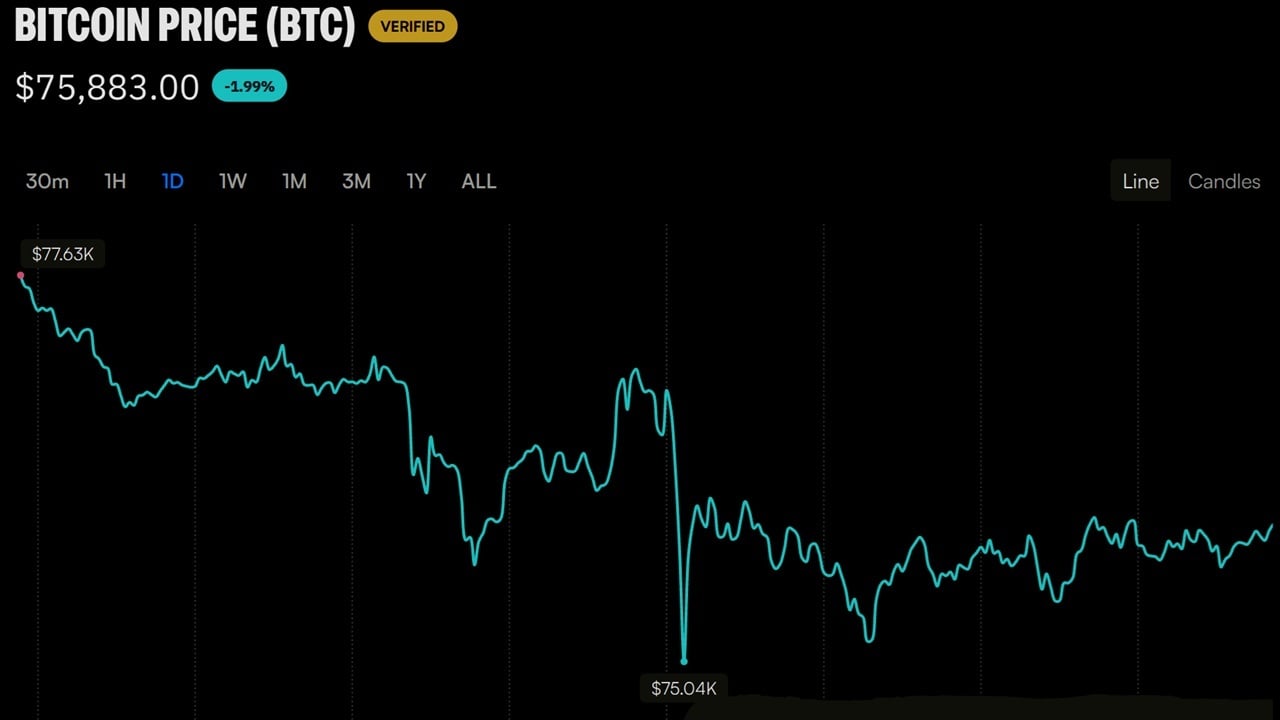
Bitcoin's price action has also turned technical. After holding in a tight range above $76,000 for an extended period, sellers broke through that level, establishing a pattern that chart analysts describe as a range breakdown—a bearish signal that can precede further losses.