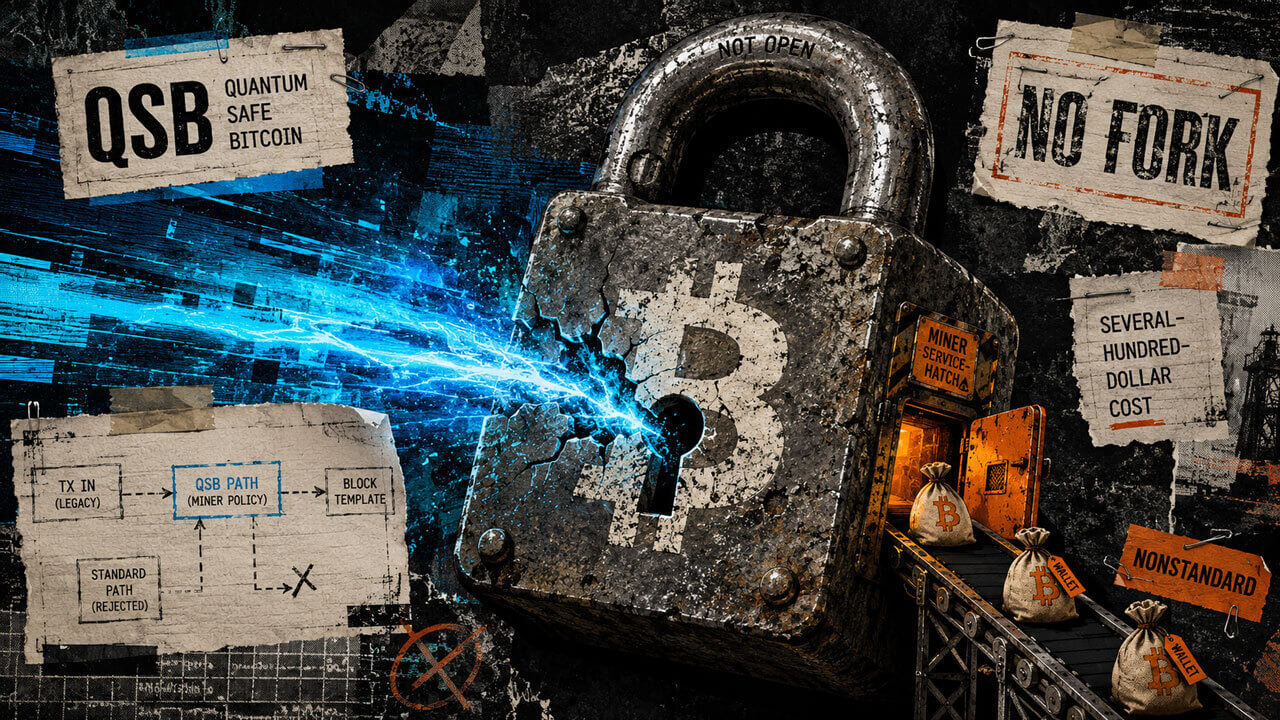
Bitcoin confirmed its first quantum-resistant transaction on mainnet on August 26, demonstrating that some coin holders could move funds away from quantum risk using existing consensus rules, without waiting for a protocol upgrade.
The transaction, included in block 964,199, used a construction developed by StarkWare researcher Avihu Levy that replaces elliptic-curve signature security with hash-based security. StarkWare Chief Executive Eli Ben-Sasson cautioned that the achievement should not be interpreted as evidence that Bitcoin is already quantum-safe, emphasizing that broader solutions are still needed to protect the network at scale.
How the Workaround Functions
The Quantum-Safe Bitcoin (QSB) method takes advantage of the fact that many Bitcoin addresses keep public keys hidden behind a hash until funds are spent. The construction moves eligible coins into a hash-based spending condition before the public key is revealed, shifting security assumptions away from elliptic-curve cryptography toward the difficulty of reversing hash functions.
While quantum computers can accelerate attacks on hash functions, the advantage is substantially smaller than the speedup they provide against public-key cryptography through Shor's algorithm.
Significant Limitations
The protection does not extend to coins whose public keys are already visible. Roughly 7 million BTC are considered potentially vulnerable because their public keys are exposed through older address formats, Taproot usage, or address reuse. These coins lack a rescue path through the QSB method.
QSB also remains impractical for routine use. Although valid under Bitcoin's consensus rules, the transaction is nonstandard and does not normally propagate through the public mempool. StarkWare had to submit the transaction directly to Bitcoin miner MARA through its Slipstream service. The required computation is expensive, with the mainnet test costing several hundred dollars.
Institutional Interest Growing
Quantum risk is moving further into institutional planning. In July, BlackRock, Coinbase, Strategy, and six other institutions formed the Bitcoin Security Consortium, pledging a combined $15 million over three years toward Bitcoin security research, including post-quantum cryptography. The U.S. Treasury has also brought digital assets into the financial sector's broader quantum-readiness planning.