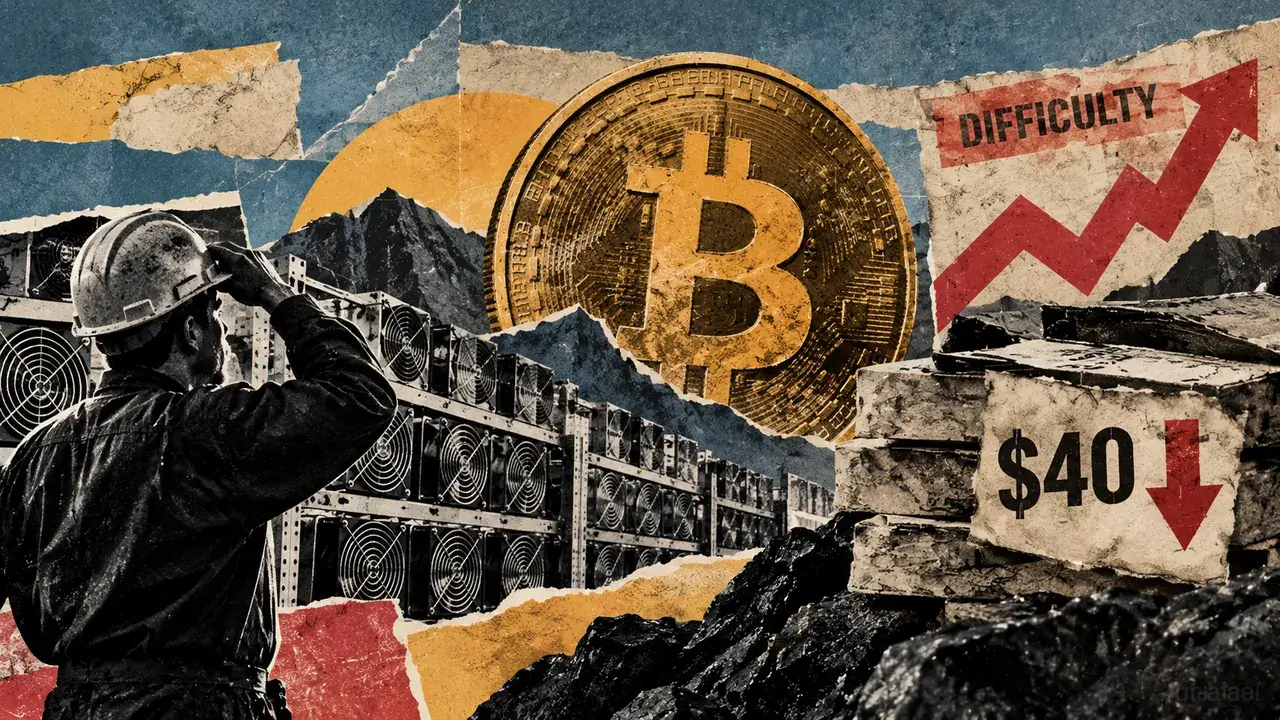
Bitcoin miners face mounting pressure from a projected difficulty increase of 5.68% scheduled for around October 16. According to network data captured on October 14, the adjustment could significantly reduce profitability for operators running less efficient equipment.
Revenue Impact and Breakeven Concerns
If Bitcoin's price, block subsidy, and average fees per block remain unchanged, the projected retarget would reduce revenue per unit of computing power by 5.37%. Network hashprice stood at $39.77 per petahash per day on October 14, measured before operating expenses.
The difficulty adjustment recalibrates every 2,016 blocks to maintain a ten-minute average block interval. The next adjustment occurs at block 971,712, with approximately 347 blocks remaining as of October 14.
Where Margins Disappear
Certain mining setups could cross below profitability thresholds entirely. For equipment consuming 20 joules per terahash and paying 8 cents per kilowatt-hour, the electricity cost cushion narrows substantially.
At the October 14 hashprice, such equipment would generate $1.37 in daily margin per petahash per second above electricity costs. After the projected retarget, that equipment would face an approximately $0.77 power shortfall daily per petahash per second, assuming other variables remain static.
The maximum electricity tariff a miner can profitably sustain falls across efficiency levels:
- 15 joules per terahash: 11.05 cents per kWh before retarget, declining to 10.45 cents after
- 20 joules per terahash: 8.29 cents per kWh before retarget, declining to 7.84 cents after
- 25 joules per terahash: 6.63 cents per kWh before retarget, declining to 6.27 cents after
- 30 joules per terahash: 5.52 cents per kWh before retarget, declining to 5.23 cents after
These thresholds exclude pool fees, cooling costs, site overhead, repairs, and financing expenses.
What Comes Next
The actual impact depends on conditions when the adjustment completes. Higher bitcoin rewards per block or fee revenue could ease pressure on margins, while lower values would intensify the squeeze.