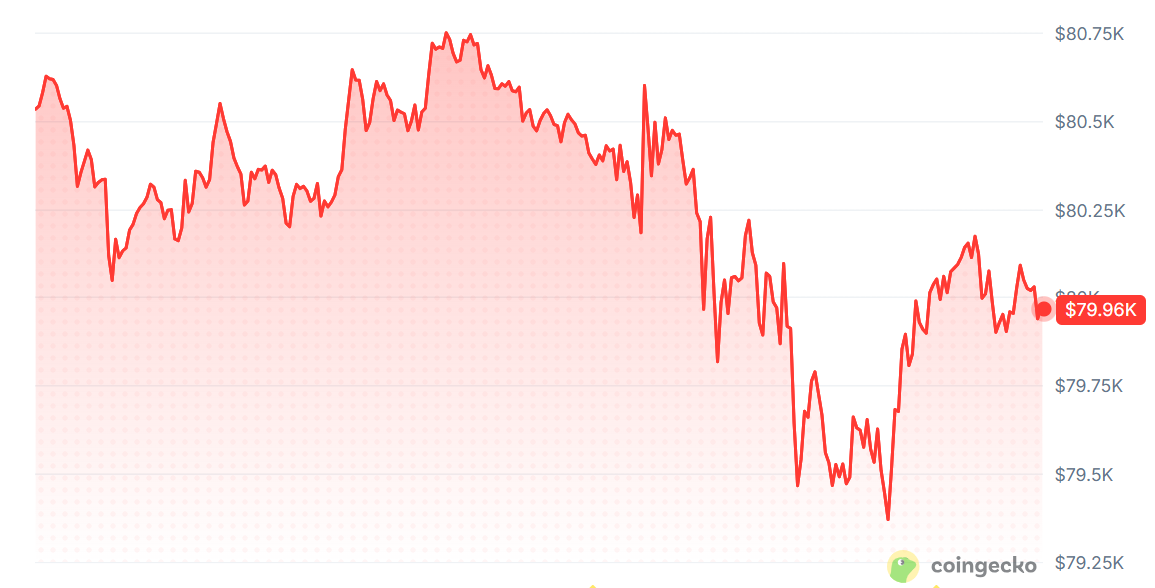
Bitcoin has declined 4.1% over the past week, trading just under $83,000 after U.S. spot Bitcoin ETFs experienced significant outflows. Wednesday saw $484.9 million flow out of Bitcoin ETFs, the largest single-day exit since June 25, according to Decrypt's ETF tracker.
The decline is particularly notable given October's historical performance. Since 2013, Bitcoin has posted a median return of roughly 14% in October, with 10 of the past 13 Octobers closing in the green—a pattern that has given rise to the term "Uptober." However, experts caution against relying on calendar-based patterns for investment decisions.
Support Levels Under Scrutiny
Bitcoin hit lows of $80,427 during the week and is currently attempting to recover above $83,000. Analysts have identified multiple potential support zones based on on-chain metrics and technical analysis.
Luke Deans, Senior Research Associate at Bitwise Europe, noted that the $83,000 region combines the average ETF cost basis with prior technical thresholds and has been tested repeatedly in recent weeks. If Bitcoin struggles to recover from current levels, lower support targets should be considered.
Ananda Banerjee, Founder and Principal Quantitative Researcher at Charlie Quant Lab, identified the strongest support at $77,000 based on on-chain metrics showing a notable cluster of Bitcoin supply purchased at that level. Deans also flagged $74,000 as support based on the Short-Term Holder Cost Basis, while the 200-day moving average sits at $72,000.
Deans stated that a move into the $72,000 to $77,000 region would represent a retest of a broader transition zone. If successfully defended, this area could mark a shift from resistance to support, signaling market strength. Failure to defend it could impair current market structure.
ETF Outflows and Missing Spot Demand
Bitcoin ETFs shed $484.9 million on Wednesday, with BlackRock's IBIT experiencing the largest outflow at $207.7 million and Fidelity's FBTC following with $105.1 million. Outflows continued Thursday with an additional $244 million flowing out.
Bitfinex analysts attributed Bitcoin's inability to sustain movement above $87,000 earlier in the week primarily to futures positioning rather than spot demand. They noted that U.S. spot Bitcoin ETF inflows have declined sharply, falling from $2.39 billion in the week of September 21-27 to $241.1 million in the week of September 28 to October 2.
Analysts observed that the average ETF investor has returned to breakeven for the first time since January—a level at which inflows have historically slowed. Can-Luca Köymen, Investment Strategist at Sygnum Bank, also highlighted that low spot volume is constraining Bitcoin's price action.
Consolidation Range and Outlook
Bitfinex analysts believe Bitcoin's consolidation range lies between $84,000 and its yearly open of $87,722. They suggested that the September Consumer Price Index report scheduled for October 14 could signal the end of this range, alongside any pickup in ETF flows.
Jake Kennis, Senior Research Analyst at Nansen, acknowledged that historical evidence supports October strength but emphasized that liquidity, positioning, macro conditions, and underlying demand are ultimately more important drivers than calendar patterns.