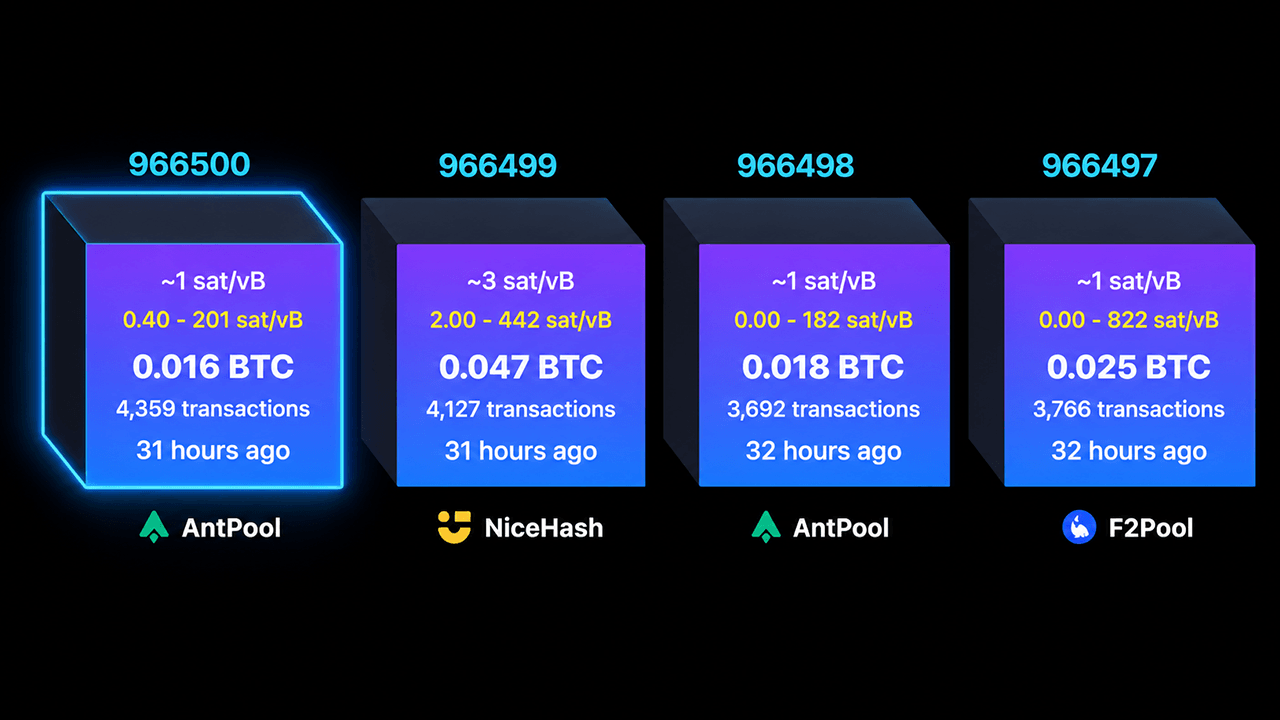
Bitcoin experienced a one-block reorganization on September 11 when two major mining pools found competing valid blocks at height 966500, according to Galaxy Research. Antpool's block ultimately prevailed and joined the chain with the most accumulated work, while Spiderpool's perfectly valid block was discarded as the network converged on a single version of the ledger.
Galaxy Research detected the anomaly through its private node, noting that it did not see the Antpool block until after it had confirmed and the chain extended further. The incident marked the third such one-block reorganization in four weeks, following reorgs at block heights 962,722 on August 16 and 963,853 on August 24.
How Blockchain Reorganizations Work
A blockchain reorganization occurs when the network temporarily builds on competing valid blocks before converging on a single chain. When two miners discover and broadcast different blocks at nearly the same time, the network eventually follows whichever chain accumulates the most computational work. The competing block is then dropped and left behind as the network reaches consensus.
Galaxy Research noted that small one-block reorgs like this are relatively common on Bitcoin and do not typically carry significant security implications.
Deeper Reorganizations Pose Greater Risks
While Bitcoin's one-block reorgs are generally benign, deeper chain reorganizations on other networks have demonstrated more serious consequences. Monero experienced an 18-block reorganization when a withheld chain was released, and Bitcoin SV underwent a 100-block reorg in the summer of 2021.
In such deeper reorgs, transactions that appeared to be confirmed can be reversed as blocks are reshuffled. When reorganizations become this extensive, they indicate genuine security concerns that warrant attention, unlike the short-lived reorgs that occasionally occur on Bitcoin.