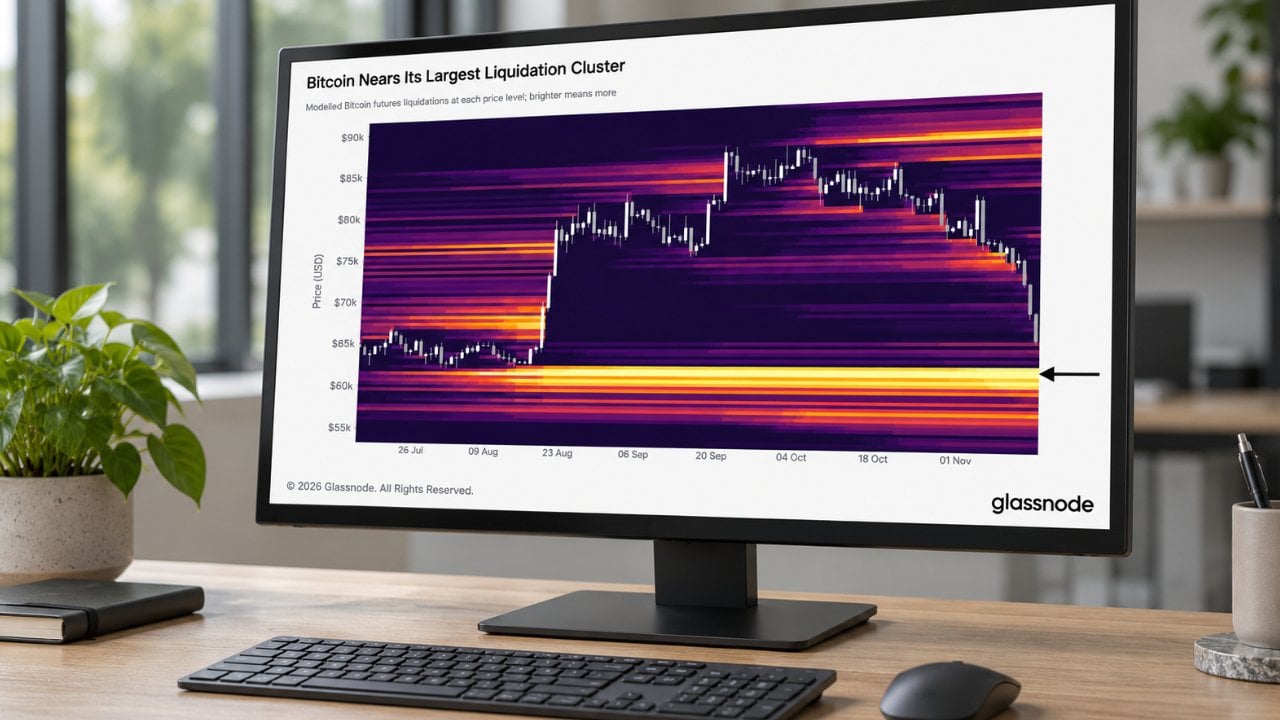
Bitcoin approached a significant liquidation zone as blockchain analytics firm Glassnode warned that forced closures of leveraged trades could deepen market declines. The alert came amid shrinking trading liquidity and persistent selling pressure across cryptocurrency markets.
Glassnode identified a concentrated liquidation cluster between $59,500 and $62,600 on its six-month liquidation heatmap. The firm noted that these long positions—bullish trades seeking to profit from rising prices—remained in place since an August breakout and had gone untouched as prices subsequently declined.
As of November 14 at 5:51 p.m. EST, bitcoin traded at $63,602, down 6.90% over 24 hours, 14.81% over one week, and 21.45% over one month. The one-year decline stood at 31.70%.
Liquidations and Liquidity Pressures Mount
When losses leave insufficient margin for open leveraged positions, exchanges automatically trigger liquidations. Approximately $1.64 billion in crypto liquidations occurred during a 24-hour period surrounding the November 13 decline, with nearly 90% involving bullish trades. These forced closures add selling pressure to markets already facing constraints.
Stablecoin supply contracted by $17 billion over one month, reducing available capital within crypto markets. U.S. spot bitcoin exchange-traded funds recorded $185.4 million in net outflows on November 13, including $143.5 million from Blackrock and $41.9 million from Fidelity. Withdrawals totaled approximately $1.07 billion during November 9-13, with every session recording net outflows. November 13 marked the seventh consecutive trading day of outflows, extending a streak that began November 5.
Selective Buying Amid Broader Decline
Despite downward pressure, Glassnode's analysis showed renewed buying among mid-sized wallet holders controlling 100 to 1,000 BTC and 1,000 to 10,000 BTC. Smaller holders and the largest cohort continued reducing their balances, concentrating buying activity among selected groups.
Earlier liquidation rounds had already cleared many long positions built during the September-to-present decline, Glassnode noted, reducing the concentration of vulnerable trades near prior price levels while leaving the deeper August cluster exposed.