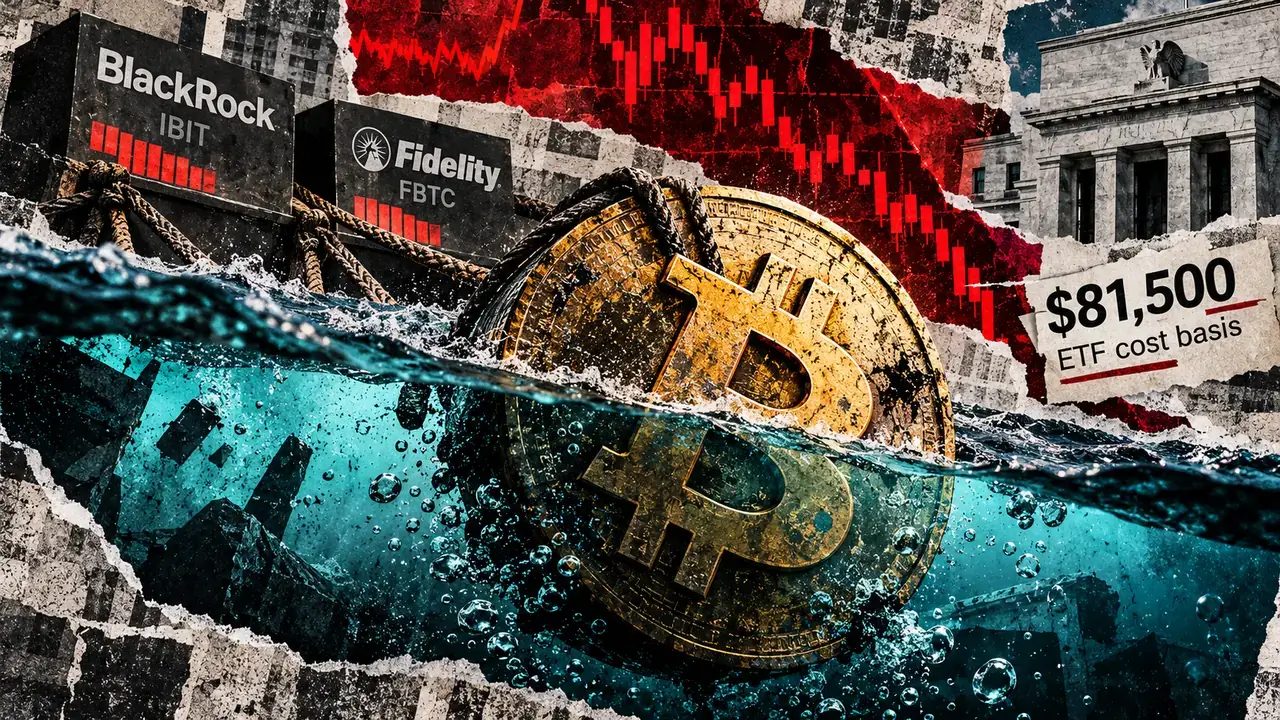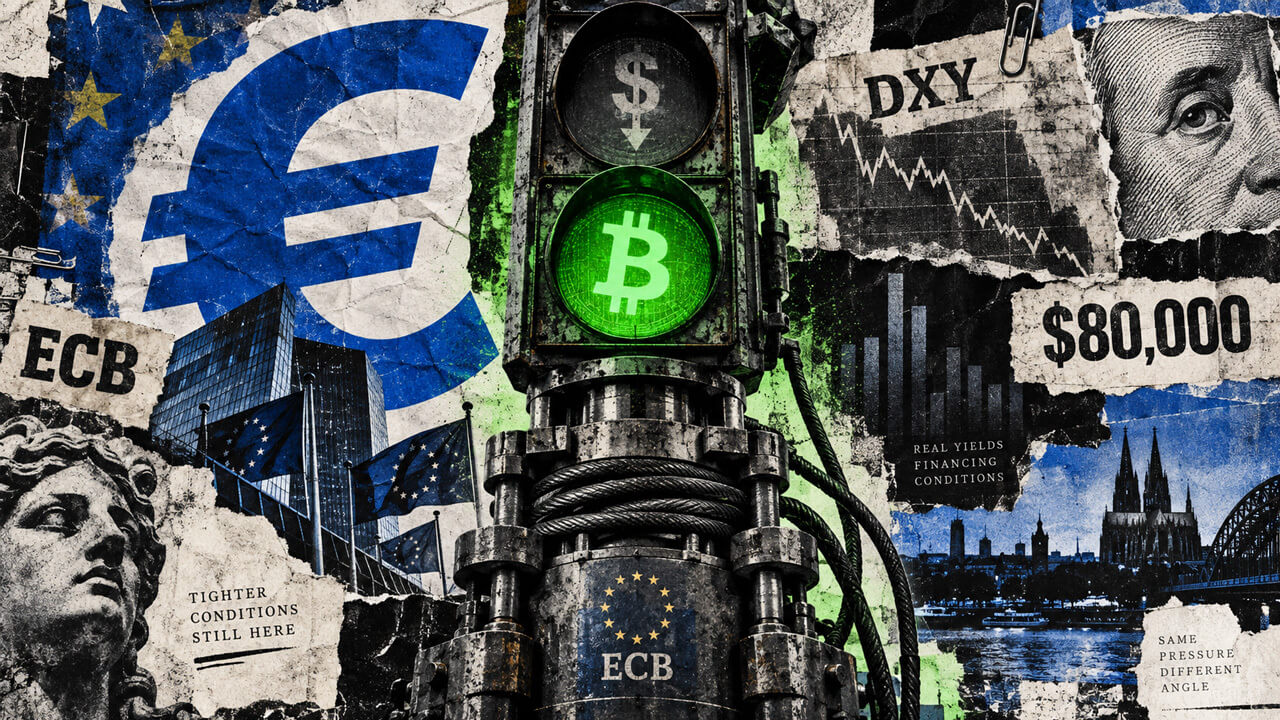
Bitcoin's next major macro catalyst may weaken the dollar without delivering the easier financing conditions that would support a sustained rally. At the time of reporting, Bitcoin was trading around $78,800, down roughly 1% over 24 hours after stronger US labor data renewed expectations that interest rates could remain elevated.
The European Central Bank's September 10 policy decision represents the next significant event that could shift currency dynamics before US inflation data refocus attention on the Federal Reserve.
The Dollar Index Complexity
The distinction between a falling dollar index and actual improvements in liquidity conditions hinges on what moves alongside the euro. The euro carries a 57.6% weight in the dollar index maintained by Intercontinental Exchange, far larger than the Japanese yen at 13.6% or the British pound at 11.9%.
A sufficiently strong move in EUR/USD can drag the dollar index lower even if US borrowing costs remain high and capital availability barely changes. This creates a potential false positive for Bitcoin traders who use the dollar index as a shorthand for liquidity conditions.
Recent trading illustrates the distinction. Between September 1 and September 3, Bitcoin gained 4.99% against the dollar and 4.63% against the euro, with advances occurring alongside a modest decline in US real yields. From September 6 to September 7, Bitcoin fell 1.55% against the dollar and 1.65% against the euro, showing weakness was visible in both currency pairs rather than being driven primarily by dollar-euro exchange rate changes.
Mixed Economic Signals in the Eurozone
The economic backdrop facing ECB officials provides reasons for a euro move without a clear shift in monetary conditions. Eurostat revised second-quarter euro-area growth to 0.6% from the previous quarter, though the composition was heavily skewed toward trade. Net exports contributed 0.9 percentage points to quarterly growth, while household consumption contributed only 0.2 points and fixed investment made essentially no contribution.
Inflation is sending similarly divided signals. Headline euro-area inflation accelerated to 3.3% in August from 2.9% in July, largely due to energy inflation jumping to 14.3%. Meanwhile, inflation excluding energy, food, alcohol and tobacco eased to 2.4% from 2.5%, while services inflation slowed to 3% from 3.3%.
The ECB's July meeting account showed that financing conditions were already tightening. Credit standards for business loans tightened somewhat in the second quarter, while mortgage standards became stricter as banks grew more concerned about economic risks. The ECB said financial conditions had tightened slightly since June, with higher longer-term yields beginning to feed into borrowing costs.
Timing Pressures
US producer-price data are due Thursday, the same day as the ECB decision, followed by August consumer-price inflation on September 11. Any ECB-driven Bitcoin rally would be vulnerable to repricing within 24 hours if US inflation data drive yields higher on Friday.
For Bitcoin to sustain gains, a euro rally that pushes the dollar index lower would need to coincide with lower real yields and easier credit conditions. If the euro strengthens while real yields remain elevated, Bitcoin could still rise, but such a move would carry less evidence that a broader liquidity shift was underway.