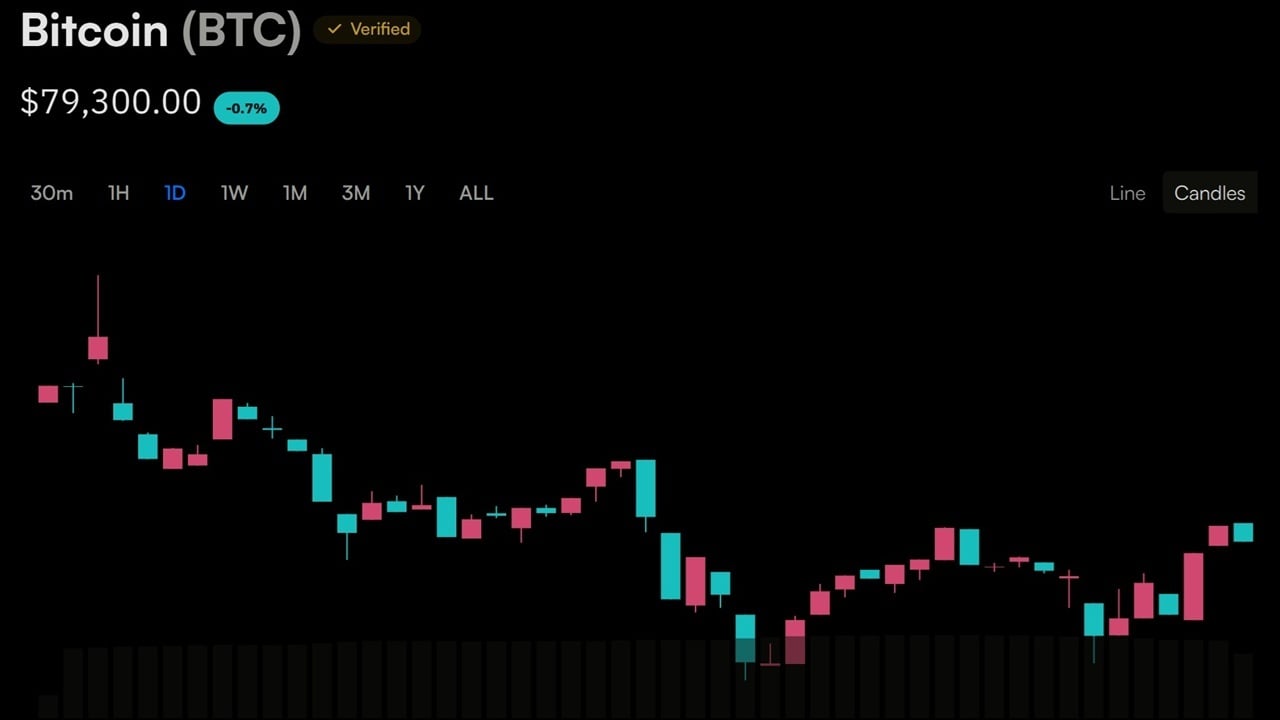
Bitcoin traded near $79,100 on Tuesday, unable to sustain moves above $80,000. Three significant economic announcements over the next eight days—jobless claims on September 10, consumer price index data on September 11, and a Federal Reserve rate decision on September 15-16—stand to reshape market expectations and potentially resolve bitcoin's recent price stagnation.
Bitcoin slipped approximately 1.5% to near $78,800 after briefly trading above $80,400. The cryptocurrency has largely traded sideways in recent weeks despite gaining close to 25% in August.
Fed Rate Expectations Shift
Market pricing for a September rate hike has moved substantially. As of late August, futures markets assigned 65.2% probability to the Federal Reserve holding rates at 3.50% to 3.75%, with only 34.8% odds of a hike to 3.75% to 4.00%. By Tuesday, that balance had flipped, with fed funds futures pricing roughly 57% probability of a rate increase.
For risk assets like bitcoin, the implications are direct. A rate hike would tighten financial conditions in a market that has already experienced significant gains, while softer inflation data or a hold decision could remove a weight that has capped rally attempts since August. Historical precedent suggests caution: three 2026 FOMC decisions through August marked bearish pivots for bitcoin, with $300 million to $500 million in mostly long positions liquidated around each announcement.
Institutional Demand Remains Steady
Spot bitcoin exchange-traded funds held $101.25 billion in net assets, with Blackrock's IBIT adding $3.575 billion over the past 30 days. Recent inflows have included $174.60 million in a single session, led by IBIT with $117.38 million and Fidelity's FBTC with $57.22 million. August produced roughly $3.5 billion in net inflows for bitcoin ETFs, the strongest month of 2026.
Institutional accumulation has continued through the recent price consolidation, keeping dips shallow despite repeated failures to sustain moves toward $82,000.
Technical Levels
Resistance sits in the $81,000 to $82,000 zone, a ceiling that has rejected repeated attempts. A close above $82,000 would restore momentum and open $85,000 as the next objective. Support runs from $77,000 to $78,000, a band that has absorbed selling multiple times. Below that level, the 20-day moving average near $75,500 becomes the key reference point.