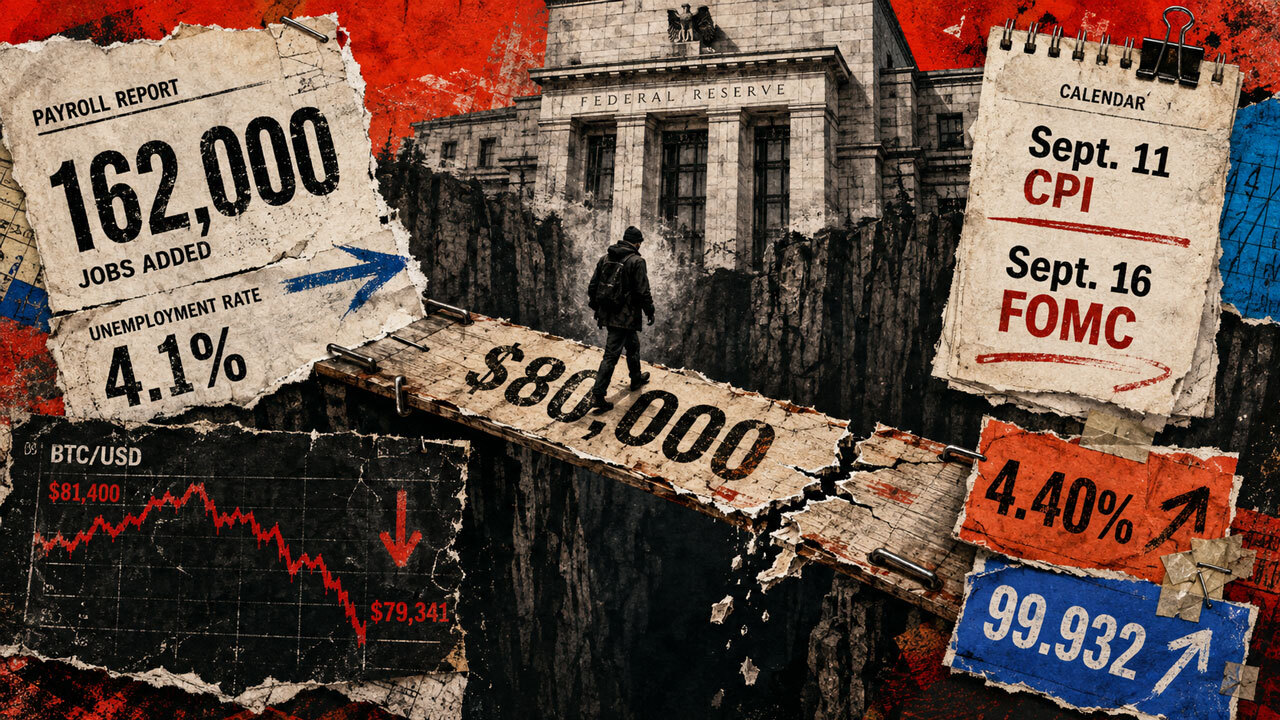
Bitcoin fell below $80,000 on Friday after the US jobs market delivered a surprise stronger than expected, prompting immediate concerns about tighter monetary policy across financial markets.
The Bureau of Labor Statistics reported that nonfarm payrolls increased by 162,000 in August, compared with a Reuters consensus of 56,000. The report, released at 8:30 a.m. ET, triggered a sharp cross-asset reaction. Unemployment remained at 4.1%, while earlier payroll estimates were revised upward by a combined 55,000.
Bitcoin lost approximately 2% in the immediate aftermath and dipped below $80,000. Within hours, BTC stabilized near $79,570, retaining a 0.83% gain over the 24-hour period. Ethereum showed greater resilience, trading near $2,454 with a 1.41% 24-hour gain, suggesting the selloff partially reversed earlier daily advances rather than producing a sustained collapse across crypto.
Rate expectations and market pressure
Markets interpreted the strong payroll figures as a reason the Federal Reserve might maintain tighter monetary policy. Reuters reported that the implied probability of a quarter-point September rate increase rose to 59% from 52% following the release.
The market repricing was evident across multiple asset classes. The two-year Treasury yield, which tracks near-term Fed expectations most closely, climbed 7.6 basis points. Ten-year and 30-year yields rose 3.2 basis points and 1 basis point, respectively. The dollar index gained approximately 0.3% to 99.3.
Higher yields increase the returns available on dollar-denominated assets, while a stronger dollar tightens financial conditions for cryptocurrency and other non-yielding assets. Gold experienced similar pressure, declining between 1.7% and 2.2% as higher rate expectations reduced its appeal.
Mixed market response
Not all markets moved in sync. S&P 500 futures turned negative after the report, down 0.22% at 8:33 a.m. ET, while Nasdaq 100 futures remained 0.07% higher. Average hourly earnings rose 0.3% for the month and 3.1% year-over-year, indicating labor market strength that contributed to the mixed reaction.
Oil markets operated under separate dynamics. Brent crude was only slightly lower near $95 after the jobs report but remained more than 8% higher for the week, driven by renewed US-Iran tensions and supply concerns rather than the payroll data alone.