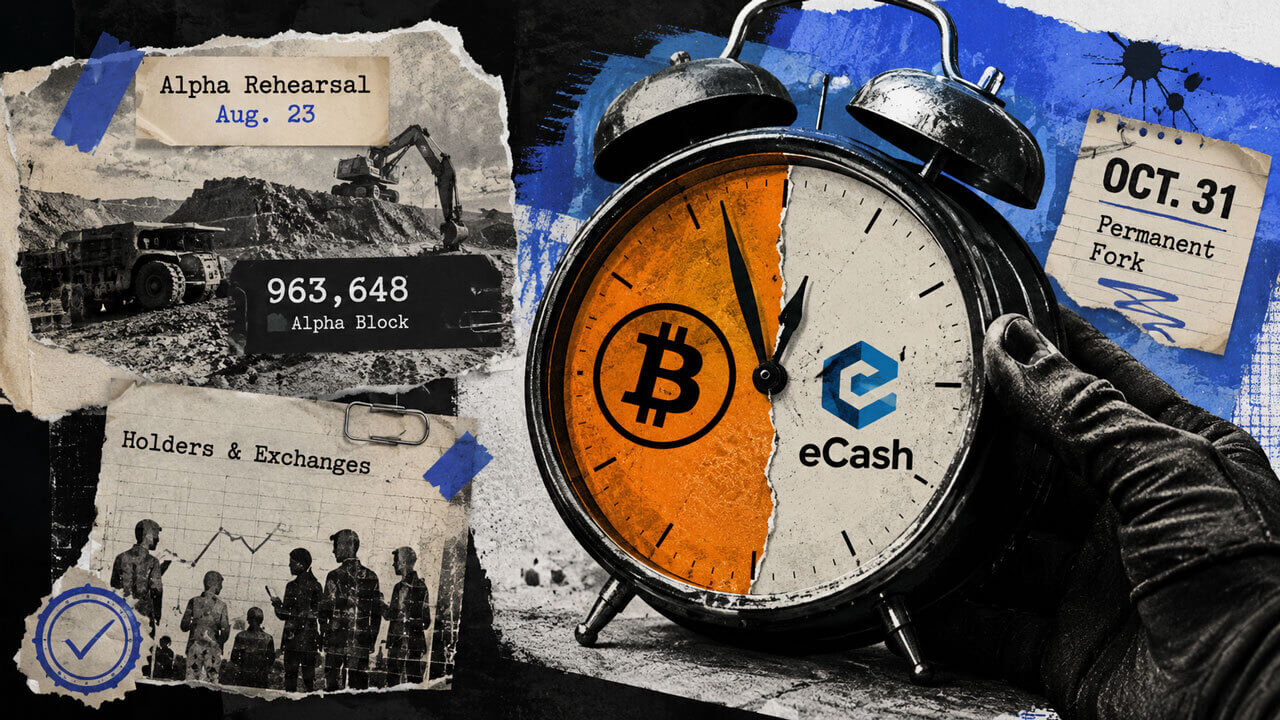
A planned eCash fork that aims to create a separate ECX asset for Bitcoin holders entered a practice phase with the launch of Alpha-chain blocks starting from height 963,648 on August 23. However, the permanent fork did not take place, leaving key technical and operational details unresolved ahead of an October 31 target.
Under the project's revised roadmap, Bitcoin holders will retain their original BTC, while the permanent ECX asset is scheduled to be credited on a 1:1 basis at a Mainnet launch around Bitcoin block 973,728 on October 31. The rollout includes three stages: the Alpha test at block 963,648 on August 23, a Beta test near block 967,680 on September 20, and the permanent Mainnet launch.
The recent Alpha launch utilized practice pECX units rather than permanent ECX balances. According to founder Paul Sztorc, practice units can be burned for real ECX at Mainnet at a rate of 1,000 pECX for 10 ECX. However, available evidence does not establish that Alpha transaction history or balances will automatically carry over into Beta or Mainnet.
Critical production components remain unfinished. The project's integration guide continues to label key values as drynet4 parameters and notes that the final fork hash, software branch, and replay scheme will be published at a later date. Current coin-splitting guidance suggests an opt-in nLockTime of 499999999 for ECX transactions, though integrators are advised to verify the final scheme prior to launch.
Major exchanges including GMO Coin, Coincheck, SBI VC Trade, and Zaif maintained normal Bitcoin services during the Alpha test while reserving risk-based policy changes for the future. GMO Coin stated it would not handle pECX or ECX during the Alpha and Beta phases, while Coincheck, SBI, and Zaif left the eventual crediting, listing, or handling of ECX undecided.
With the initial test window concluding with low impact on Bitcoin ownership, wallets, miners, and exchanges are now looking toward the October 31 Mainnet target as final software and replay details remain the primary checkpoints.