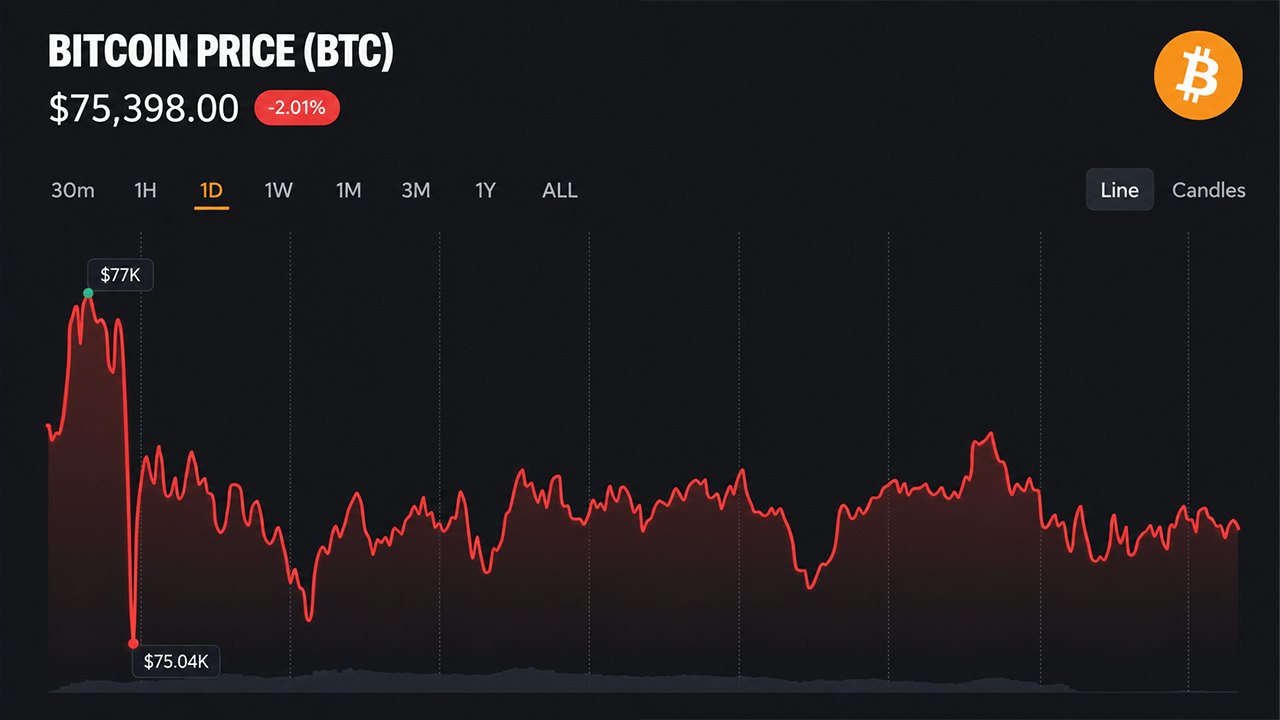
Bitcoin's price remained volatile following a sharp drop triggered by the failed passage of the CLARITY Act in Congress. The cryptocurrency spent the last 24 hours hovering between $75,000 and $76,000, with traders bracing for an upcoming Federal Reserve rate decision where prediction markets widely expect a 25-basis-point hike based on recent economic data.
Market data shows bitcoin briefly reclaimed $77,000 after dipping below $76,000 but failed to sustain the rebound. The cryptocurrency then fell to a low of $74,913 before rebounding to find support above $75,500. At the time of reporting, bitcoin traded just above $75,700, marking daily losses of under 1% and a decline of nearly 4% over the previous seven days.
The price volatility corresponded with significant liquidations on derivatives markets. Over $140 million in leveraged positions were liquidated for the second consecutive day, with liquidated long bets exceeding $110 million—a more than 10% increase from the prior day. Across the broader cryptocurrency market, $362 million in long positions were wiped out compared to $113 million in short positions.
Industry Response to Legislative Setback
The CLARITY Act, billed as crucial legislation for the crypto industry's U.S. future, ultimately failed to advance. Despite the setback, industry figures downplayed the impact on long-term prospects.
Michael Saylor stated that with the legislation stalled, he expects the SEC, CFTC, and Treasury to advance rules under existing law, banks to expand Bitcoin custody services and lending, and continued capital allocation toward Bitcoin and digital credit.
Joshua Riezman, chief legal and strategy officer at GSR, said that with Congress unable to deliver comprehensive market structure legislation, regulatory attention would shift to U.S. agencies.
Companies Pursue International Alternatives
Solowin Holdings emphasized that relying on Congress for regulatory clarity represented a high-stakes gamble. The firm noted that it had proactively pursued crypto-friendly overseas jurisdictions, securing regulatory approval from the Central Bank of Bahrain to issue stablecoins via its AX Coin subsidiary and obtaining a position as a pioneer participant in the Hong Kong Monetary Authority's EnsembleTX pilot initiative through its Hong Kong-based brokerage, Solomon JFZ.
Solowin argued that the CLARITY Act's failure vindicated this approach, positioning companies with established licenses under agency supervision ahead of those that relied solely on legislative solutions.