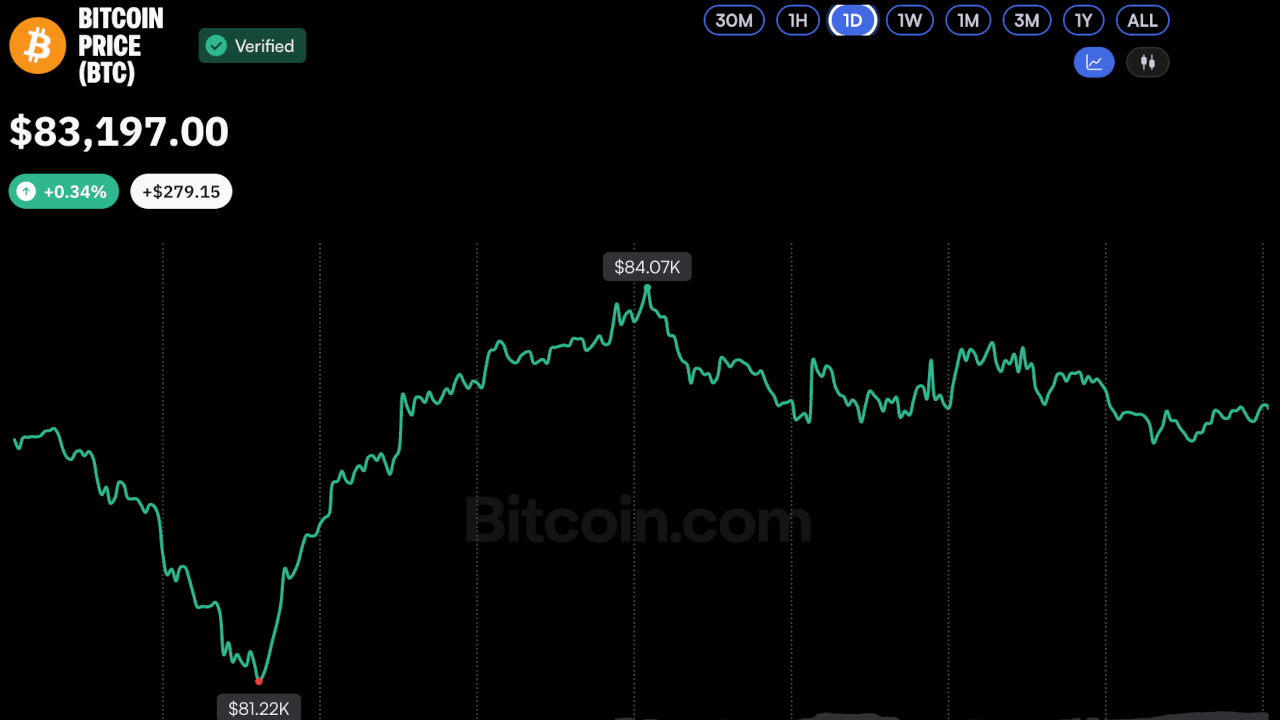
Bitcoin is trading near $83,327, up 0.6% over the past 24 hours but down 2.9% over the past week, according to available market data.
The cryptocurrency has struggled against a challenging macroeconomic backdrop, with rising energy prices reigniting inflation concerns. This has pushed U.S. Treasury yields higher and strengthened the dollar as investors reassess the Federal Reserve's interest-rate trajectory.
Traders are pricing in a 19.4% chance of a 25-basis-point rate hike at the Fed's October 28 meeting, down from 22.1% a week ago and 42.5% a month ago. Despite expectations for easing rate hikes, elevated long-term Treasury yields mean broader financial conditions have not fully improved.
The 10-year Treasury yield stands at 5.24% and the 30-year yield at 5.60%, having reached 52-week highs of 5.37% and 5.73% the previous week. These represent their highest levels in more than two decades.
U.S. spot Bitcoin ETFs drew $21.13 million in net inflows on Friday, following outflows of $487.07 million on Wednesday and $244.13 million on Thursday. Digital asset fund flows have slowed after $11.1 billion of inflows since mid-July.
Bitcoin has been trading mainly between approximately $80,300 and $87,100. Technical analysts note that a break above $85,600 on stronger volume could open the way toward $87,395, while a drop below $82,000 would raise the risk of a move toward $79,000.
Upcoming U.S. inflation data is expected to prove decisive in shaping expectations for the Federal Reserve's next move and may influence Bitcoin's near-term direction.