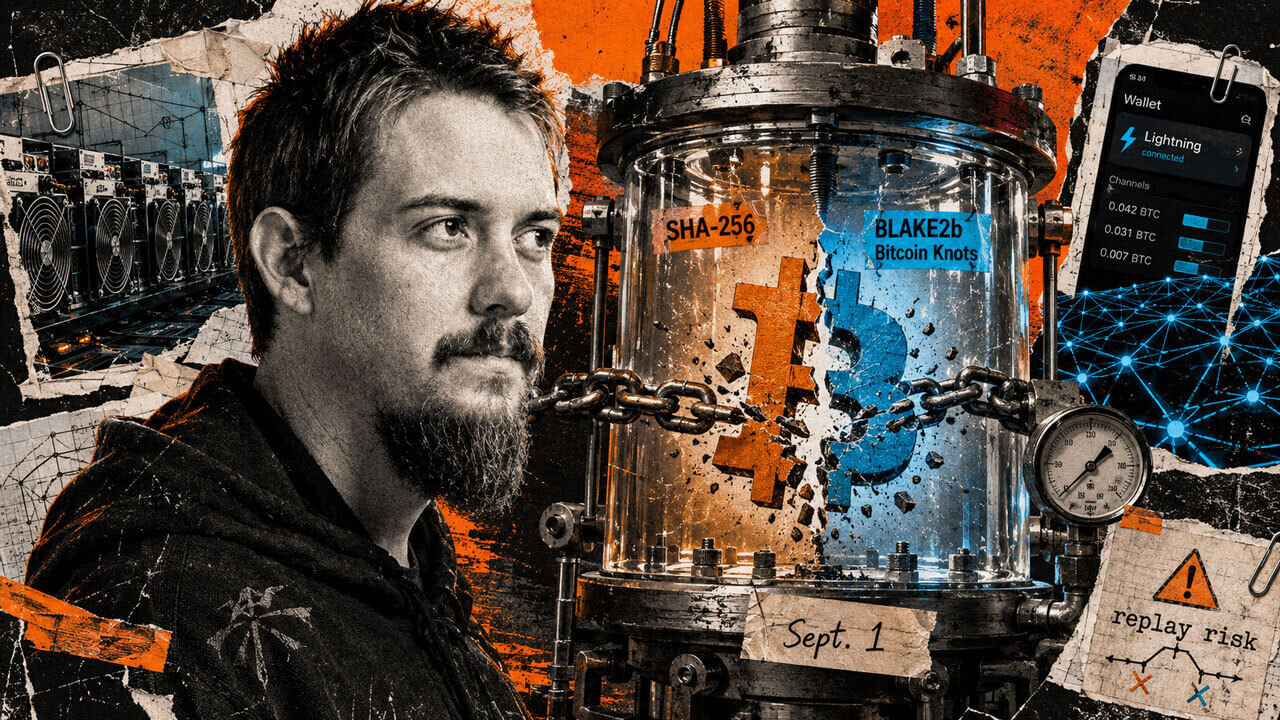
Bitcoin Knots is preparing a Sunday test to switch from SHA-256d to BLAKE2b proof of work on a proposed breakaway network. Developer Luke Dashjr announced on August 29 that Bitcoin Knots 29.4.1rc4 would establish the final SHA-256d block before the switch, with a potential final release scheduled for September 1 if successful.
The attempt follows the failure of a previous fork proposal, BIP-110, which split from Bitcoin three weeks earlier but stalled after producing only two blocks. The new approach seeks to avoid reliance on existing Bitcoin miners by permanently moving the breakaway network to hardware capable of BLAKE2b mining, including machines originally built for Sia such as Bitmain's Antminer A3 and Goldshell SC5 models.
Unresolved Technical Questions
Several critical issues remain unresolved ahead of the weekend test. As of August 29, the public Bitcoin Knots release page had not published rc4 or a final 29.4.1 build, while key proof-of-work changes remained open in development.
Calculations indicate that maintaining 10-minute block intervals would require approximately 870 terahashes per second, but estimated testnet4 capacity was only 50 to 70 TH/s. This gap highlights uncertainty about whether sufficient miners will participate.
Bitcoin Knots must also finalize consensus rules, including the BLAKE2b implementation, activation height, and block-weight limits. A discrepancy exists between the FAQ description of a 700,000-weight-unit cap and a source commit setting it at 800,000, a difference that could cause nodes to disagree on block validity.
Infrastructure and Economic Challenges
Even successful block production would not guarantee the fork's viability. The new chain changes the block header to a 164-byte format using BLAKE2b, while existing wallets and infrastructure expect Bitcoin's 80-byte SHA-256d headers. Light wallets, indexers, and explorers may require modifications to follow the new ledger.
As of August 29, no major exchange, wallet, custodian, explorer, or Lightning implementation had publicly committed to supporting the new chain. The proposal suggests exchanges pause deposits and withdrawals around the fork and announce which chain they will recognize.
The fork also carries replay risk, since transactions spending pre-fork coins could potentially be valid on both chains. Bitcoin Knots has proposed a SIGHASH_UNIFIED signing mode for optional replay protection, though it would not automatically protect all existing wallets or transactions.
The BLAKE2b switch addresses only proof of work and does not modify Bitcoin's existing addresses, private keys, or transaction signatures, leaving the network without quantum resistance.