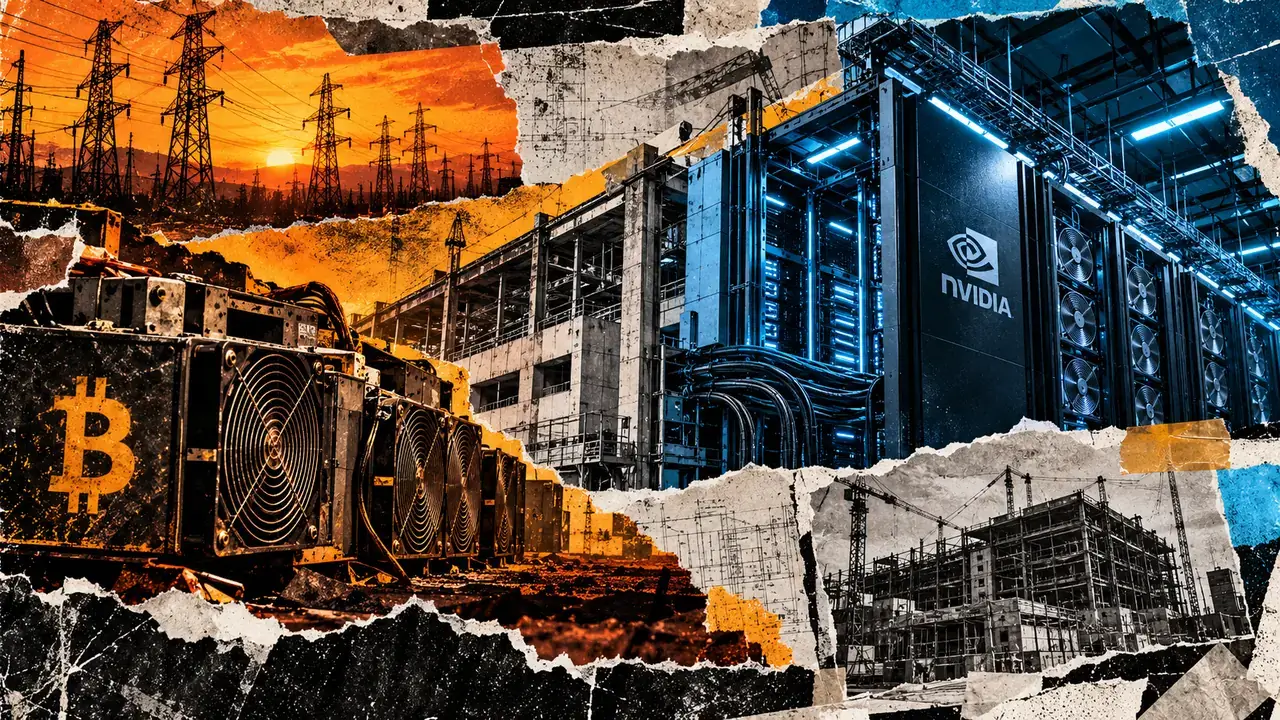
Bitcoin miners spent years securing cheap electricity and negotiating grid connections for their operations. Now AI companies want those same connections, making aging mines valuable real estate despite the fundamental differences between mining and AI data center infrastructure.
The specialized computers used to mine Bitcoin, known as ASICs, are impractical for training AI models. However, the land, substations, and power agreements surrounding them could spare data-center developers years of waiting for grid access and regulatory approvals.
SWI Group took control of Bitcoin miner Genesis Digital Assets in 2024 and announced an €800 million capital increase in October to expand its AI infrastructure business. Two weeks later, SWI Compute disclosed roughly $1 billion in NVIDIA equipment orders and its first customers.
Why Mining Equipment Is Losing Value
Bitcoin mining has become increasingly challenging for publicly traded operators. Core Scientific wrote down $266.5 million of mining equipment and infrastructure in its first quarter, including $151.6 million related to mining machines and $114.9 million to mining infrastructure. Meanwhile, the company's newer AI colocation business was already producing positive gross margins while mining operations lost money at the gross-profit level.
Mining hardware deteriorates as it ages, but working grid connections actually increase in value. Utilities must assess transmission capacity and approve upgrades, making existing connections difficult to replicate or obtain.
Conversion Costs Remain Substantial
Converting Bitcoin mining facilities to AI-grade data centers requires far more than equipment swaps. AI data centers need sophisticated cooling, high-speed networking, redundant power systems, and strict uptime guarantees for densely packed GPU clusters—standards most Bitcoin mines were not built to meet.
CoinShares estimated in September that converting mining infrastructure to AI-grade facilities costs roughly $8 million to $15 million per MW, compared to $700,000 to $1 million per MW for conventional mining infrastructure. This order-of-magnitude difference explains why operating AI facilities command significantly higher valuations than powered mining sites.
A review of more than $100 billion in AI deals found that only around 550 MW was billing out of more than 4 GW under contract. HIVE's $350 million AI agreement required an estimated $185 million hardware buildout before most revenue could materialize.
Where the Money Actually Goes
Core Scientific's operating agreements with CoreWeave reveal how AI revenue gets divided. In its second quarter, Core Scientific reported $136.7 million in colocation revenue from 437 MW of billing customers. Of that amount, $98.8 million came from license fees and $35.1 million from power charges passed through to customers. Since the electricity reimbursement appears as an equivalent expense, more than a quarter of the colocation revenue represents utility costs being passed along rather than profit earned by providing the facility.
CoreWeave helps fund construction but recovers some contribution through rent credits, while operators like Core Scientific borrow billions, build facilities, and risk penalties for late delivery. This structure means electricity access attracts customers, but contracts determine who actually gets paid.
Financing and Shareholder Exposure
Debt investors are lending against facilities that must be completed, power that must be delivered, and customers whose payments must support borrowing. Market volatility has already affected investor confidence—on October 26, CoreWeave shares declined 4.5% premarket and Core Scientific declined 1.7% following reports about lenders' reluctance to fund specialized AI cloud operators.
SWI's acquisition of Genesis came with complexities in valuation. SWI's initial $500 million investment bought approximately 38.3% of Genesis's equity and rights to 77.2% of certain preferred-share liquidation preferences, which govern claims on proceeds rather than ordinary ownership.
Between existing grid connections and final customer payments stand construction companies, hardware suppliers, tenants, and creditors, each with contractual claims on the economics. SWI has not disclosed which Genesis sites will host its approximately $1 billion in NVIDIA equipment, how much of its reported 1.2 GW can convert economically, or when converted sites might earn AI revenue.
While Bitcoin miners do possess infrastructure that AI developers need, the potential value does not automatically flow to mining shareholders. The real returns will go to companies that can convert megawatts to operating capacity without surrendering most proceeds to customers, contractors, and lenders.