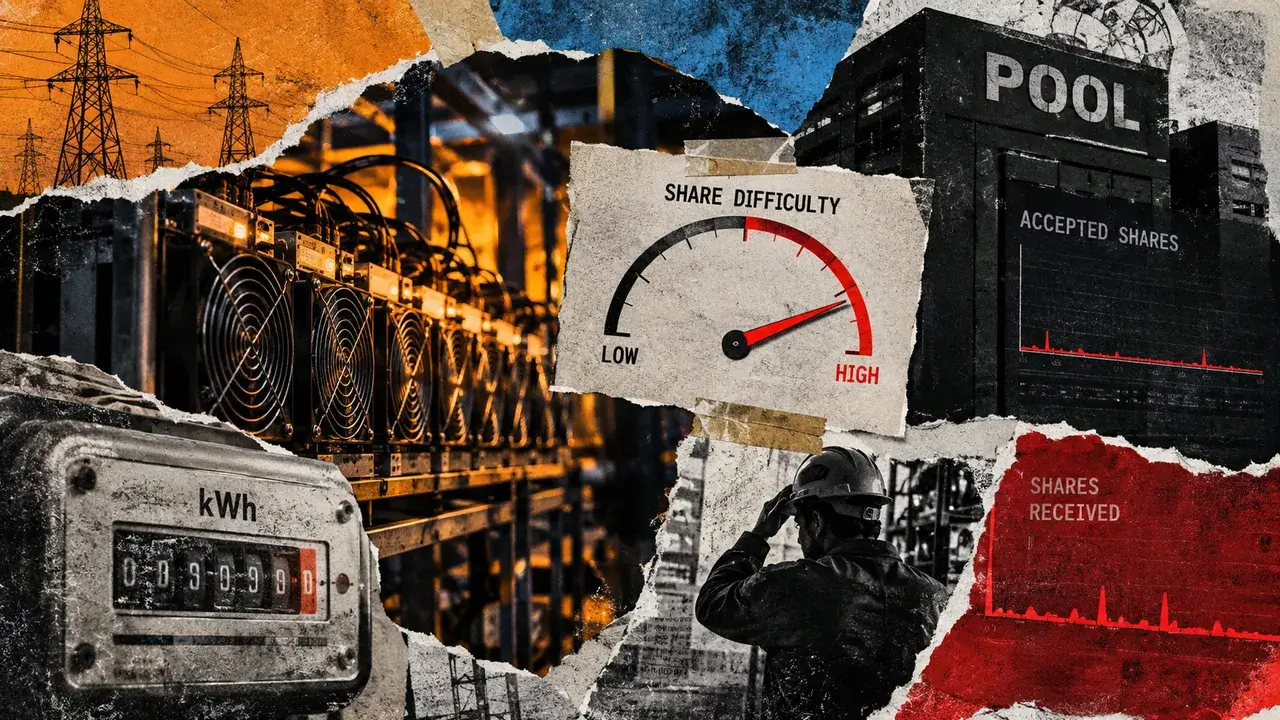
Some Bitcoin mining pools use variable-difficulty controllers that can inadvertently waste energy during power reductions. When a miner's hashrate drops sharply, certain controllers may continue assigning work calibrated for the machine's former speed, creating a window where the miner consumes electricity while accepted shares become rare or nonexistent.
The issue stems from how pool-assigned share difficulty works. Pools assign each connection a share difficulty easier than Bitcoin's network difficulty, adjusting it through a variable-difficulty controller to maintain a steady stream of shares that helps the pool estimate hashrate and account for contributed work. Price's analysis, published in July and highlighted by Bitcoin Optech in September, describes a failure mode where this adjustment gets stuck.
How the Controller Trap Forms
If a vardiff controller only recalculates when a share arrives, an abrupt hashrate reduction can create a problem. The outdated, harder difficulty assignment makes the next share less likely to arrive quickly. Without a fresh share to trigger an update, the controller holds the wrong difficulty setting, keeping shares sparse and potentially leaving miners without payment during that interval, depending on their pool's accounting method.
The scenario mirrors real operational conditions. During a January 2026 U.S. winter storm, Bitcoin's network hashrate dropped sharply as miners reduced power consumption to manage energy use.
Recovery and Testing
The Stratum V2 reference implementation avoids permanent freezes by recalculating difficulty on a timer rather than only when shares arrive. However, timer-based recovery can still be slow on long-lived channels, and this behavior is not mandatory across all Stratum V2 deployments.
Analysis identifies ckpool as an example of a deployed share-triggered controller. No comprehensive measurement of how widespread the behavior is or whether it has caused material losses has been documented.
The MARA Foundation's open-source shape-proxy tool now allows operators to test their pool's controller behavior directly. The tool can simulate apparent hashrate declines without changing physical miner output, revealing whether assigned difficulty recovers or remains stuck.