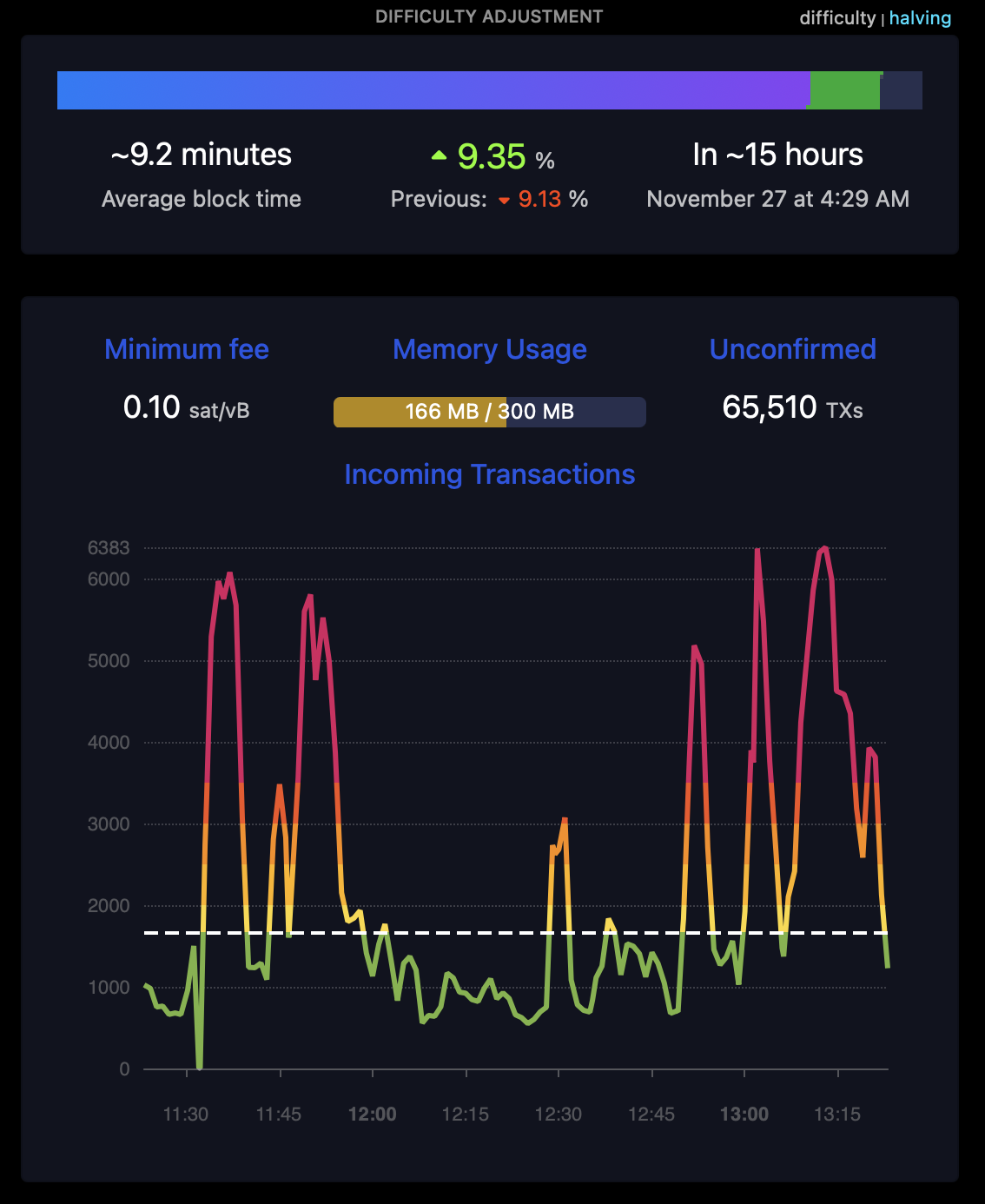
Bitcoin mining difficulty is on course to increase by approximately 9% at the next network adjustment, expected on November 27. The adjustment would reverse much of the relief miners received on November 14, when difficulty fell 9.13%. Current network estimates put mining difficulty at 134.82 trillion, with projections showing it climbing toward 147 trillion if the increase materializes.
The Bitcoin network adjusts mining difficulty every 2,016 blocks to maintain an average block production time of approximately ten minutes. When blocks are produced too quickly, the network increases the mathematical difficulty of discovering new blocks. The upcoming adjustment reflects a faster pace of block production during the current difficulty period.
A 9% increase in difficulty does not translate to an identical reduction in mining revenue. Under otherwise unchanged conditions, expected Bitcoin production per unit of computing power would decline by approximately 8.3%. A miner producing 1 BTC over a given period would expect to produce approximately 0.917 BTC over an equivalent period following the adjustment.
Financial Impact on Mining Operations
A more useful measure of mining industry economics is hashprice, which tracks expected daily revenue per petahash of computing power. Recent network data puts daily hashprice at around $28 per petahash.
Consider a hypothetical mining operation with 20 joules per terahash energy efficiency and $0.05 per kilowatt-hour electricity rates. Operating one petahash continuously costs approximately $24 per day in electricity alone, leaving about $4 as electricity-adjusted margin against $28 in gross daily mining revenue.
If difficulty rises 9% while Bitcoin's price and average fees per block remain unchanged, daily revenue would fall to approximately $25.69, shrinking the electricity-adjusted margin to less than $2. This represents approximately a 58% reduction in margins under these operating assumptions.
Uneven Impact Across the Industry
The network adjustment affects all operators equally, but its financial consequences are not uniform. An operator with newer machines and inexpensive power can more easily absorb the change. Another running older equipment may find switching off part of its fleet more economical than continuing to mine.
Some established Bitcoin mining businesses are redirecting infrastructure toward artificial intelligence and high-performance computing, leveraging their access to substantial electricity capacity and established data centers.
Miner Selling and Market Response
Rising difficulty raises questions about potential increased Bitcoin selling from miners facing margin pressure. While some miners may need to sell more BTC to finance operations and settle electricity bills, network difficulty alone provides no direct evidence of increased miner sales. Some operators hold substantial treasury reserves, others sell regularly regardless of conditions, and businesses can reduce expenses or shut down inefficient equipment instead of liquidating holdings.
Actual miner balance data, exchange transfers, and company treasury disclosures will provide more useful evidence than the difficulty adjustment itself. The key developments to monitor are whether the estimated increase materializes at the next adjustment block and how hashprice and network computing power respond in the following period.