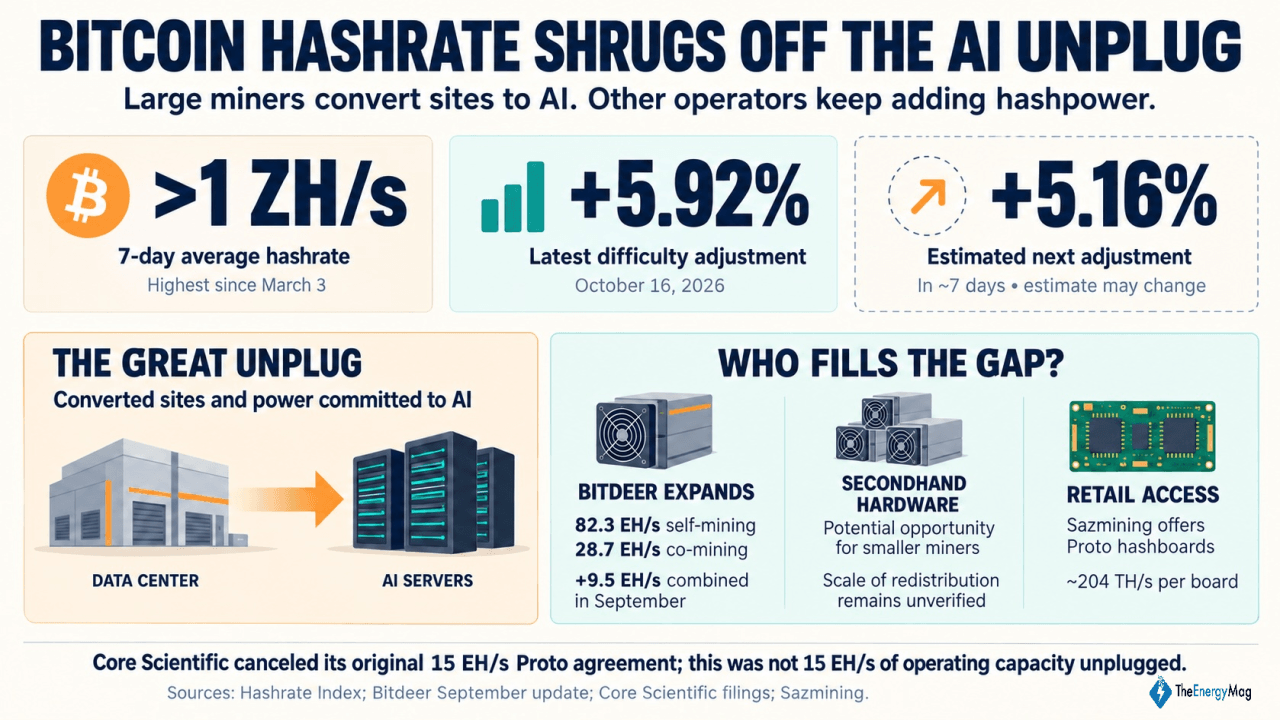
Bitcoin's network hashrate has regained 1 zettahash per second (1,000 exahashes per second) over the past week, reaching its highest level since March 3, according to analysis from Blocksbridge Consulting's Miner Weekly newsletter.
The recovery is notable given the substantial shift of mining capacity toward artificial intelligence applications by major public mining companies. Bitcoin's mining difficulty increased 5.92% on October 16, with projections indicating another estimated 5.16% increase within approximately seven days.
Large-scale miners have been converting facilities from Bitcoin mining to AI services, which represents a lasting change. Once machines are removed and a facility's power is committed to AI customers, that capacity typically does not return to Bitcoin mining even if market conditions improve. Converting a $1.5 billion equivalent in mining hardware—based on an assumed $20 per terahash purchase price—has removed substantial hashrate from the network.
The hashrate rebound is occurring despite these conversions, indicating that replacement capacity is coming from other sources. Bitdeer (NASDAQ: BTDR) expanded its self-mining capacity to 82.3 exahashes per second in September, up from 79.9 EH/s in August. Its co-mining business, which operates Bitdeer-owned machines in third-party data centers, grew to 28.7 EH/s from 21.6 EH/s during the same period.
Smaller and medium-sized operators are acquiring equipment that departing larger miners no longer require. Machines moved to buyers with cheaper electricity and available capacity can remain competitive. Resale channels such as Sazmining list pre-owned equipment for hosting in Paraguay and Texas, though these listings do not identify original owners or quantify the volume of public-miner inventory reaching smaller buyers.
The shift reflects a reversal of the 2021 mining arms race, when large operators dominated hardware acquisition. Major miners including Core Scientific (NASDAQ: CORZ) have reduced their equipment commitments as they pursue higher-density colocation models and AI opportunities, creating space for smaller participants to acquire hardware at discounted prices.
With difficulty increases already recorded and another expected soon, competitive pressure in the network is intensifying.