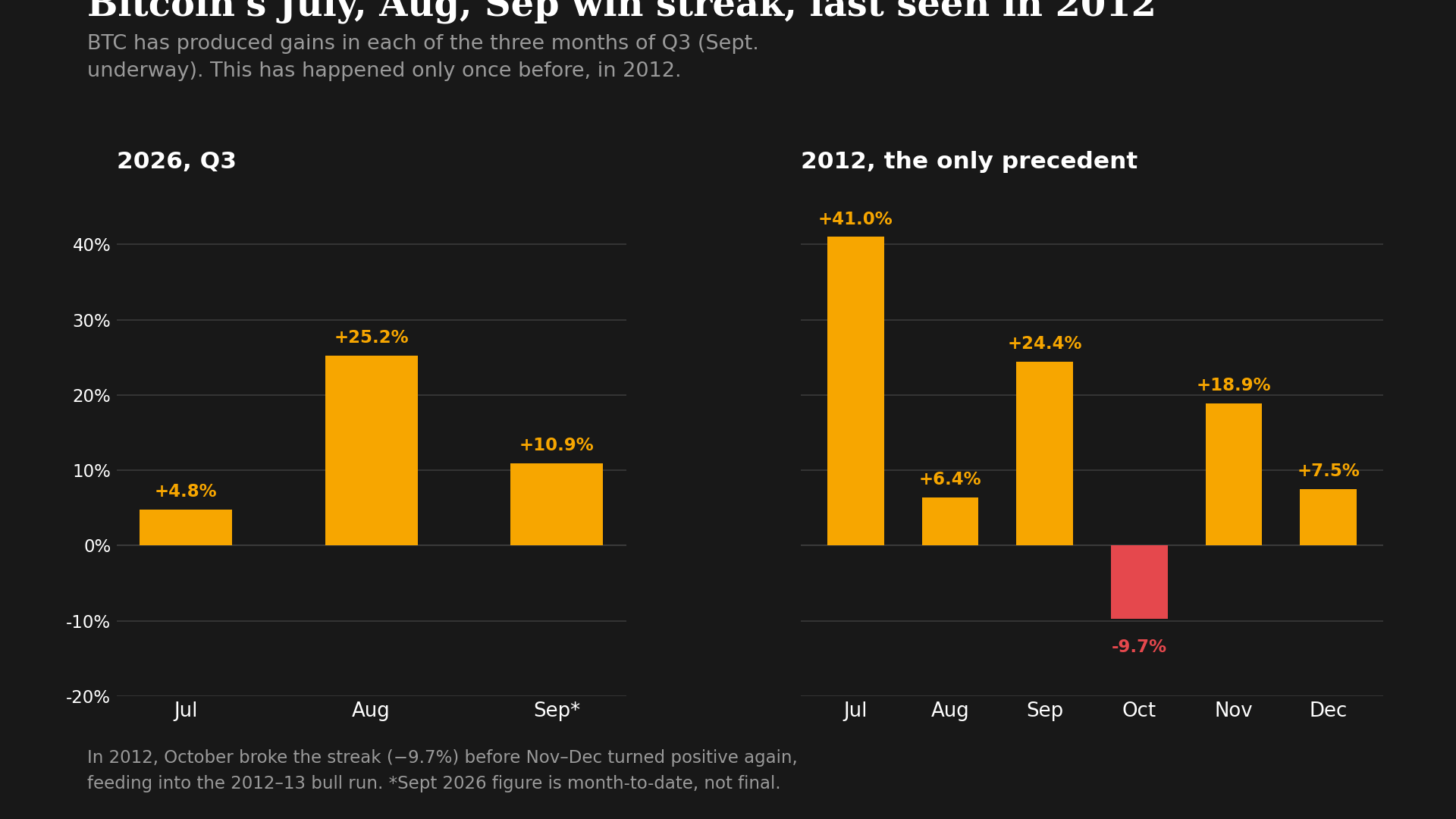
Bitcoin is on track for its first consecutive three-month winning streak since 2012, with gains of 4.8% in July, 25.2% in August, and 10.9% through September.
The only prior instance of such a streak occurred in 2012, when bitcoin posted monthly gains of 41.0%, 6.4%, and 24.4% respectively. That streak was interrupted by a 9.7% decline in October, which bottomed at $10.17 on October 26 before initiating a 165-day rally that carried the price to $230 by April 2013—a gain exceeding 2,000%.
Analysts caution against drawing firm conclusions from the historical parallel. Bitcoin has traded since at least late 2010, and this pattern has occurred only once, providing an insufficient sample size for predictive analysis. Some cycle models suggest a potentially bullish phase could begin in October or November, though historical patterns remain approximate rather than fixed rules.
The scale of any potential rally may also differ materially from 2012. At that time, bitcoin was thinly traded and worth barely $10, making its price susceptible to movement by a relatively small number of buyers. Today, bitcoin operates within a multi-trillion-dollar market featuring substantial institutional participation, deep liquidity across numerous venues, and sophisticated trading strategies including options, futures, and basis trades—market structures that did not exist at comparable scale in 2012.