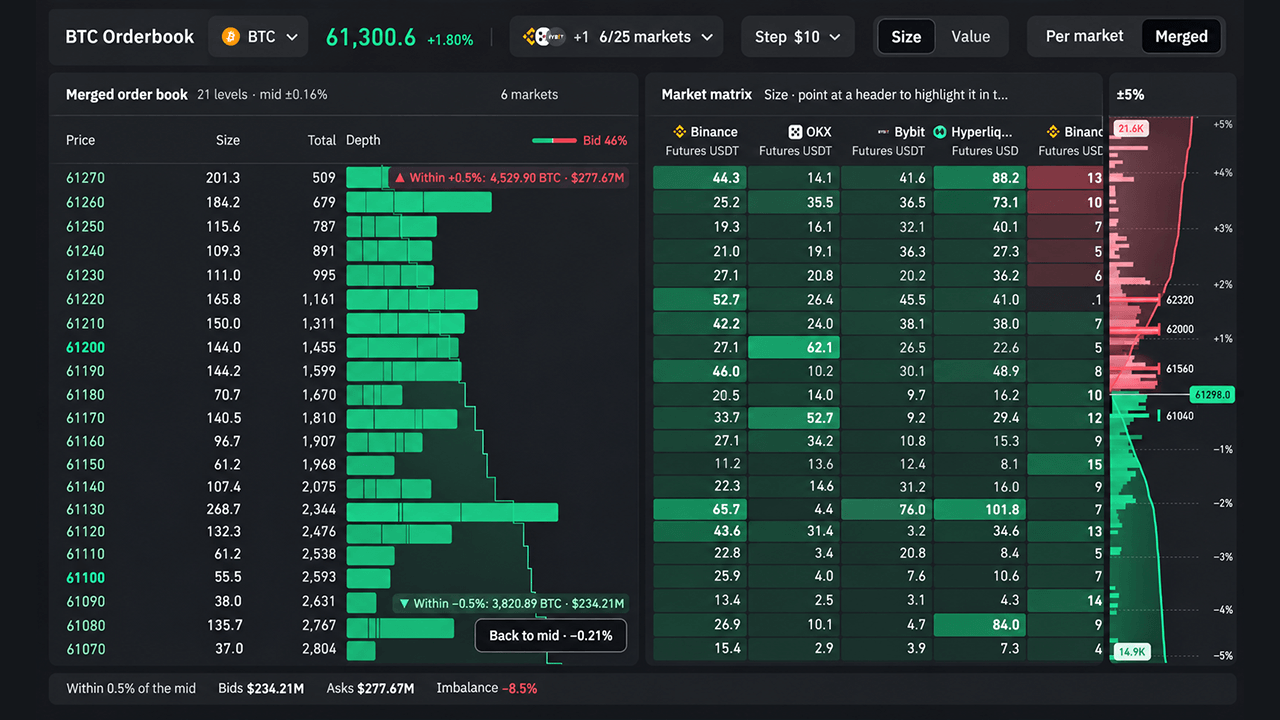
Bitcoin broke below $62,000 for the first time since August following the release of the latest Federal Open Market Committee minutes, which strengthened expectations for additional interest rate hikes. The decline reflects broader concerns about the Federal Reserve's hawkish policy outlook and its potential impact on riskier assets like cryptocurrency.
The FOMC minutes indicated that almost all Fed officials expect more rate hikes to bring inflation back to the 2% target, with some suggesting a potential 50-basis-point increase if inflation worsens. The Fed currently maintains rates at 3.75%-4%, but market expectations now point toward a December rate decision. According to CME data, traders assign 100% probability to a rate hike, with 92.7% expecting a 25-basis-point increase and 7.3% expecting a 50-basis-point move.
Bitcoin's Q4 performance has deteriorated significantly. The cryptocurrency is down 24.45% for the quarter, with November's 18.48% decline accelerating the correction. This performance now approaches Bitcoin's Q4 2018 record, when it fell 43.5% during the bear market—a gap of approximately 19 percentage points.
Traditional market indicators reinforce the bearish environment. The Dollar Index reached 103.82 on November 18, its highest level since April 2025, while U.S. 10-year Treasury yields rose above 5.1%. Analysts suggest that if this trend continues, traditional assets may become more attractive than volatile cryptocurrencies.
On-Chain Signals Show Widespread Losses
On-chain data paints a concerning picture for Bitcoin holders. According to Glassnode, investors are booking losses at levels comparable to major market bottoms in 2018, 2020, and 2022. The $62,000-$66,000 range is acting as a key support level, with nearly 20% of short-term holder supply concentrated there.
Bitcoin's 30-day Net Realized Profit/Loss fell to -$8.4 billion recently, the lowest level since summer. Between November 15-18 alone, investors realized $5.4 billion in losses. Long-term holders have also begun selling at a loss, with their SOPR metric dropping to 0.73—its lowest level since August.
Spot Bitcoin ETFs have recorded $1.9 billion in net outflows for 2026, adding to the bearish sentiment. However, analysts note that current losses remain below those recorded during previous capitulation events in February ($30 billion) and June ($18.4 billion), suggesting the selling pressure may not have reached its peak.
Downside Scenarios and Technical Comparisons
If Bitcoin declines below $60,000, liquidations of approximately 20% of short-term supply could be triggered. Research firm Wintermute anticipates further downside, with $50,000 identified as a possible target. Such a move would represent nearly a 40% Q4 decline for Bitcoin.
Bitcoin's performance relative to gold also reflects weakness. The Bitcoin-to-Gold ratio recovered above its 200-day moving average on November 18, but the ratio remains down nearly 16% for Q4, indicating that Bitcoin continues to underperform gold over the quarter.
For Bitcoin to limit further losses, analysts highlight the need for stronger spot demand, ETF inflows, and a recovery in its performance against gold. The December FOMC meeting adds to market uncertainty about whether buyers can absorb current selling pressure and stabilize prices.